
PC Club Enpower Sabre Extreme: E6600 Made Easy
- Posted in
- Systems
Standard Application Benchmarks
We'll start with a look at typical application performance. Results from 3DMark05/06, PCMark05, AutoGK with DivX 6.2.5, and Cinebench 9.5 were collected. Given that we are comparing different configurations, the results should not be taken as an apples to apples comparison but rather as performance offered at various price points.
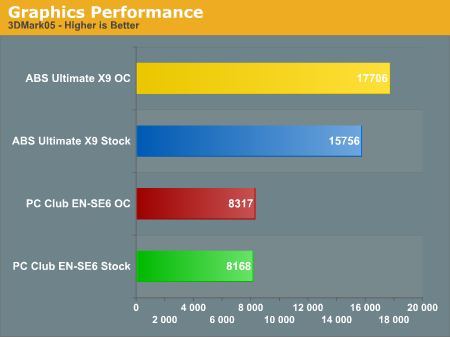
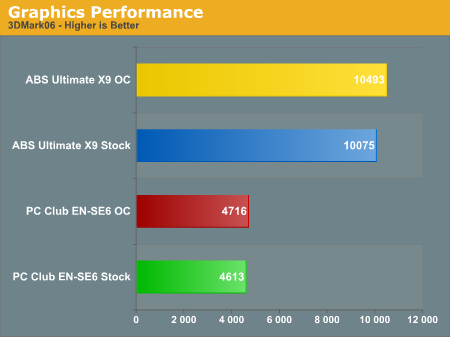
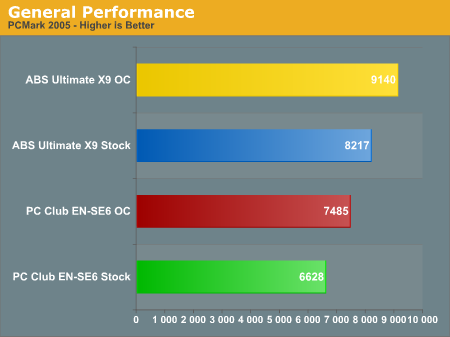
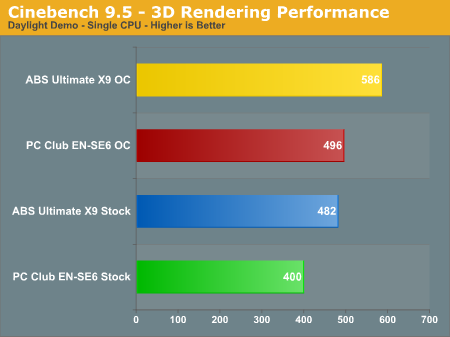
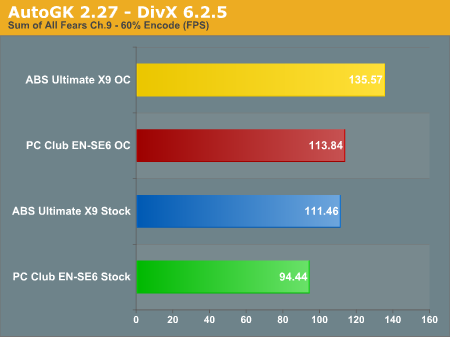
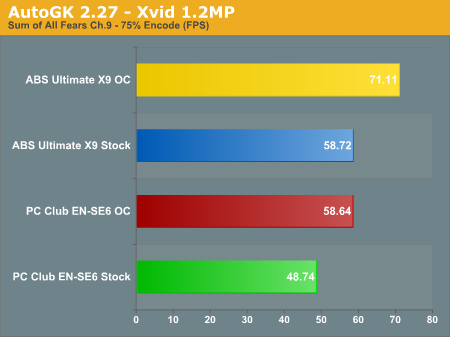
We consider 3DMark to be more of a synthetic benchmark, though it is widely used a measure of system gaming performance. Even at roughly equivalent clock speeds (overclocked Sabre Extreme versus stock clock speed Ultimate X9), it is not at all surprising to see the ABS X9 CrossFire outperform the PC Club configuration. When we get to the actual gaming tests, we will see what level of performance is really offered. The different graphics cards also have an impact on the PCMark05 results, though in practice all the tested configurations are sufficiently fast for just about any office related task.
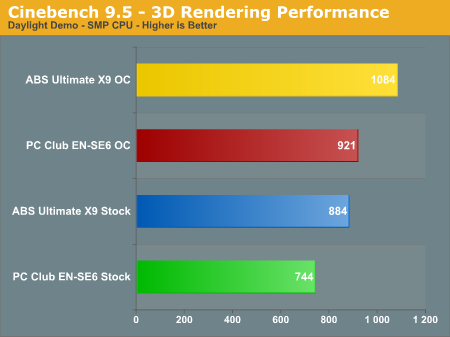
In Cinebench and AutoGK performance, the impact of faster CPU speeds is clearly apparent for tasks like video encoding and 3D rendering. If you don't ever do video or 3D rendering or other similar work, a faster CPU may not be terribly important. On the other hand, if you're constantly running CPU limited tasks, spending money on a faster CPU (or overclocking) can definitely help out.
AutoGK often benefits from additional memory performance, which can be seen by comparing the 3.0 GHz PC Club results against the 2.93 GHz ABS results. In DivX, the 2.5% increase in clock speed is negated by the better memory timings and bandwidth of the ABS system. Xvid doesn't seem to benefit as much from tighter memory timings or increased bandwidth, as the 2.1% performance advantage the PC Club OC holds over the ABS almost matches the clock speed difference. With DivX encode rates almost doubling that of Xvid for the chosen task, it does makes sense that the DivX encode could use more memory bandwidth. Better memory is also important for improved overclocking, especially if you want to use a cheaper CPU with a lower multiplier. As we showed in our revised look at the ASUS P5B Deluxe, the E6400 required RAM capable of at least DDR2-890 operation to reach our maximum overclocks while the E6300 required RAM that could run at DDR2-1050.
We'll start with a look at typical application performance. Results from 3DMark05/06, PCMark05, AutoGK with DivX 6.2.5, and Cinebench 9.5 were collected. Given that we are comparing different configurations, the results should not be taken as an apples to apples comparison but rather as performance offered at various price points.
We consider 3DMark to be more of a synthetic benchmark, though it is widely used a measure of system gaming performance. Even at roughly equivalent clock speeds (overclocked Sabre Extreme versus stock clock speed Ultimate X9), it is not at all surprising to see the ABS X9 CrossFire outperform the PC Club configuration. When we get to the actual gaming tests, we will see what level of performance is really offered. The different graphics cards also have an impact on the PCMark05 results, though in practice all the tested configurations are sufficiently fast for just about any office related task.
In Cinebench and AutoGK performance, the impact of faster CPU speeds is clearly apparent for tasks like video encoding and 3D rendering. If you don't ever do video or 3D rendering or other similar work, a faster CPU may not be terribly important. On the other hand, if you're constantly running CPU limited tasks, spending money on a faster CPU (or overclocking) can definitely help out.
AutoGK often benefits from additional memory performance, which can be seen by comparing the 3.0 GHz PC Club results against the 2.93 GHz ABS results. In DivX, the 2.5% increase in clock speed is negated by the better memory timings and bandwidth of the ABS system. Xvid doesn't seem to benefit as much from tighter memory timings or increased bandwidth, as the 2.1% performance advantage the PC Club OC holds over the ABS almost matches the clock speed difference. With DivX encode rates almost doubling that of Xvid for the chosen task, it does makes sense that the DivX encode could use more memory bandwidth. Better memory is also important for improved overclocking, especially if you want to use a cheaper CPU with a lower multiplier. As we showed in our revised look at the ASUS P5B Deluxe, the E6400 required RAM capable of at least DDR2-890 operation to reach our maximum overclocks while the E6300 required RAM that could run at DDR2-1050.
Originally published at https://www.anandtech.com/show/2071 (Wayback Machine).