
Shuttle SN27P2 SFF: AM2 gets the Tiny Treatment
- Posted in
- Systems
Noise, Heat and Power
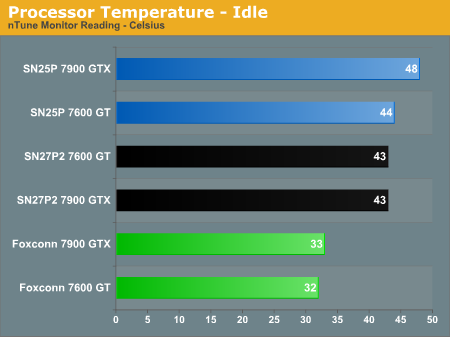
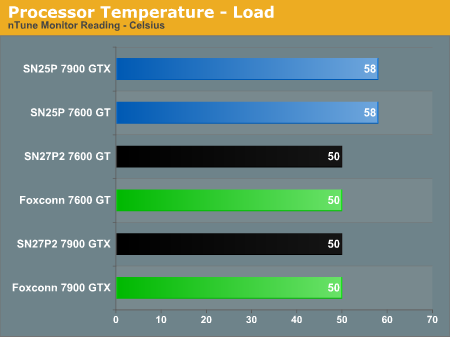
We mentioned already that the changes to our SFF test platform make it difficult to compare this new system with previous offerings. To provide something of an apples-to-apples comparison, we equipped an SN25P with an X2 4600+ (overclocked to 2.6 GHz to reach equivalent performance to the 5000+). Noise measurements were then taken at idle and at full load at a distance of 48", using both a 7900 GTX and an XFX 7600 GT XXX. Full load was achieved by running two instances of Folding@Home while looping 3DMark05. Idle measurements were taken with the system at the Windows desktop and no applications running. In order to measure CPU temperatures, we used the NVIDIA nTune 5.0 System Monitor; there may be differences between the motherboards and chipsets when reporting processor temperatures, but the important thing is that the systems run stable, and we can attest to the fact that none of the systems crashed during testing (except when we tried overclocking). Finally, system power draw was measured at the wall outlet using a Kill-A-Watt device.
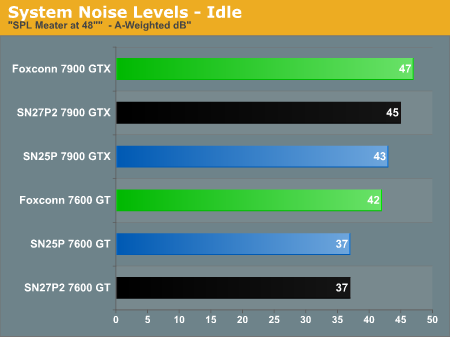
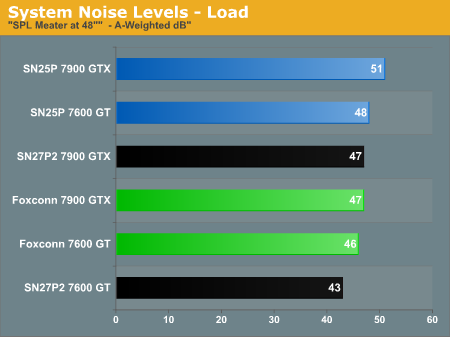
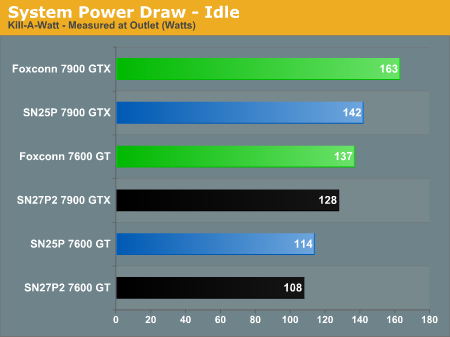
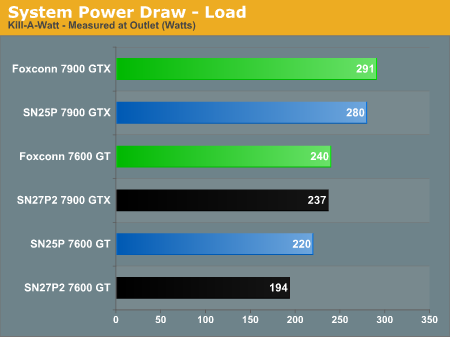
First, in terms of noise, the SN27P2 tends to run slightly quieter than the old SN25P. Looking at the power draw numbers, it also uses slightly less power, which probably accounts for the difference in noise levels that we're measuring. The difference in power draw is almost certainly caused by the switch from DDR to DDR2 memory -- 2.6V versus 2.0V in our test systems. Also note that the testing environment is slightly warmer than in previous SFF articles: 24°C versus 21°C. Testing during less hospitable times of day at room temperatures of 34°C did result in slightly higher noise levels at idle, but maximum noise level were generally consistent. The difference is that maximum noise levels were more easily achieved with a higher ambient temperature. It's definitely worth noting the relatively large difference in noise levels between the 7600 GT and 7900 GTX configurations. It doesn't matter as much in the ATX system, but in the SFF units the huge 7900 GTX card really adds a lot of noise at idle.
You can see that the noise and power testing hasn't changed radically from socket 939. When the system is idle, it is relatively quiet, and system power draw is within 15W. Once you place a full load on the processor -- especially if you put 100% load on both CPU cores -- the CPU fan speed and noise levels ramp up substantially, and the increased strain on the memory subsystem results in a 40W difference. Both SFF units still use less power than a full-size ATX motherboard, though likely that has as much to do with the 700 W OCZ power supply as it does with the motherboard size. In terms of CPU temperatures, it is important to note that both Shuttle systems are functioning with "smart" fan speed controls enabled, so the maximum CPU temperature is generally consistent while higher noise levels are generated under high CPU loads.
Provided you don't plan on running CPU intensive tasks 24/7, the typical noise levels are quieter than what most desktop systems provide. (Of course, you could also spend some effort to build a nearly-silent desktop PC if that's what you want.) If you pair the system up with a fanless GPU, it won't be silent, but it will also be far from annoyingly loud in most instances. Load up a game or perform some heavy video encoding -- or perhaps both at the same time -- and that assessment changes, of course.
We mentioned already that the changes to our SFF test platform make it difficult to compare this new system with previous offerings. To provide something of an apples-to-apples comparison, we equipped an SN25P with an X2 4600+ (overclocked to 2.6 GHz to reach equivalent performance to the 5000+). Noise measurements were then taken at idle and at full load at a distance of 48", using both a 7900 GTX and an XFX 7600 GT XXX. Full load was achieved by running two instances of Folding@Home while looping 3DMark05. Idle measurements were taken with the system at the Windows desktop and no applications running. In order to measure CPU temperatures, we used the NVIDIA nTune 5.0 System Monitor; there may be differences between the motherboards and chipsets when reporting processor temperatures, but the important thing is that the systems run stable, and we can attest to the fact that none of the systems crashed during testing (except when we tried overclocking). Finally, system power draw was measured at the wall outlet using a Kill-A-Watt device.
First, in terms of noise, the SN27P2 tends to run slightly quieter than the old SN25P. Looking at the power draw numbers, it also uses slightly less power, which probably accounts for the difference in noise levels that we're measuring. The difference in power draw is almost certainly caused by the switch from DDR to DDR2 memory -- 2.6V versus 2.0V in our test systems. Also note that the testing environment is slightly warmer than in previous SFF articles: 24°C versus 21°C. Testing during less hospitable times of day at room temperatures of 34°C did result in slightly higher noise levels at idle, but maximum noise level were generally consistent. The difference is that maximum noise levels were more easily achieved with a higher ambient temperature. It's definitely worth noting the relatively large difference in noise levels between the 7600 GT and 7900 GTX configurations. It doesn't matter as much in the ATX system, but in the SFF units the huge 7900 GTX card really adds a lot of noise at idle.
You can see that the noise and power testing hasn't changed radically from socket 939. When the system is idle, it is relatively quiet, and system power draw is within 15W. Once you place a full load on the processor -- especially if you put 100% load on both CPU cores -- the CPU fan speed and noise levels ramp up substantially, and the increased strain on the memory subsystem results in a 40W difference. Both SFF units still use less power than a full-size ATX motherboard, though likely that has as much to do with the 700 W OCZ power supply as it does with the motherboard size. In terms of CPU temperatures, it is important to note that both Shuttle systems are functioning with "smart" fan speed controls enabled, so the maximum CPU temperature is generally consistent while higher noise levels are generated under high CPU loads.
Provided you don't plan on running CPU intensive tasks 24/7, the typical noise levels are quieter than what most desktop systems provide. (Of course, you could also spend some effort to build a nearly-silent desktop PC if that's what you want.) If you pair the system up with a fanless GPU, it won't be silent, but it will also be far from annoyingly loud in most instances. Load up a game or perform some heavy video encoding -- or perhaps both at the same time -- and that assessment changes, of course.
Originally published at https://www.anandtech.com/show/2038 (Wayback Machine).