
Foxconn and Gigabyte Tackle Socket AM2
- Posted in
- Motherboards
3D Rendering
We ran a couple publicly available 3D rendering applications along with our iPEAK hard disk controller performance tests. The chipset of choice can play a large role in the iPEAK scores, whereas the 3D rendering performance generally stresses the CPU more than anything else, though the memory subsystem can also play a part.
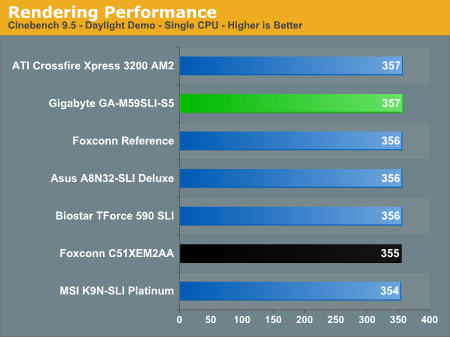
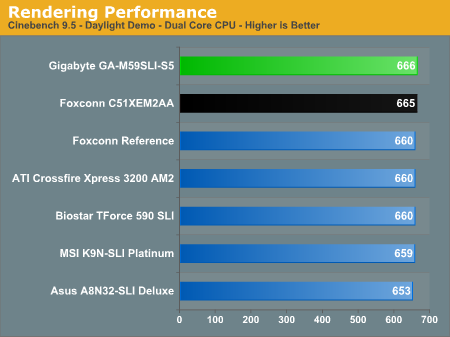
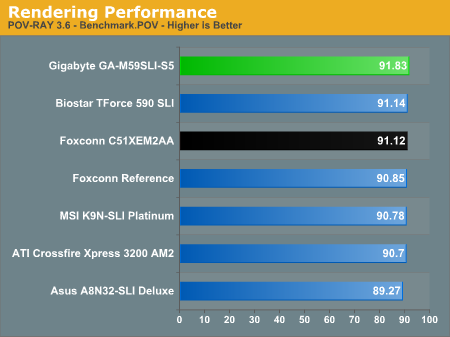
In 3D rendering, the results are all close enough that we would basically call it a tie. The difference between the fastest and slowest motherboard is less than 1%, and it's worth noting that base CPU clock speeds may be slightly higher on some motherboards -- for example, at least one board had a 200.9 MHz HTT bus when set to 200 MHz. We aren't really concerned about the minor overclock, but that also means the margin for error in terms of absolute performance is at least 1%. The end result is that 3D rendering performance is as stated a tie.
I/O Performance
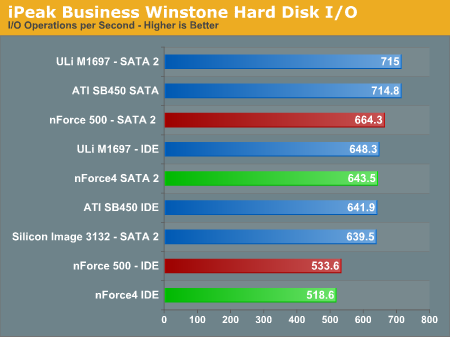
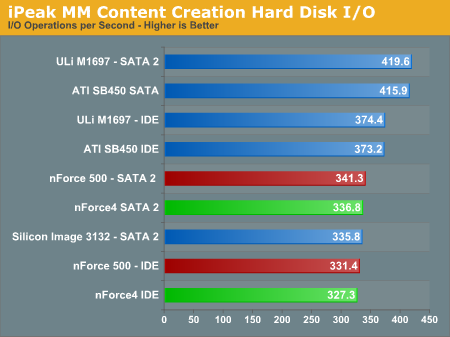
There are differences in iPEAK performance, but the differences are generally confined to the chipset being used. While pure theoretical hard drive performance might be interesting to some people, in most tasks the hard drive is not the bottleneck. If you are truly concerned with hard drive performance, you should take a look at our storage reviews -- we should be adding several new articles in this area shortly.
We ran a couple publicly available 3D rendering applications along with our iPEAK hard disk controller performance tests. The chipset of choice can play a large role in the iPEAK scores, whereas the 3D rendering performance generally stresses the CPU more than anything else, though the memory subsystem can also play a part.
In 3D rendering, the results are all close enough that we would basically call it a tie. The difference between the fastest and slowest motherboard is less than 1%, and it's worth noting that base CPU clock speeds may be slightly higher on some motherboards -- for example, at least one board had a 200.9 MHz HTT bus when set to 200 MHz. We aren't really concerned about the minor overclock, but that also means the margin for error in terms of absolute performance is at least 1%. The end result is that 3D rendering performance is as stated a tie.
I/O Performance
There are differences in iPEAK performance, but the differences are generally confined to the chipset being used. While pure theoretical hard drive performance might be interesting to some people, in most tasks the hard drive is not the bottleneck. If you are truly concerned with hard drive performance, you should take a look at our storage reviews -- we should be adding several new articles in this area shortly.
Originally published at https://www.anandtech.com/show/2033 (Wayback Machine).