
Foxconn and Gigabyte Tackle Socket AM2
- Posted in
- Motherboards
Benchmark Setup
Our AM2 testbed remains the same as in previous articles. All components other than the motherboard are kept as constant as possible. Here are the details.
We previously tested the Foxconn motherboard using the initial BIOS from NVIDIA's nForce5 launch. We have now updated to a newer BIOS revision, and we also tested with the new 91.31 NVIDIA video drivers. We will include results from the reference Foxconn motherboard as well as the updated version for comparison. Performance in a few areas has improved slightly, and it also seems to have decreased slightly in other areas. The net result is that the new BIOS and drivers seem to improve performance overall by a slight amount, but most of our test results are so close together that the board layout, feature set, and level of support that the manufacturer provides in the form of BIOS updates will take prefer precedence over the pure performance numbers.
Note that Network, USB, and Firewire testing will not be included in this article, as the results are the same as what we have previously reported. Rest assured that we did not encounter anything during testing that would indicate any problem(s) in these areas.
General Performance
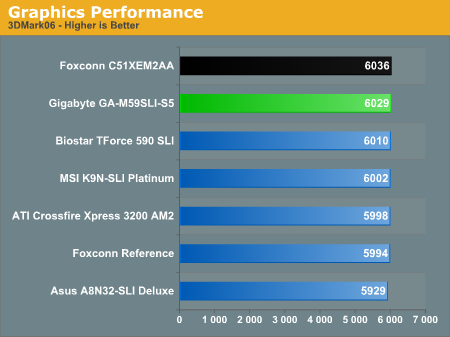
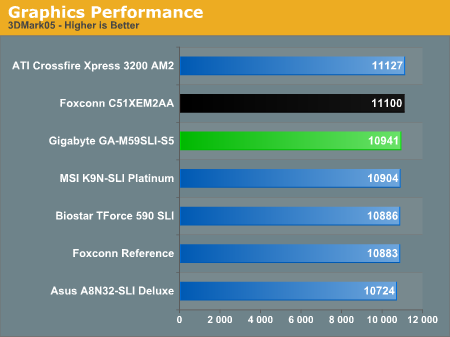
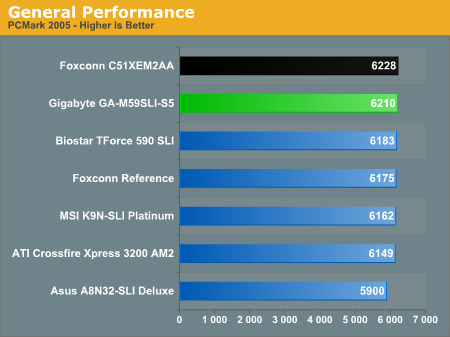
We're providing results from Futuremark's latest applications as an overview of overall system performance. We consider all three benchmarks to be both real world and synthetic in nature, but they all have the benefit of generating relatively consistent results. As you can see from the charts, all of the systems are clustered tightly together, with the difference between the fastest and slowest AM2 board measuring less than 2%. Unless you have the reflexes and built-in system timer of an android, it is unlikely that you would notice a difference between any of the systems in practical use. There is also no clear pattern yet showing one board as performing consistently better or worse than the others, though the Foxconn and Gigabyte boards are at the top of the charts. At least in terms of Futuremark benchmarks, we would say any purchase decision should be based off of price and features.
Our AM2 testbed remains the same as in previous articles. All components other than the motherboard are kept as constant as possible. Here are the details.
| Performance Test Configuration - Foxconn C51-XEM2AA | |
| Processor: | AMD Athlon 64 X2 - 4800+ (AM2) |
| RAM: | 2 x 1GB Corsair Twin2x2048-8500C5 DDR2-800 at CL3-3-3-13 2T |
| Hard Drive(s): | 1 x Maxtor MaXLine III 7L300S0 300GB 7200 RPM SATA (16MB Buffer) |
| System Platform Drivers: | NVIDIA 9.34 |
| Video Cards: | 1 x EVGA 7900GTX - All Tests 2 x EVGA 7900GTX for SLI Tests |
| Video Drivers: | NVIDIA 91.31 |
| Cooling: | Zalman CNPS9500 AM2 |
| Power Supply: | OCZ GamexStream 700W |
| Operating System(s): | Windows XP Professional SP2 |
| Performance Test Configuration - Gigabyte GA-M59SLI-S5 | |
| Processor: | AMD Athlon 64 X2 - 4800+ (AM2) |
| RAM: | 2 x 1GB Corsair Twin2x2048-8500C5 DDR2-800 at CL3-3-3-8 1T |
| Hard Drive(s): | 1 x Maxtor MaXLine III 7L300S0 300GB 7200 RPM SATA (16MB Buffer) |
| System Platform Drivers: | NVIDIA 9.34 |
| Video Cards: | 1 x EVGA 7900GTX - All Tests 2 x EVGA 7900GTX for SLI Tests |
| Video Drivers: | NVIDIA 91.31 |
| Cooling: | Zalman CNPS9500 AM2 |
| Power Supply: | OCZ GamexStream 700W |
| Operating System(s): | Windows XP Professional SP2 |
We previously tested the Foxconn motherboard using the initial BIOS from NVIDIA's nForce5 launch. We have now updated to a newer BIOS revision, and we also tested with the new 91.31 NVIDIA video drivers. We will include results from the reference Foxconn motherboard as well as the updated version for comparison. Performance in a few areas has improved slightly, and it also seems to have decreased slightly in other areas. The net result is that the new BIOS and drivers seem to improve performance overall by a slight amount, but most of our test results are so close together that the board layout, feature set, and level of support that the manufacturer provides in the form of BIOS updates will take prefer precedence over the pure performance numbers.
Note that Network, USB, and Firewire testing will not be included in this article, as the results are the same as what we have previously reported. Rest assured that we did not encounter anything during testing that would indicate any problem(s) in these areas.
General Performance
We're providing results from Futuremark's latest applications as an overview of overall system performance. We consider all three benchmarks to be both real world and synthetic in nature, but they all have the benefit of generating relatively consistent results. As you can see from the charts, all of the systems are clustered tightly together, with the difference between the fastest and slowest AM2 board measuring less than 2%. Unless you have the reflexes and built-in system timer of an android, it is unlikely that you would notice a difference between any of the systems in practical use. There is also no clear pattern yet showing one board as performing consistently better or worse than the others, though the Foxconn and Gigabyte boards are at the top of the charts. At least in terms of Futuremark benchmarks, we would say any purchase decision should be based off of price and features.
Originally published at https://www.anandtech.com/show/2033 (Wayback Machine).