
Khadas Mind Premium Review: Raptor Lake-P in a Modular Portable Workstation
Power Consumption and Thermal Characteristics
The power consumption at the wall was measured with a 4K display being driven through the HDMI port of the core computing unit in both configurations. In the graph below, we compare the idle and load power of the Khadas Mind Premium with other systems evaluated before. For load power consumption, we ran the AIDA64 System Stability Test with various stress components, as well as our custom stress test with Prime95 / Furmark, and noted the peak as well as idling power consumption at the wall.
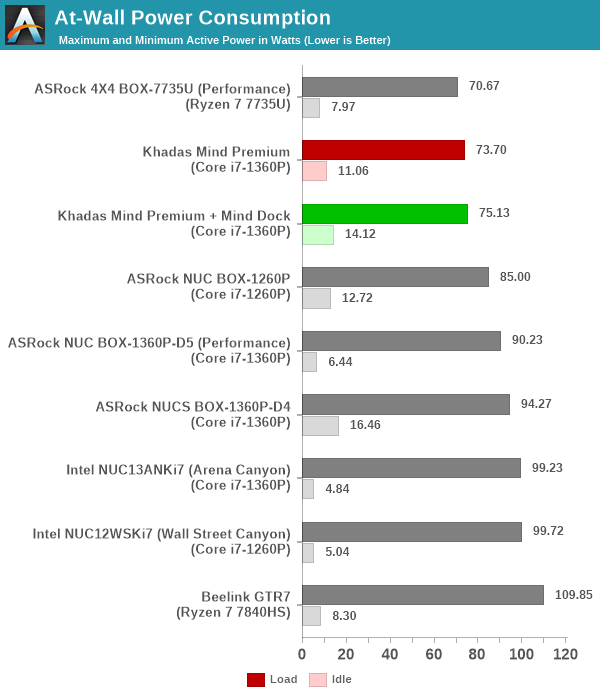
While the load numbers put the Mind Premium in the top half of the graph, the idle numbers are very disappointing. The load numbers are consistent with the TDP and suggested PL1 / PL2 values for the processors in the systems, and do not come as any surprise. While the Arena Canyon NUC idled at 4.84W, and the NUC BOX-1360P/D5 at 6.44W, the Mind Premium idles at 11.06W. Adding the dock to the mix drives that up by a few watts. It should be possible for Khadas to tweak the default BIOS settings to optimize this aspect.
Stress Testing
Our thermal stress routine is a combination of Prime95, Furmark, and Finalwire's AIDA64 System Stability Test. The following 9-step sequence is followed, starting with the system at idle:
- Start with the Prime95 stress test configured for maximum power consumption
- After 30 minutes, add Furmark GPU stress workload
- After 30 minutes, terminate the Prime95 workload
- After 30 minutes, terminate the Furmark workload and let the system idle
- After 30 minutes of idling, start the AIDA64 System Stress Test (SST) with CPU, caches, and RAM activated
- After 30 minutes, terminate the previous AIDA64 SST and start a new one with the GPU, CPU, caches, and RAM activated
- After 30 minutes, terminate the previous AIDA64 SST and start a new one with only the GPU activated
- After 30 minutes, terminate the previous AIDA64 SST and start a new one with the CPU, GPU, caches, RAM, and SSD activated
- After 30 minutes, terminate the AIDA64 SST and let the system idle for 30 minutes
Traditionally, this test used to record the clock frequencies - however, with the increasing number of cores in modern processors and fine-grained clock control, frequency information makes the graphs cluttered and doesn't contribute much to understanding the thermal performance of the system. The focus is now on the power consumption and temperature profiles to determine if throttling is in play.
| Custom Stress Test - Power Consumption Profile | |||
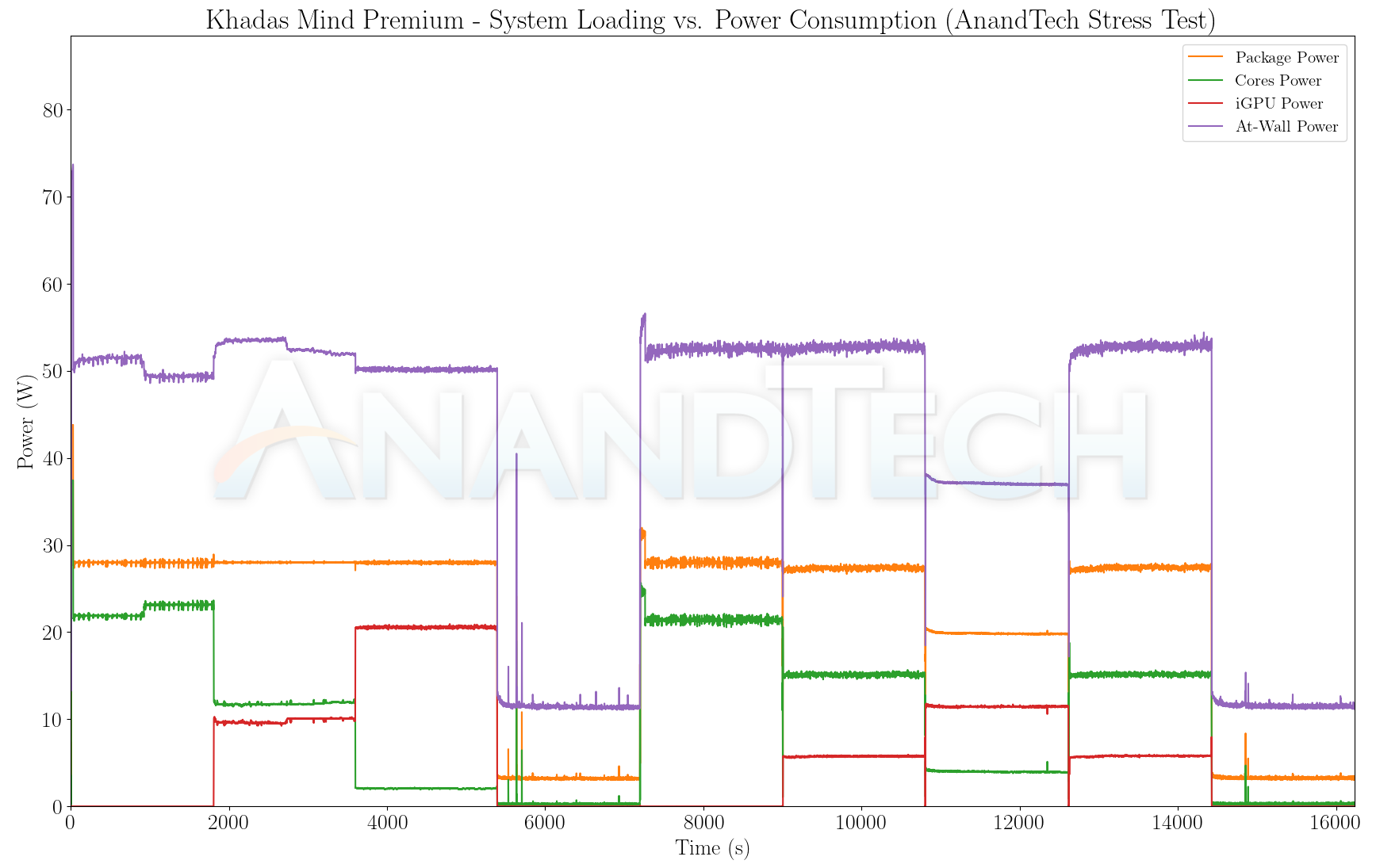
The cooling solution for the processor package is effective, and the package power doesn't dip below the PL1 value of 28W throughout the duration in which it is stressed. The iGPU alone seems to have a power budget of around 20W.
| Custom Stress Test - Temperature Profile | |||
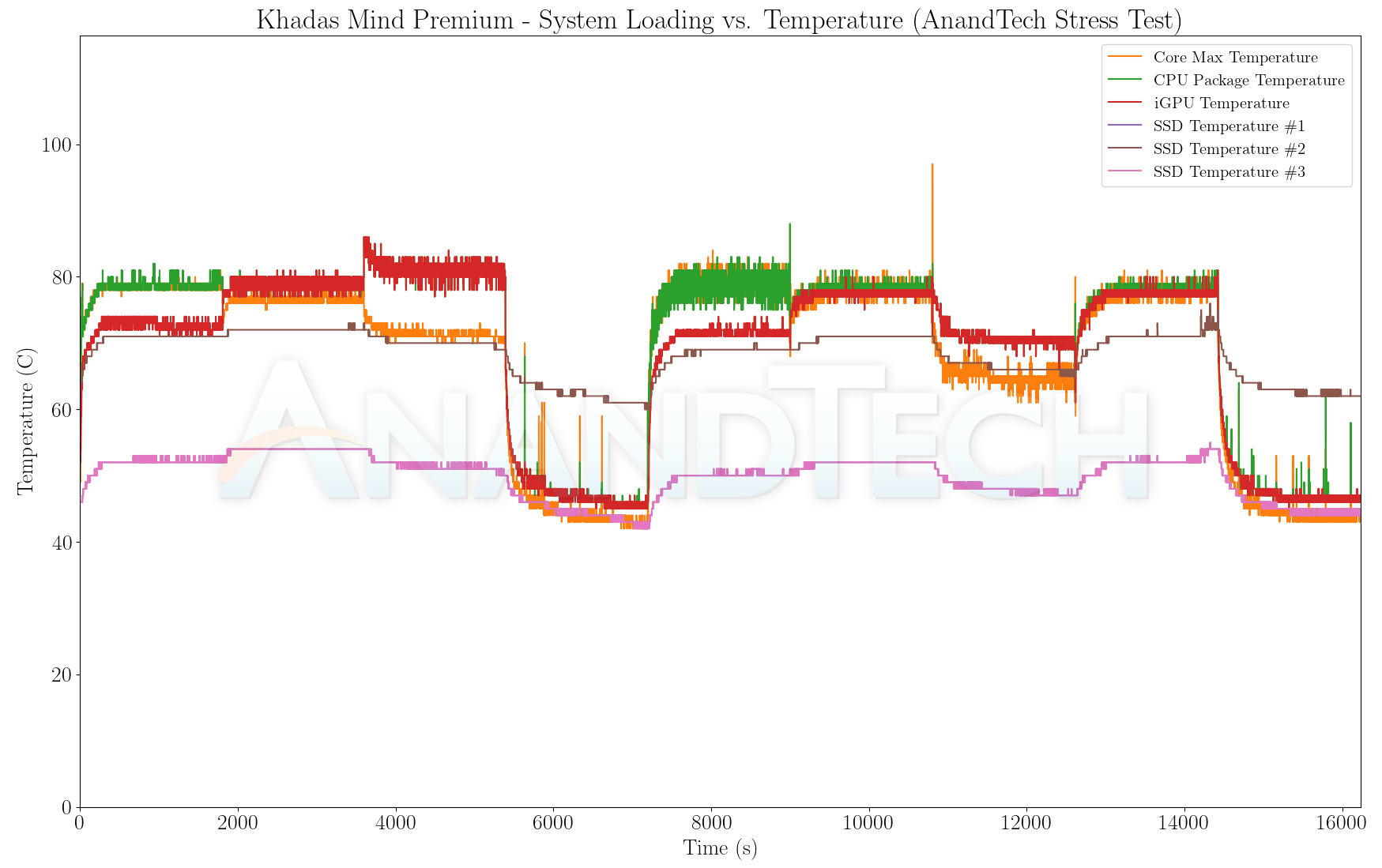
On the temperature front, the package remains below 85C and there is no throttling from a package power consumption perspective. Certain parts of the SSD reach worrisome temperatures (as high as 78C) even when it is not subject to active stress.
Originally published at https://www.anandtech.com/show/20038/khadas-mind-portable-modular-workstation-review-raptor-lakep-in-a-different-avatar (Wayback Machine).