
Khadas Mind Premium Review: Raptor Lake-P in a Modular Portable Workstation
HTPC Credentials
The 2022 Q4 update to our system reviews brings an updated HTPC evaluation suite for systems. After doing away with the evaluation of display refresh rate stability and Netflix streaming evaluation, the local media playback configurations have also seen a revamp. This section details each of the workloads processed on the Khadas Mind Premium as part of the HTPC suite.
YouTube Streaming Efficiency
YouTube continues to remain one of the top OTT platforms, primarily due to its free ad-supported tier. Our HTPC test suite update retains YouTube streaming efficiency evaluation as a metric of OTT support in different systems. Mystery Box's Peru 8K HDR 60FPS video is the chosen test sample. On PCs running Windows, it is recommended that HDR streaming videos be viewed using the Microsoft Edge browser after putting the desktop in HDR mode.
| YouTube Streaming Statistics | |||
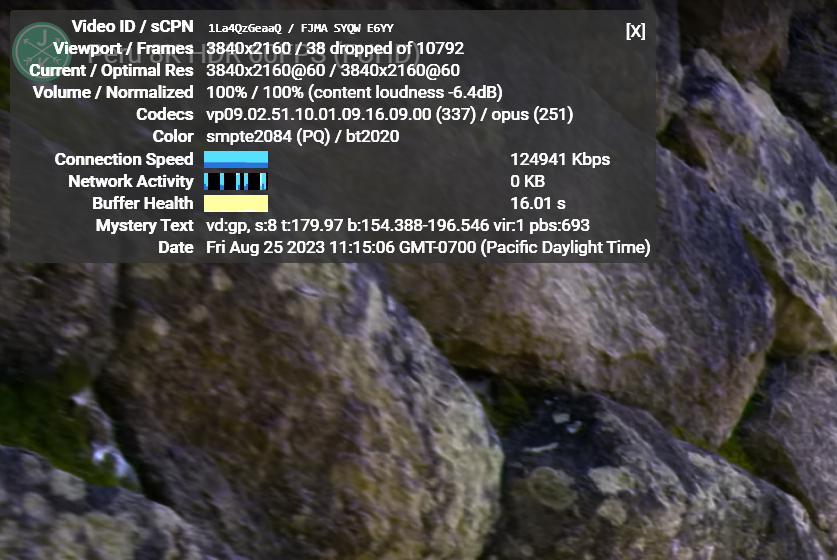
The GPU in Khadas Mind Premium supports hardware decoding of VP9 Profile 2, and we see the stream encoded with that codec being played back. The streaming is perfect, thanks to the powerful GPU and hardware decoding support - the few dropped frames observed in the statistics below are due to mouse clicks involved in bringing up the overlay.
The streaming efficiency-related aspects such as GPU usage and at-wall power consumption are also graphed below for both configurations.
| YouTube Network Streaming Efficiency | |||
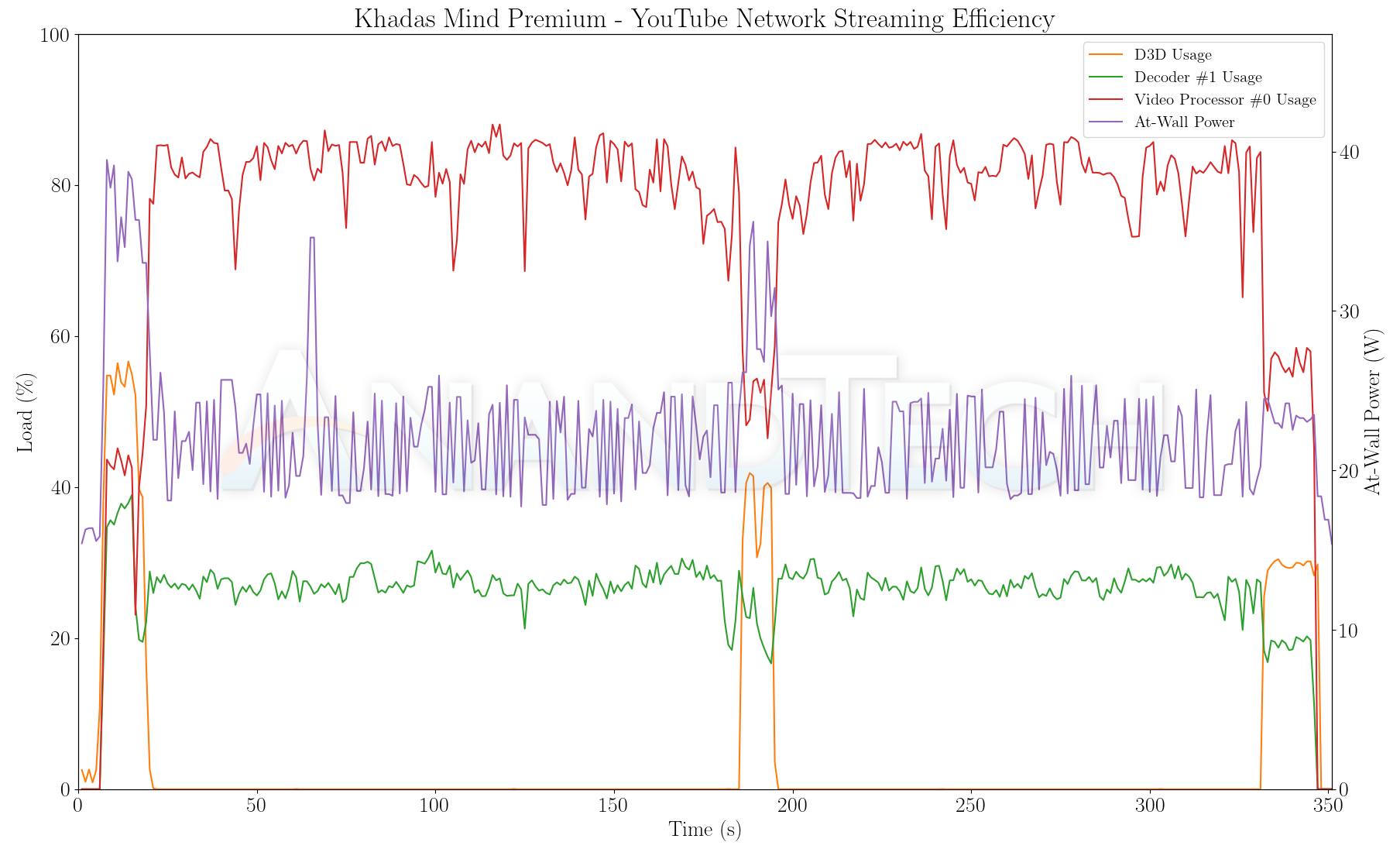
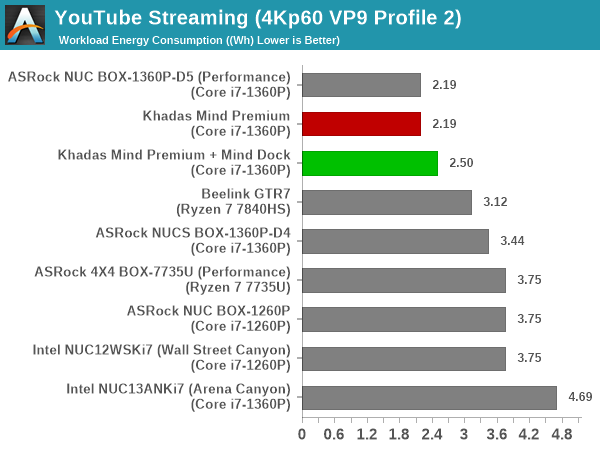
HDR playback of the YouTube stream is very energy efficient, and matches that of the ASRock Industrial NUC BOX-1360P/D5. Obviously, adding the dock does increase the energy consumption, but it is still much better than most of the other systems in the mix.
Hardware-Accelerated Encoding and Decoding
The transcoding benchmarks in the systems performance section presented results from evaluating the QuickSync encoder within Handbrake's framework. The capabilities of the decoder engine are brought out by DXVAChecker.

Video Decoding Hardware Acceleration in Khadas Mind Premium
The iGPU in Raptor Lake-P system supports hardware decode for a variety of codecs including AVC, JPEG, HEVC (8b and 10b, 4:2:0 and 4:4:4), and VP9 (8b and 10b, 4:2:0 and 4:4:4). AV1 decode support is also present. This is currently the most comprehensive codec support seen in the PC space.
Local Media Playback
Evaluation of local media playback and video processing is done by playing back files encompassing a range of relevant codecs, containers, resolutions, and frame rates. A note of the efficiency is also made by tracking GPU usage and power consumption of the system at the wall. Users have their own preference for the playback software / decoder / renderer, and our aim is to have numbers representative of commonly encountered scenarios. Our Q4 2022 test suite update replaces MPC-HC (in LAV filters / madVR modes) with mpv. In addition to being cross-platform and open-source, the player allows easy control via the command-line to enable different shader-based post-processing algorithms. From a benchmarking perspective, the more attractive aspect is the real-time reporting of dropped frames in an easily parseable manner. The players / configurations considered in this subsection include:
- VLC 3.0.18
- Kodi 20.2
- mpv 0.35.1 (hwdec auto, vo=gpu-next)
- mpv 0.35.1 (hwdec auto, vo=gpu-next, profile=gpu-hq)
Fourteen test streams (each of 90s duration) were played back from the local disk with an interval of 30 seconds in-between. Various metrics including GPU usage, at-wall power consumption, and total energy consumption were recorded during the course of this playback.
All our playback tests were done with the desktop HDR setting turned on. It is possible for certain system configurations to automatically turn on/off the HDR capabilities prior to the playback of a HDR video, but, we didn't take advantage of that in our testing.
| VLC Playback Efficiency | |||
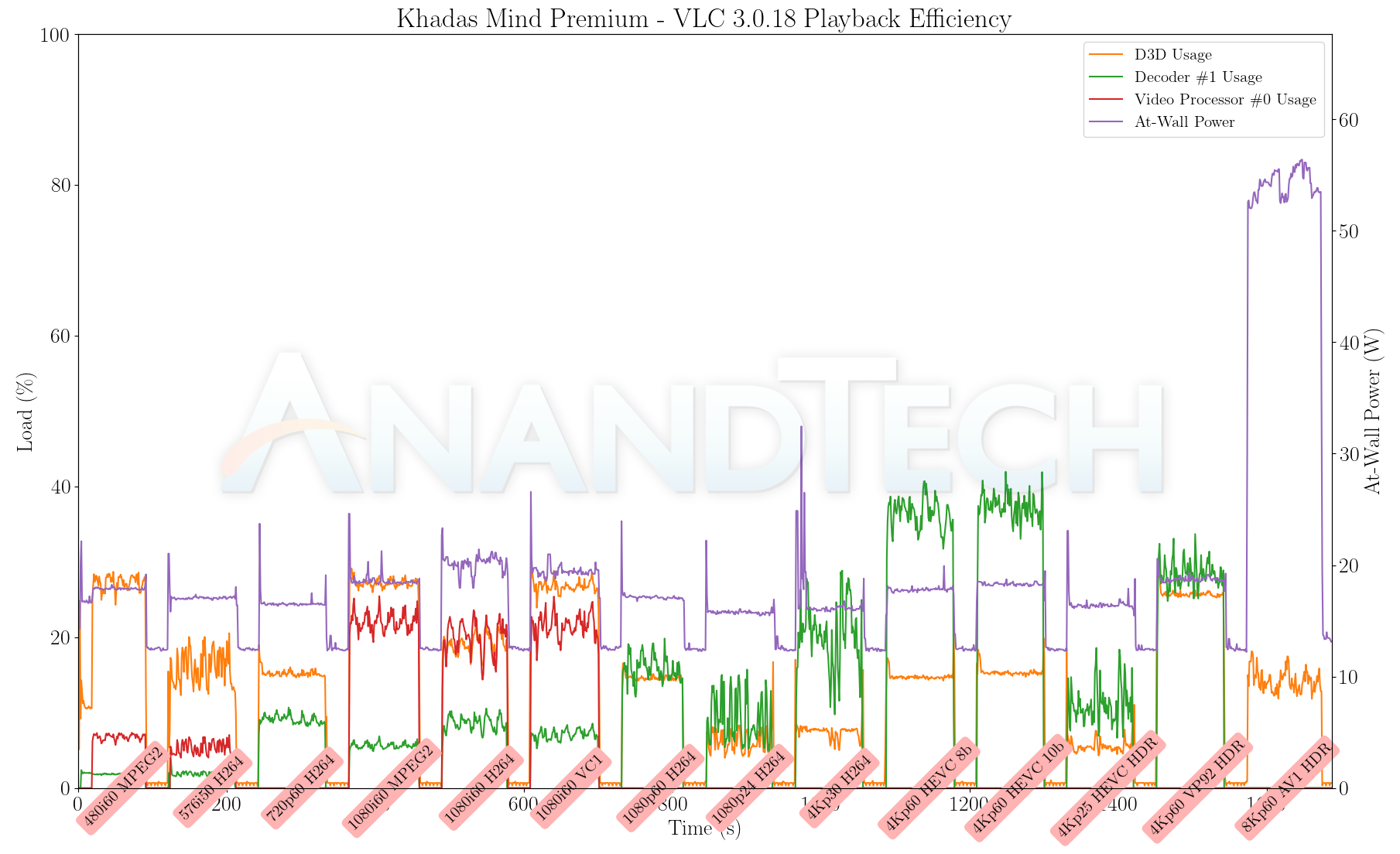
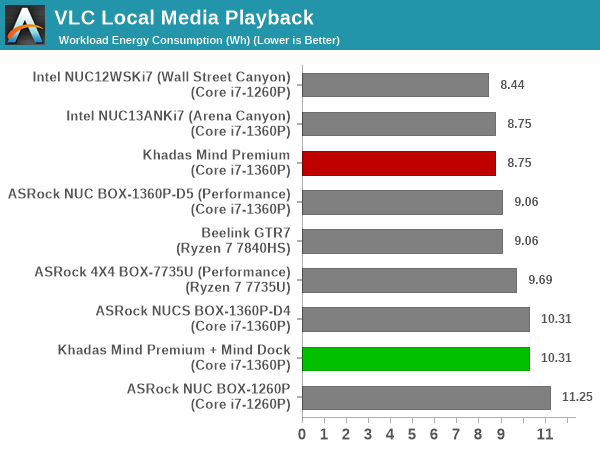
Playback was perfect for all codecs except AV1 (the CPU is not strong enough for software-only 8Kp60 decoding), and the power consumption numbers are excellent - matching that of the Arena Canyon NUC near the top of the table.
| Kodi Playback Efficiency | |||
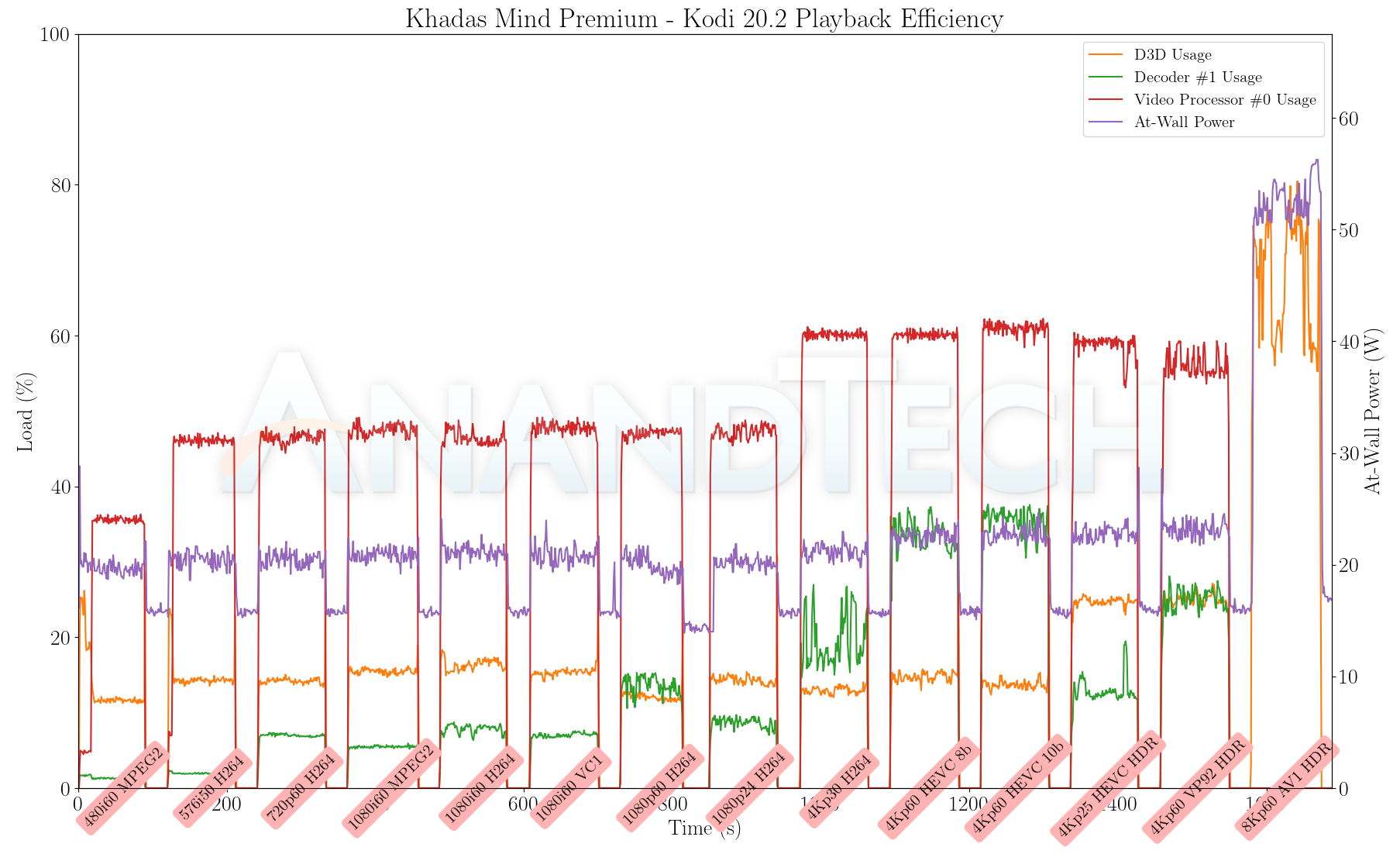
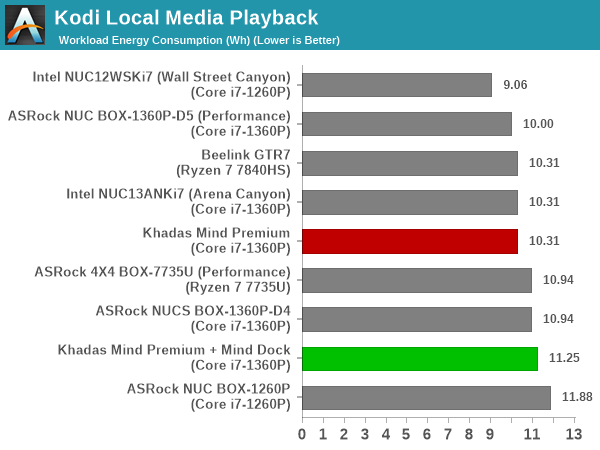
The scenario seen with VLC is replicated in Kodi also - no proper AV1 playback, but energy numbers good enough to put the Mind Premium on par with the Arena Canyon NUC at the third place in the table.
| mpv (Default) Playback Efficiency | |||
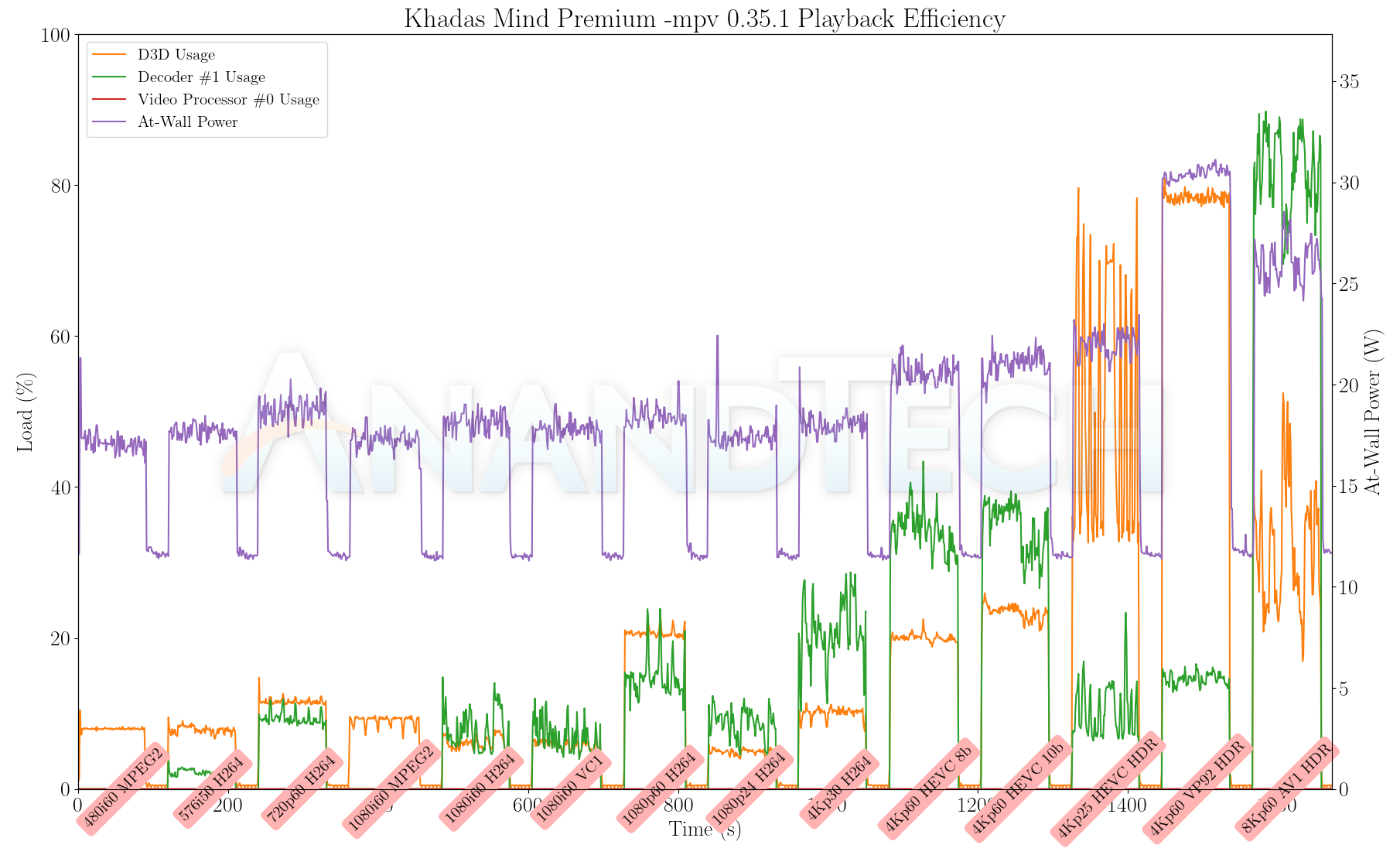
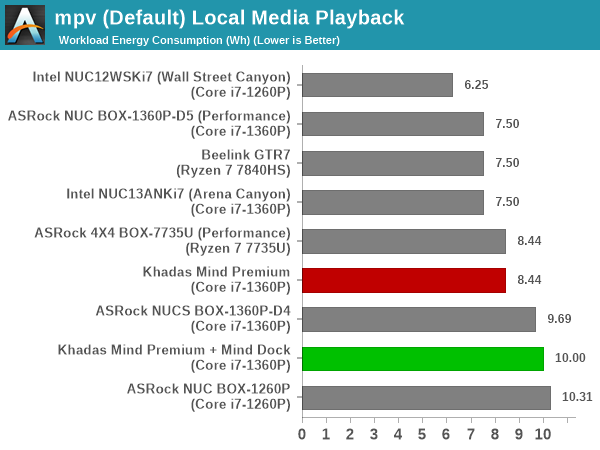
mpv playback with the gpu-next video output driver is reasonably energy efficient. We also have hardware accelerated decode for AV1. However, the playback for that clip still has issues, with more than half of the frames getting dropped in the video output (the decoder itself doesn't drop any frames).
| mpv (GPU-HQ) Playback Efficiency | |||
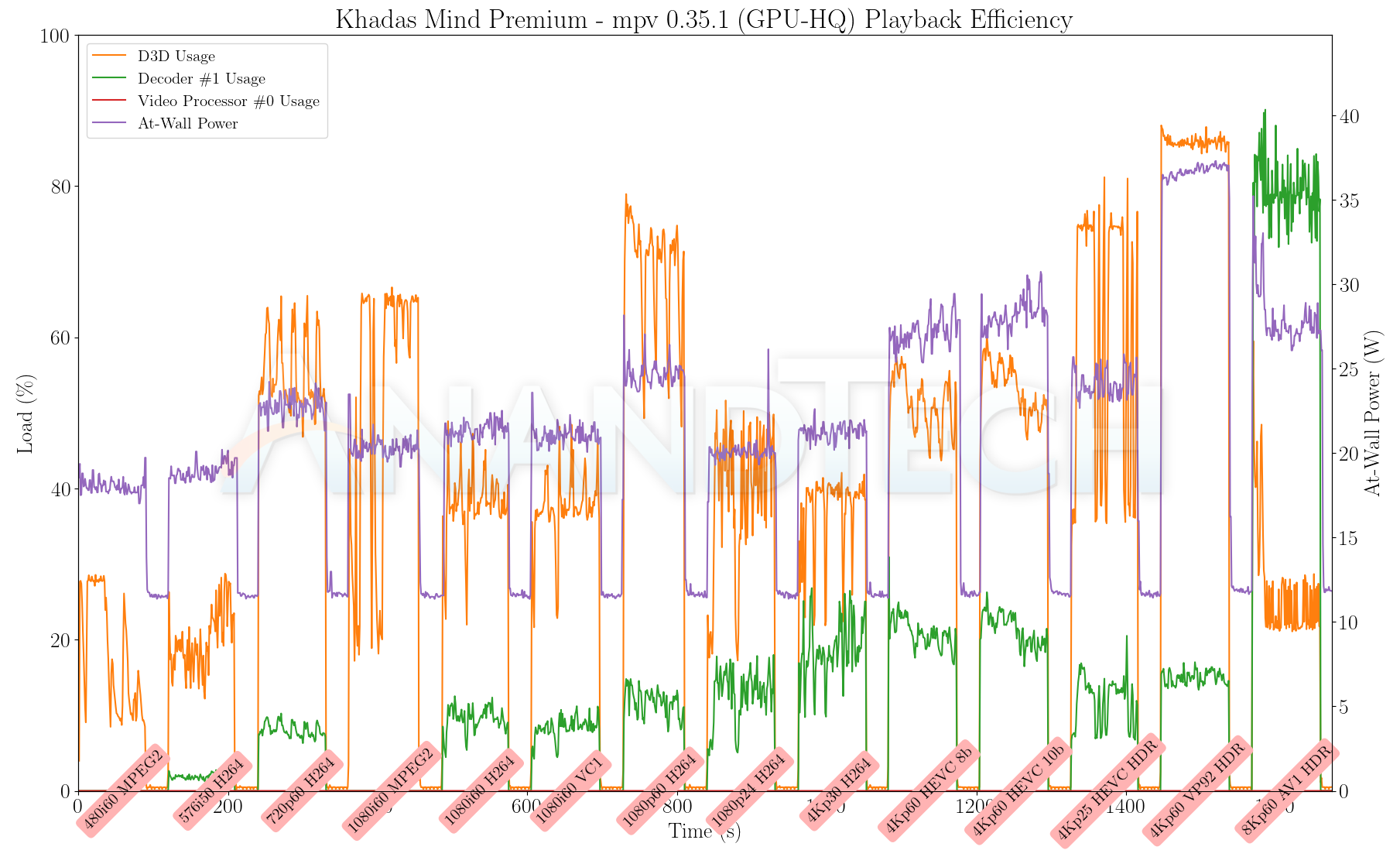
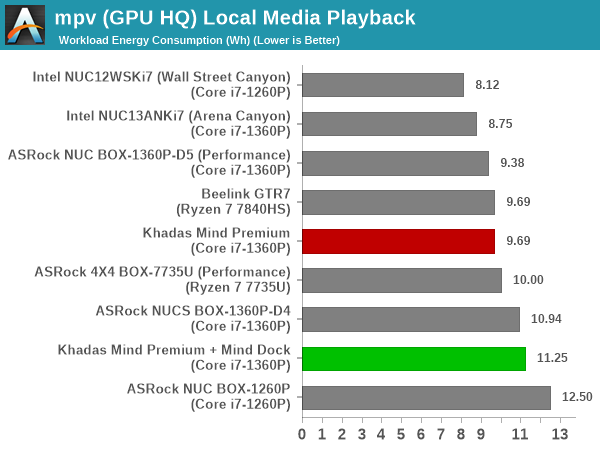
Putting additional stress on the GPU shaders for video post processing does result in increased energy consumption, but there are no dropped frames. The relative positions in the energy consumption graph remain the same. The 8Kp60 AV1 decode video output issue remains the same irrespective of the used profile.
Originally published at https://www.anandtech.com/show/20038/khadas-mind-portable-modular-workstation-review-raptor-lakep-in-a-different-avatar (Wayback Machine).