
Infrant Technologies’ ReadyNAS NV: Enterprise Features, Desktop Footprint
- Posted in
- Storage
Iozone Results
Iozone is a command-line benchmark, which is very extensive in testing various combinations of file sizes and transfer sizes to measure average transfer rates. We used the following command to run the benchmark:
Write Benchmarks
Below are the graphed results for the write portion of the Iozone benchmark. To get a better look at how the two ReadyNAS devices compare, we created two separate graphs for each file size tested: one without the Seagate RAID 5 array, and the other, the mouse over image that includes the Seagate results. The comparison between the NAS devices is clearer without the Seagate data on the chart. Alternatively, we have posted the PDFs (graphs) and Excel files (raw data) of the results to provide some extra numbers to look at here.
We see an improvement in performance with the ReadyNAS NV while transferring 512MB and 1GB files, which is great for media servers that serve movies. However, according to our results, transferring audio files will reflect the performance that we ended up with on the last generation ReadyNAS X6.
Iozone is a command-line benchmark, which is very extensive in testing various combinations of file sizes and transfer sizes to measure average transfer rates. We used the following command to run the benchmark:
iozone -Rab [results file name] -i 0 -i 1 -g 1G -+u -f [path to directory on NAS device under test] -zThe output CSV file produced results for re/write and re/read operations as well as the amount of CPU time used during the specified operations. The most important results, however, are the transfer rates for files of the following sizes: 64KB, 4096KB, 512MB, and 1GB. We carefully chose these file sizes to report because we believed these to be the most common sizes of files used on a daily basis by the typical home/small office client.
Write Benchmarks
Below are the graphed results for the write portion of the Iozone benchmark. To get a better look at how the two ReadyNAS devices compare, we created two separate graphs for each file size tested: one without the Seagate RAID 5 array, and the other, the mouse over image that includes the Seagate results. The comparison between the NAS devices is clearer without the Seagate data on the chart. Alternatively, we have posted the PDFs (graphs) and Excel files (raw data) of the results to provide some extra numbers to look at here.
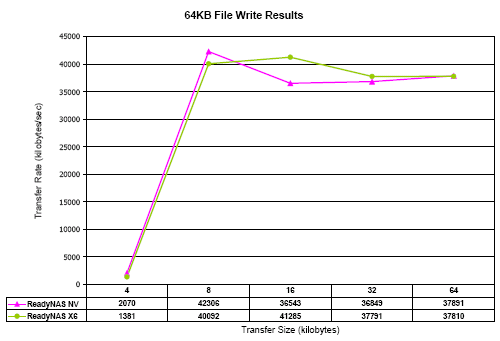
Hold your mouse over to compare to Seagate's 250GB 7200.8 x 4 in RAID 5.
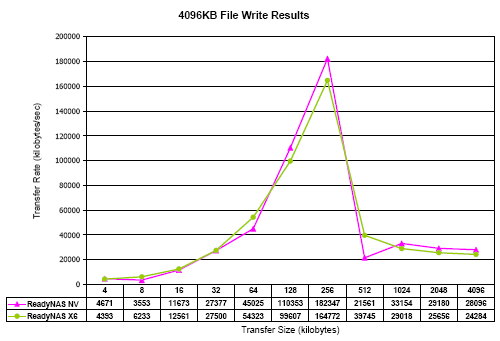
Hold your mouse over to compare to Seagate's 250GB 7200.8 x 4 in RAID 5.
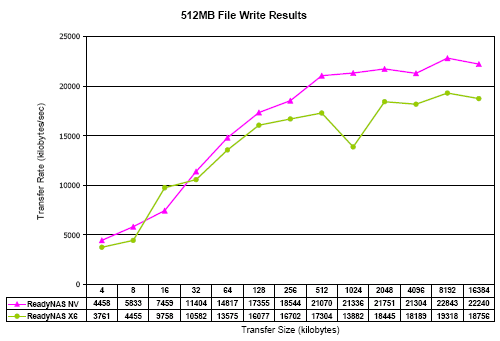
Hold your mouse over to compare to Seagate's 250GB 7200.8 x 4 in RAID 5.
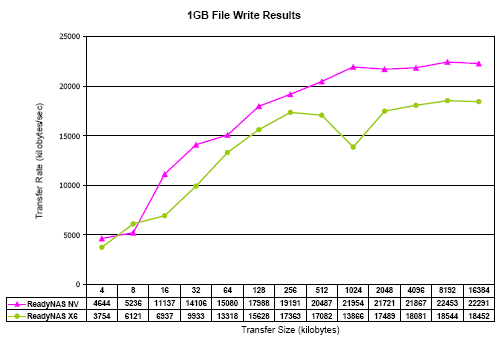
Hold your mouse over to compare to Seagate's 250GB 7200.8 x 4 in RAID 5.
We see an improvement in performance with the ReadyNAS NV while transferring 512MB and 1GB files, which is great for media servers that serve movies. However, according to our results, transferring audio files will reflect the performance that we ended up with on the last generation ReadyNAS X6.
Originally published at https://www.anandtech.com/show/1973 (Wayback Machine).