
Looking Back Pt. 2: X800 & Catalyst Under The Knife
- Posted in
- GPUs
Half-Life 2
There’s little that can be said about Half-Life 2 that hasn’t already been said, other than that perhaps Valve put the game’s graphics to a point where the gritty, depressing world of Half-Life was a little too well done. It’s not a tropical paradise, and it’s not one large monster closet, but Half-Life 2 is unique among first-person shooters for what it does with putting players in the middle of a crumbling city. It is for this reason that the game offers a good take on another aspect of performance.
Here again, we also see some more aggressive performance improvements in the case of AA/AF than without.
There’s little that can be said about Half-Life 2 that hasn’t already been said, other than that perhaps Valve put the game’s graphics to a point where the gritty, depressing world of Half-Life was a little too well done. It’s not a tropical paradise, and it’s not one large monster closet, but Half-Life 2 is unique among first-person shooters for what it does with putting players in the middle of a crumbling city. It is for this reason that the game offers a good take on another aspect of performance.
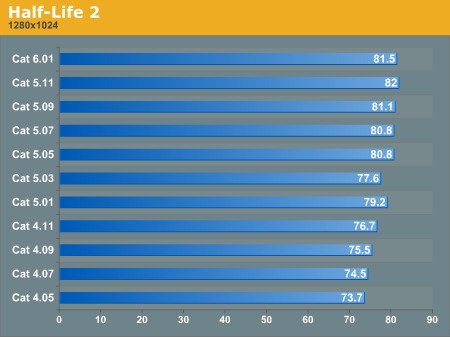
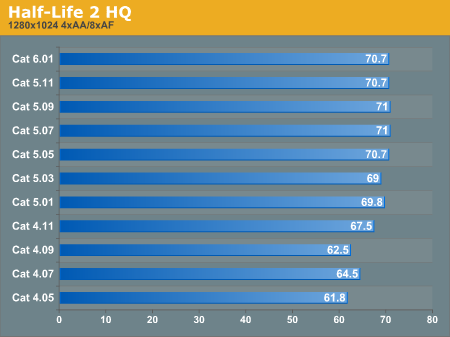
Here again, we also see some more aggressive performance improvements in the case of AA/AF than without.
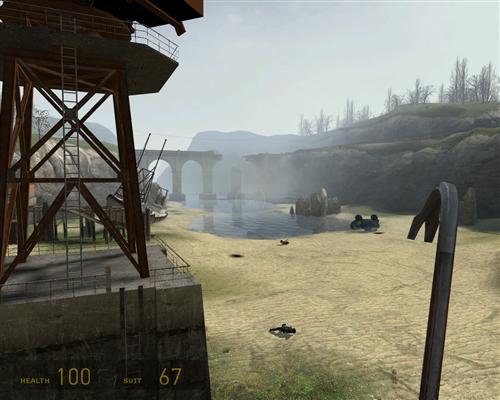
Catalyst 4.05 versus 6.01 (mouse over to see 4.05)
Originally published at https://www.anandtech.com/show/1952 (Wayback Machine).