
Looking Back Pt. 2: X800 & Catalyst Under The Knife
- Posted in
- GPUs
Doom 3
Moving back in to first-person shooters, Doom 3 is without a doubt the most interesting game tested on the Catalyst drivers today. With its emphasis on darkness and a unified lighting system, Doom 3 presents a very different situation than most first-person shooters do, hopefully giving us a different take on performance in such a game. It’s also the OpenGL game of choice for this roundup; though, as we’ll see, just being OpenGL doesn’t mean it’s a great indicator of OpenGL performance.
Shortly after Doom 3 was released, ATI found itself in an interesting situation with regards to what they could do to improve performance. There was a bottleneck in the game in how specular highlighting was applied, and while ATI made some efforts to optimize their drivers for the game, as seen with the 4.09 drivers, this kind of bottleneck was a fundamental issue on which ATI would have to take more serious measures if they wanted to remove it.
What ended up being the bottleneck was that John Carmack, id’s lead programmer, had decided to use a lookup method for determining what highlighting values should be used, based on referencing a specifically constructed texture map with these pre-computed values. It turned out that the R420 could actually calculate such values faster than it could look them up, so to fix the bottleneck would mean replacing the entire shader with what was only a mathematical approximation for the real values in the texture map. However, given the scrutiny over optimizations, it is a difficult choice to make. We’ve covered the issue before, but ultimately, these optimizations are valid in most cases, and the result is the performance improvement as seen above. This case, however, will always serve as a reminder of how fine of a line there is between optimizing and cheating in a game.
But getting back to performance as a whole, outside of ATI’s shader replacement, there’s no further changes in performance. Unfortunately, the replacement means that Doom3 isn’t too great of an OpenGL benchmark, but as the number of OpenGL games continues to dwindle, there is little else on the market to play that uses OpenGL, which isn’t Doom 3 (or Doom 3 engine based) in the first place.
Moving back in to first-person shooters, Doom 3 is without a doubt the most interesting game tested on the Catalyst drivers today. With its emphasis on darkness and a unified lighting system, Doom 3 presents a very different situation than most first-person shooters do, hopefully giving us a different take on performance in such a game. It’s also the OpenGL game of choice for this roundup; though, as we’ll see, just being OpenGL doesn’t mean it’s a great indicator of OpenGL performance.
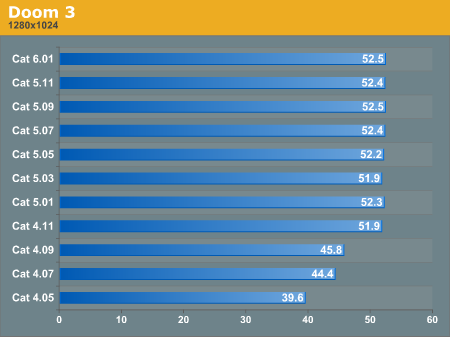
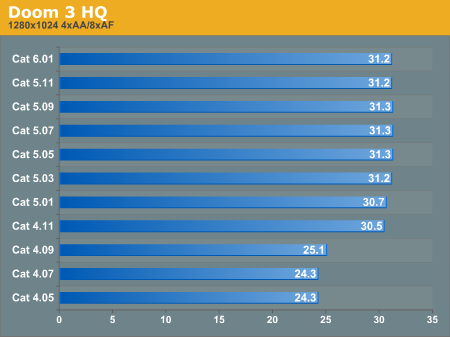
Shortly after Doom 3 was released, ATI found itself in an interesting situation with regards to what they could do to improve performance. There was a bottleneck in the game in how specular highlighting was applied, and while ATI made some efforts to optimize their drivers for the game, as seen with the 4.09 drivers, this kind of bottleneck was a fundamental issue on which ATI would have to take more serious measures if they wanted to remove it.
What ended up being the bottleneck was that John Carmack, id’s lead programmer, had decided to use a lookup method for determining what highlighting values should be used, based on referencing a specifically constructed texture map with these pre-computed values. It turned out that the R420 could actually calculate such values faster than it could look them up, so to fix the bottleneck would mean replacing the entire shader with what was only a mathematical approximation for the real values in the texture map. However, given the scrutiny over optimizations, it is a difficult choice to make. We’ve covered the issue before, but ultimately, these optimizations are valid in most cases, and the result is the performance improvement as seen above. This case, however, will always serve as a reminder of how fine of a line there is between optimizing and cheating in a game.
But getting back to performance as a whole, outside of ATI’s shader replacement, there’s no further changes in performance. Unfortunately, the replacement means that Doom3 isn’t too great of an OpenGL benchmark, but as the number of OpenGL games continues to dwindle, there is little else on the market to play that uses OpenGL, which isn’t Doom 3 (or Doom 3 engine based) in the first place.
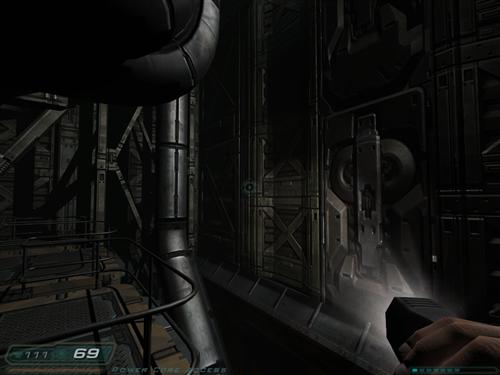
Catalyst 4.05 versus 6.01 (mouse over to see 4.05)
Originally published at https://www.anandtech.com/show/1952 (Wayback Machine).