
Price-Point Comparing Three-Way Case Shootout
- Posted in
- Cases/Cooling/PSUs
Benchmark Comparisons
To get as meaningful a comparison as possible between the different cases, we installed the same set of hardware into each one; our new standard ATX test bed. While our X1 and P150 did both include power supplies, we still wanted to test just the case to eliminate any other variables.
Continuing with the new ATX test bed we used for the HTPC comparison, we now have many points of measurement in the computer and can get a really good idea of how well the cases are performing in the temperature arena.
As always, however, temperatures alone don't tell the whole story. Since Antec makes it very clear that the P150 is all about silence, we tested the case with the tri-speed fan set to the lowest level. The noise levels from each case are summarized in the following table:
The E68's cooling performance is still amazing, but now, the reasons are slightly more obvious - the 120mm fan included with the case makes significantly more noise than the other two cases' solutions. That having been said, the E68 still was definitely within tolerable limits for us, and would certainly suit the majority of users fine, especially if they are used to keeping their computers under their desk and don't mind the aforementioned sound of simply "moving air".
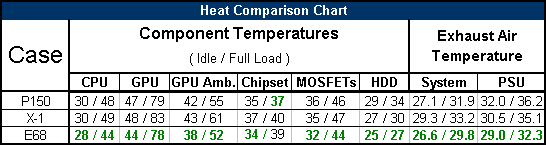
Even focusing too much on the obvious winners from each category really isn't the right thing to do here either though; it's once when you take both charts into consideration that the P150 starts to finally strut its stuff. Compared directly to the just-as-quiet X1, the P150 keeps critical components - especially the GPU and chipset - slightly cooler. With only a single fan against the X1's two, this can only be explained by sheer good case design and a very efficient fan. However, hard drive temperatures aren't the best on the P150, so it'd be wisest to pair it with hard drives that are either known for running cool or for being able to withstand heat without any issues.
Finally, a couple of words about the included power supplies on the X1 and P150: our Antec test unit must have been defective, as it was causing boot problems in not only our test bed, but in another computer as well. When it was running, it was virtually silent - even quieter than our MadDog unit.
Update: It sounds like there IS a real issue going on with the Neo HE power supply included with the P150.. the silent PC forums make mention of it but the easiest place to see that there must be problems with it is in the newegg user reviews for the case.
The Raidmax power supply was also practically silent, and worked fine in the test bed under heavy loads for several hours, and in another gaming computer for a couple of weeks without any problems.
To get as meaningful a comparison as possible between the different cases, we installed the same set of hardware into each one; our new standard ATX test bed. While our X1 and P150 did both include power supplies, we still wanted to test just the case to eliminate any other variables.
| ATX Test Bed | |
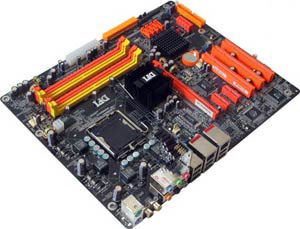
| DFI LanParty UT 915P-T12 Pentium 4 530 Prescott 3.0ghz OCZ 512MB DDR2 x 2 Thermaltake Golden Orb II Maxtor 80gb IDE Hard Drive Chaintech GeForce 6600GT MSI DVD-CD/R/RW Combo drive MadDog MD-600SCPS PSU |
 |
Continuing with the new ATX test bed we used for the HTPC comparison, we now have many points of measurement in the computer and can get a really good idea of how well the cases are performing in the temperature arena.
As always, however, temperatures alone don't tell the whole story. Since Antec makes it very clear that the P150 is all about silence, we tested the case with the tri-speed fan set to the lowest level. The noise levels from each case are summarized in the following table:
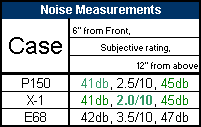
The E68's cooling performance is still amazing, but now, the reasons are slightly more obvious - the 120mm fan included with the case makes significantly more noise than the other two cases' solutions. That having been said, the E68 still was definitely within tolerable limits for us, and would certainly suit the majority of users fine, especially if they are used to keeping their computers under their desk and don't mind the aforementioned sound of simply "moving air".
Even focusing too much on the obvious winners from each category really isn't the right thing to do here either though; it's once when you take both charts into consideration that the P150 starts to finally strut its stuff. Compared directly to the just-as-quiet X1, the P150 keeps critical components - especially the GPU and chipset - slightly cooler. With only a single fan against the X1's two, this can only be explained by sheer good case design and a very efficient fan. However, hard drive temperatures aren't the best on the P150, so it'd be wisest to pair it with hard drives that are either known for running cool or for being able to withstand heat without any issues.
Finally, a couple of words about the included power supplies on the X1 and P150: our Antec test unit must have been defective, as it was causing boot problems in not only our test bed, but in another computer as well. When it was running, it was virtually silent - even quieter than our MadDog unit.
Update: It sounds like there IS a real issue going on with the Neo HE power supply included with the P150.. the silent PC forums make mention of it but the easiest place to see that there must be problems with it is in the newegg user reviews for the case.
The Raidmax power supply was also practically silent, and worked fine in the test bed under heavy loads for several hours, and in another gaming computer for a couple of weeks without any problems.
Originally published at https://www.anandtech.com/show/1922 (Wayback Machine).