
HP DX5150 – OEM plus AMD
- Posted in
- Systems
Gaming Benchmarks - Doom 3
As with BF2, we chose to test in two different settings. We selected the low-quality mode and high-quality modes and benchmarked them at varying resolutions. You can see the settings used in the following images.
Without disabling some of the advanced options, Doom 3 is still very taxing on low end graphics cards. For the discrete graphics cards where we tested both modes, the difference between the low and high settings is at most 10% - at least until we enable antialiasing. Antialiasing puts a larger strain on the GPU memory subsystem, allowing the high-end cards to flex their muscle. Here are the results:
Shifting to the high-quality mode, scores are mostly within 5% of each other. The custom system once again leads by about 6% - at best - but at reasonable resolutions with anything other than the 7800 GTX, it's close enough that we wouldn't worry too much about the loss of performance.
While we didn't include scores here, Quake 4 is pretty much the same story as Doom 3. You really need at least some form of discrete graphics before you can play either game. This appears to be due to the Doom 3 engine's desire for lots of bandwidth. Since both of these platforms share system memory bandwidth between the graphics and the processor, the net result of around 3.2 GB per second is insufficient.
As with BF2, we chose to test in two different settings. We selected the low-quality mode and high-quality modes and benchmarked them at varying resolutions. You can see the settings used in the following images.
 |
 |
 |
| Click on images to enlarge. | ||
Without disabling some of the advanced options, Doom 3 is still very taxing on low end graphics cards. For the discrete graphics cards where we tested both modes, the difference between the low and high settings is at most 10% - at least until we enable antialiasing. Antialiasing puts a larger strain on the GPU memory subsystem, allowing the high-end cards to flex their muscle. Here are the results:
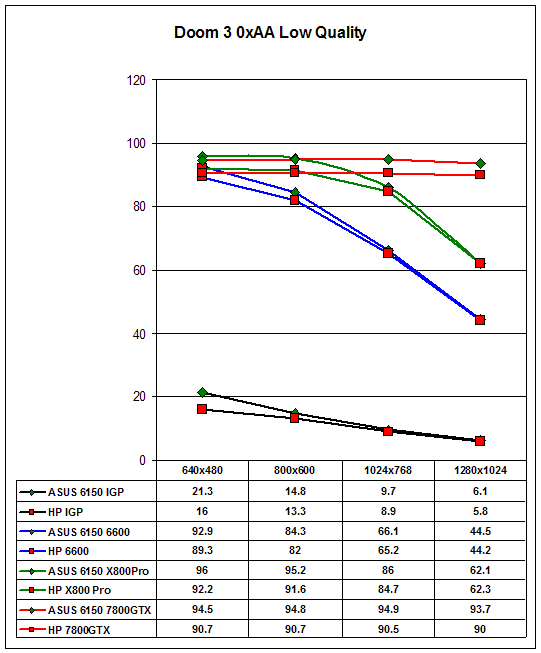
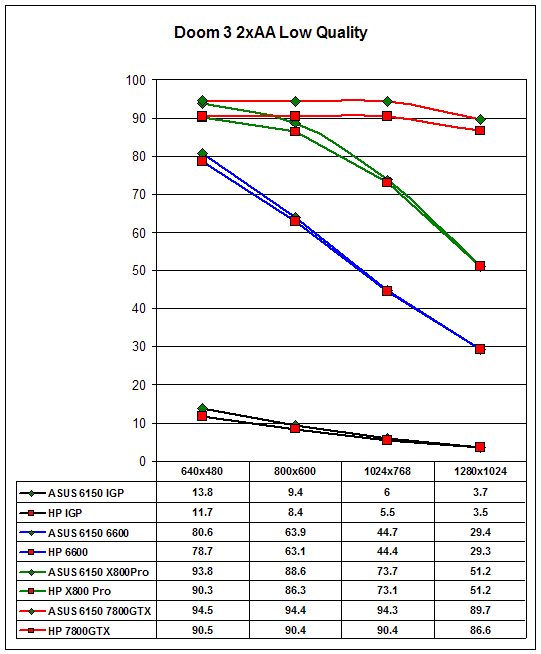
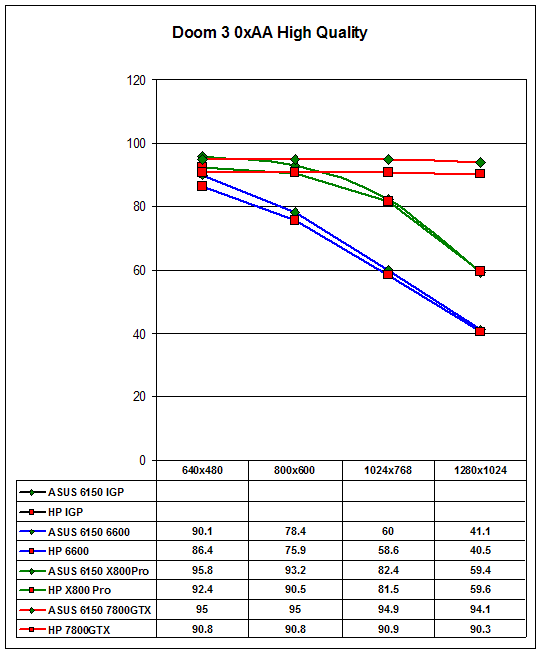
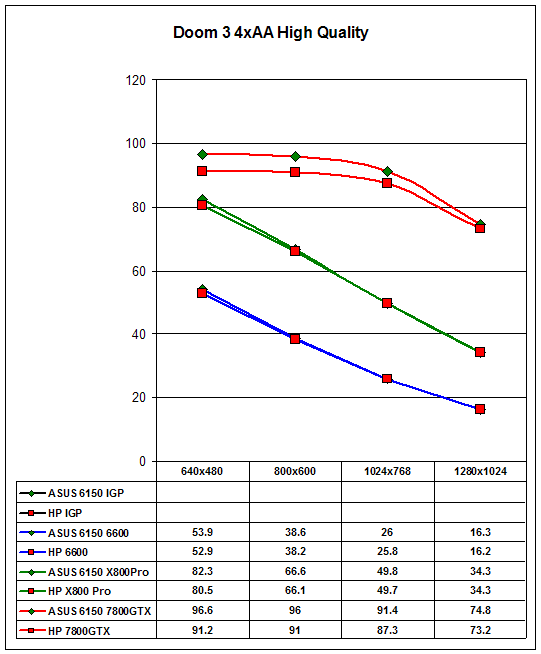
Shifting to the high-quality mode, scores are mostly within 5% of each other. The custom system once again leads by about 6% - at best - but at reasonable resolutions with anything other than the 7800 GTX, it's close enough that we wouldn't worry too much about the loss of performance.
While we didn't include scores here, Quake 4 is pretty much the same story as Doom 3. You really need at least some form of discrete graphics before you can play either game. This appears to be due to the Doom 3 engine's desire for lots of bandwidth. Since both of these platforms share system memory bandwidth between the graphics and the processor, the net result of around 3.2 GB per second is insufficient.
Originally published at https://www.anandtech.com/show/1895 (Wayback Machine).