
Asus A8N32-SLI Deluxe: NVIDIA Dual x16 for the Athlon 64
- Posted in
- Motherboards
Gaming Performance
SLI
Single Video
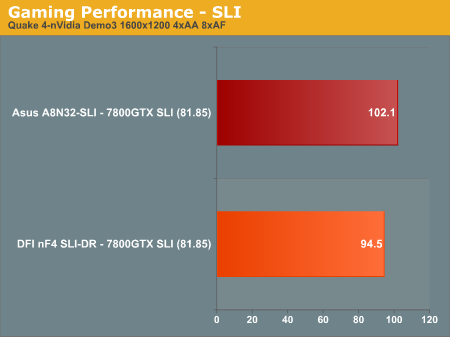
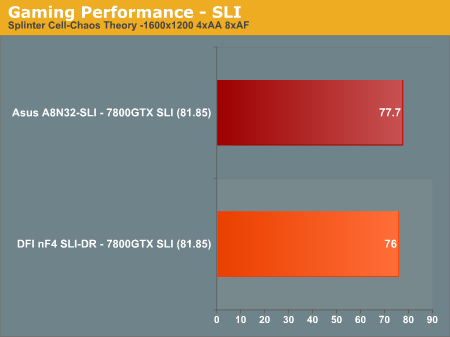
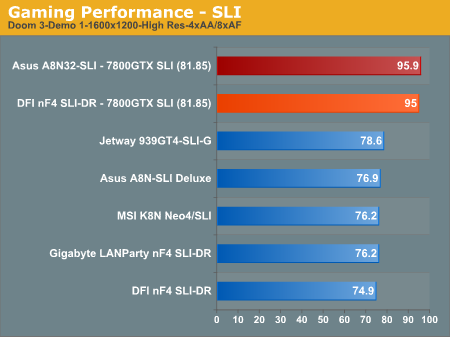
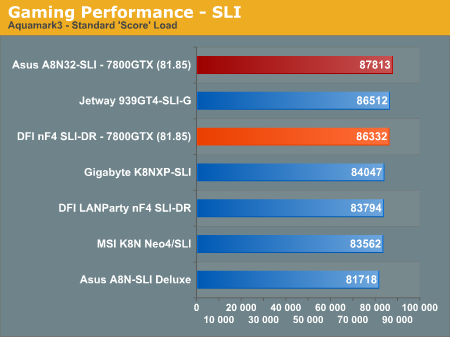
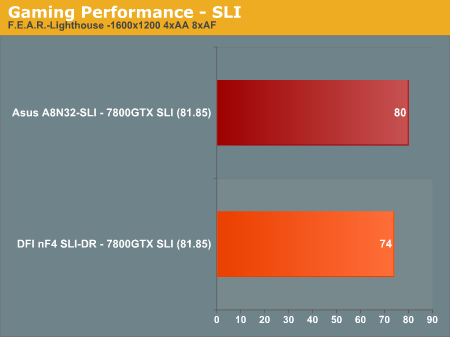
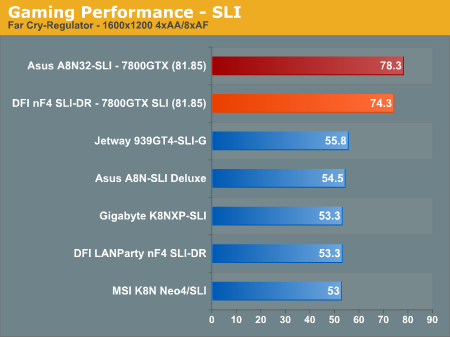
Since the DFI and Asus were both tested with the same CPU, memory, video cards, and video drivers, let's compare performance in SLI mode as a percentage increase in the six tested games.
Using the same video drivers and components, the Asus Dual x16 was 1% to 8.1% faster than the DFI Dual x8. These increases are small enough that we took a closer look at single card performance to see if the real difference was Dual x16 or something else.
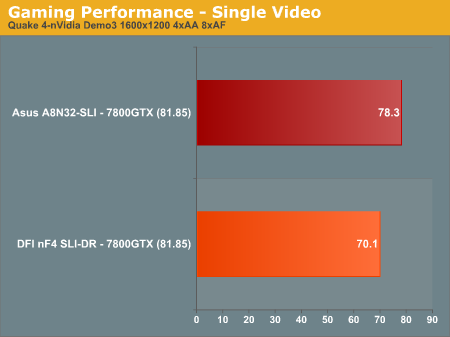
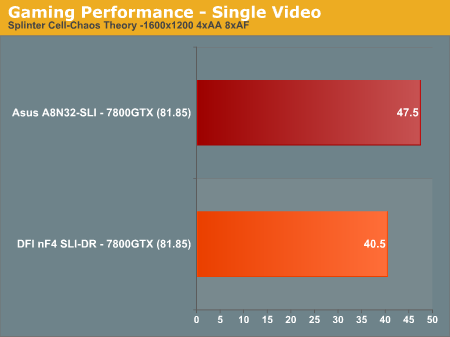
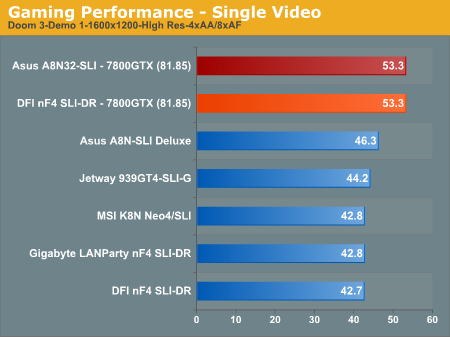
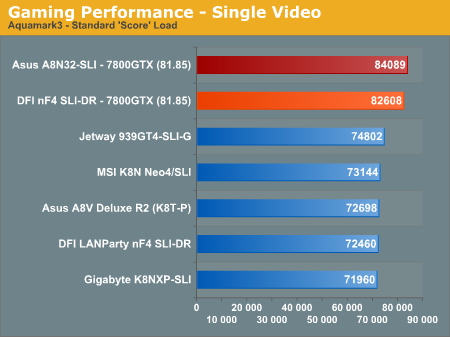
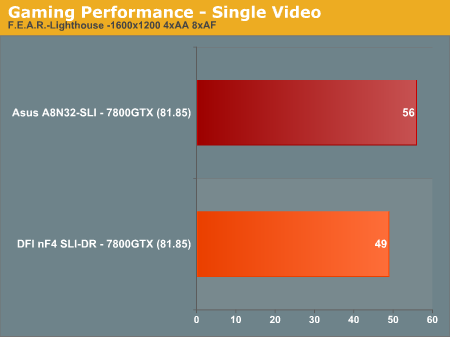
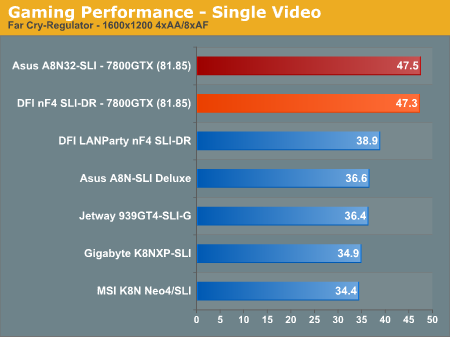
In single video card mode, we were completely surprised to find performance increases on the Asus as high as 17.3%. This is an even higher performance increase than SLI mode, but in this case, both the DFI and Asus are running a single card in x16 mode. How is this possible? We re-ran benches several times and attained the same results. It is also interesting that while there is almost no increase in single mode in "older" games, the newest and most demanding titles show the biggest increases.
Perhaps the MCP51 is more efficient than the older nF4 SLI chip, or perhaps the design of the AMD Dual x16 improves video performance across the board. Or maybe the 8-phase Asus design really makes a difference. We won't know the true answer until we do much more testing on the new Dual x16 boards. Whatever the explanations that will be found, it is clear that the Asus A8N32-SLI is slightly faster in older game titles in both single-video and SLI modes. In newer and more demanding games, the Asus can be 8% to 17% faster than the best of the current dual x8 solutions.
SLI
Single Video
Since the DFI and Asus were both tested with the same CPU, memory, video cards, and video drivers, let's compare performance in SLI mode as a percentage increase in the six tested games.
| SLI - NVIDIA 81.85 Drivers, 6.82 Platform | |||
| Game | DFI nF4 SLI-DR (2 x8) | Asus A8N32-SLI (2 x16) | % Increase |
| Aquamark 3 | 86332 | 87813 | +1.7 |
| Far Cry | 74.3 | 78.3 | +5.4 |
| Doom 3 | 95.0 | 95.9 | +1.0 |
| Splinter Cell-Chaos Theory | 76.0 | 77.7 | +2.2 |
| Quake 4 | 94.5 | 102.1 | +8.0 |
| F.E.A.R. | 74.0 | 80 | +8.1 |
Using the same video drivers and components, the Asus Dual x16 was 1% to 8.1% faster than the DFI Dual x8. These increases are small enough that we took a closer look at single card performance to see if the real difference was Dual x16 or something else.
| Single Video - NVIDIA 81.85 Drivers, 6.82 Platform | |||
| Game | DFI nF4 SLI-DR (1 x16) | Asus A8N32-SLI (1 x16) | % Increase |
| Aquamark 3 | 82608 | 84089 | +1.8 |
| Far Cry | 47.3 | 47.5 | +0.4 |
| Doom 3 | 53.3 | 53.3 | 0.0 |
| Splinter Cell-Chaos Theory | 40.5 | 47.5 | +17.3 |
| Quake 4 | 70.1 | 78.3 | +11.7 |
| F.E.A.R. | 49 | 56 | +14.3 |
In single video card mode, we were completely surprised to find performance increases on the Asus as high as 17.3%. This is an even higher performance increase than SLI mode, but in this case, both the DFI and Asus are running a single card in x16 mode. How is this possible? We re-ran benches several times and attained the same results. It is also interesting that while there is almost no increase in single mode in "older" games, the newest and most demanding titles show the biggest increases.
Perhaps the MCP51 is more efficient than the older nF4 SLI chip, or perhaps the design of the AMD Dual x16 improves video performance across the board. Or maybe the 8-phase Asus design really makes a difference. We won't know the true answer until we do much more testing on the new Dual x16 boards. Whatever the explanations that will be found, it is clear that the Asus A8N32-SLI is slightly faster in older game titles in both single-video and SLI modes. In newer and more demanding games, the Asus can be 8% to 17% faster than the best of the current dual x8 solutions.
Originally published at https://www.anandtech.com/show/1845 (Wayback Machine).