
Intel's 65nm Processors: Overclocking Preview
- Posted in
- CPUs
Overclocking Potential of Intel's 65nm Processors
The biggest question on our mind was how far we could push Intel's new 65nm processors. Keep in mind that these are still early 65nm samples and the actual launch is still some time away, so overclocking potential could very well improve beyond what we report here. That being said, the launch of Cedar Mill and Presler is quite possibly the last time that we will be able to hit extremely high clock speeds for a very long time on Intel processors, so we were quite curious.
First up was Cedar Mill, which we had running at 3.60GHz at 1.300V by default. Our first test was to see how far we could get it without increasing the core voltage, and the best that we could do there was 4.25GHz (250MHz x 17.0).
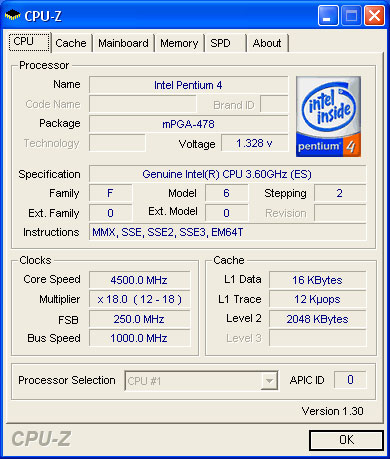
Our next test was to see how high we could push the 3.60GHz processor on a stock Intel HSF. The result ended up being 4.50GHz at 1.4125V, using a 250MHz FSB and the chip's default 18x clock multiplier:
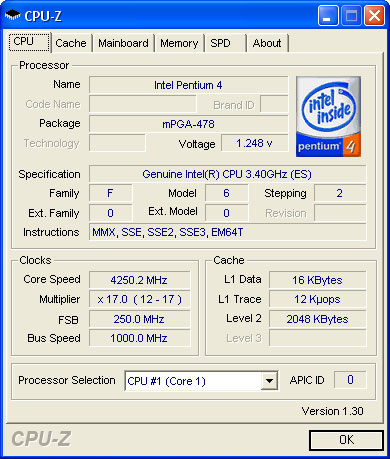
Next up was the dual-core Presler, which ran at a stock speed of 3.40GHz at 1.300V. Without increasing the core voltage at all, we couldn't break 3.5GHz on our Presler sample, so we went straight to bumping up the voltage. At 1.3625V, we managed to get Presler up to 4.25GHz (250MHz x 17.0), which was a fairly reasonable boost. The best overclocks that we have seen on a Smithfield based Pentium D have taken the chip up to 3.9GHz, so breaking 4.0GHz on a dual core Pentium D is pretty impressive (especially with twice the cache).
The biggest question on our mind was how far we could push Intel's new 65nm processors. Keep in mind that these are still early 65nm samples and the actual launch is still some time away, so overclocking potential could very well improve beyond what we report here. That being said, the launch of Cedar Mill and Presler is quite possibly the last time that we will be able to hit extremely high clock speeds for a very long time on Intel processors, so we were quite curious.
First up was Cedar Mill, which we had running at 3.60GHz at 1.300V by default. Our first test was to see how far we could get it without increasing the core voltage, and the best that we could do there was 4.25GHz (250MHz x 17.0).
Our next test was to see how high we could push the 3.60GHz processor on a stock Intel HSF. The result ended up being 4.50GHz at 1.4125V, using a 250MHz FSB and the chip's default 18x clock multiplier:
Next up was the dual-core Presler, which ran at a stock speed of 3.40GHz at 1.300V. Without increasing the core voltage at all, we couldn't break 3.5GHz on our Presler sample, so we went straight to bumping up the voltage. At 1.3625V, we managed to get Presler up to 4.25GHz (250MHz x 17.0), which was a fairly reasonable boost. The best overclocks that we have seen on a Smithfield based Pentium D have taken the chip up to 3.9GHz, so breaking 4.0GHz on a dual core Pentium D is pretty impressive (especially with twice the cache).
Originally published at https://www.anandtech.com/show/1834 (Wayback Machine).