
USB Flash Drive Roundup - 10/2005
- Posted in
- Memory
Dual Channel Flash Drives
With flash drives, the fewer chips you use, the smaller your device can be and the cheaper it can be as well. It is almost always cheaper for a manufacturer to use one 4Gbit flash device than to use two 2Gbit devices, so as long as there is a high enough density available, you would expect manufacturers to always opt for a single chip flash solution (at least for the memory). Lately, however, some controller manufacturers have offered "dual channel" controllers that allow you to read from/write to multiple flash devices simultaneously; think of it like RAID-0 for flash drives.
The performance boost for a dual channel drive over a single channel drive depends a lot on the type of flash used as well as the controller itself. In many cases, however, a dual channel drive can be up to 2x as fast as a single channel drive.
Most physically larger drives that are branded as high performance drives are dual channel solutions, even if they aren't marketed as such. The cheaper drives end up being single chip/single channel, and of course, the small form factor drives end up being single chip/single channel as well.
With flash drives, the fewer chips you use, the smaller your device can be and the cheaper it can be as well. It is almost always cheaper for a manufacturer to use one 4Gbit flash device than to use two 2Gbit devices, so as long as there is a high enough density available, you would expect manufacturers to always opt for a single chip flash solution (at least for the memory). Lately, however, some controller manufacturers have offered "dual channel" controllers that allow you to read from/write to multiple flash devices simultaneously; think of it like RAID-0 for flash drives.
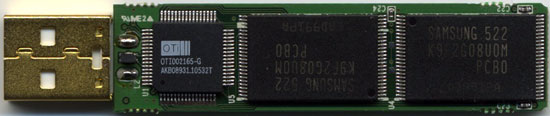
A multi-channel USB flash drive; note the presence of two flash devices to the right of the OTi controller.
The performance boost for a dual channel drive over a single channel drive depends a lot on the type of flash used as well as the controller itself. In many cases, however, a dual channel drive can be up to 2x as fast as a single channel drive.
Most physically larger drives that are branded as high performance drives are dual channel solutions, even if they aren't marketed as such. The cheaper drives end up being single chip/single channel, and of course, the small form factor drives end up being single chip/single channel as well.
Originally published at https://www.anandtech.com/show/1807 (Wayback Machine).