
ATI’s Crossfire: Best Overclocker on the Market?
- Posted in
- CPUs
Basic Features: ATI Crossfire AMD Reference Board
It is almost heresy to call the options and adjustments on the Crossfire AMD "Basic Features", since they are clearly the best that we have ever seen on any AMD motherboard. The DFI nForce4 Ultra and SLI boards have quickly developed a reputation for offering the enthusiast every imaginable BIOS option. We mention the DFI only to put in perspective that the ATI offers 2 more memory adjustments not found on the DFI, a wider range of vDIMM to 4.0V, and even more controls to tweak the performance of the motherboard. It is clear that ATI has worked with a lot of enthusiasts in refining the Crossfire AMD - it shows in the depth and breadth of available options.
At the other end of the spectrum, ATI also offers automatic overclocking options in the BIOS for those uncomfortable with manual overclocking. You can dial in 1% to 15% overclocking and the board handles all the adjustments for you.
You may have noticed that the Gigabyte that we previewed several months ago controlled Crossfire with a "paddle board" similar to what we are accustomed to on NVIDIA. The AMD Reference Board does not use a paddle-card and all switching is done in the BIOS. In fact, the AMD Reference Board is capable of full auto-switching of single or dual video cards with no adjustments required in the BIOS if left in "Auto" mode. A number of video switching options are available to motherboard manufacturers.
| ATI Crossfire AMD Reference Board | |
| CPU Interface | Socket 939 Athlon 64 |
| Chipset | ATI RD480 Northbridge - ATI SB450 Southbridge |
| Bus Speeds | 200 to 500MHz in 1MHz Increments |
| Memory Speeds | DDR200,266,333,366,400,433,466,500 |
| PCIe Speeds | 100 to 200MHz in 1MHz increments |
| PCI/AGP | Fixed at 33/66 |
| Core Voltage | Auto, 0.825V to 1.55V in 0.025V increments PLUS .0V to 0.6V in 0.02V increments (Maximum vCore 2.15V) |
| CPU Clock Multiplier | 4x-25.5x in 0.5X increments |
| DRAM Voltage | Auto, 2.5V to 3.0V in .02V increments 3.0V to 4.0V in .05V increments (Maximun Memory Voltage 4.0V) |
| HyperTransport Frequency | 1000MHz (1GHz) |
| HyperTransport Multiplier | Auto, 1X to 5X |
| HyperTransport Voltage | 1.22V, 1.29V, 1.39V, 1.5V |
| Xpress 200 Voltage | 1.22V, 1.29V, 1.39V, 1.5V |
| PCIe 1.2 Voltage | 1.22V, 1.29 V, 1.39 V, 1.5V |
| PCIe 1.8 Voltage | 1.8V, 1.9V |
| Auto Overclocking | 1% to 15% |
| Memory Slots | Four 184-pin DDR DIMM Slots Dual-Channel Configuration Regular Unbuffered Memory to 4GB Total |
| Expansion Slots | 2 PCIe x16 2 PCI Slots |
| Onboard SATA/RAID | 4 SATA Drives by SB450 (RAID 0, 1, JBOD) 2 SATA II Drives by Sil 3231 |
| Onboard IDE/IDE RAID | Two Standard ATA133/100/66 (4 drives) |
| Onboard USB 2.0/IEEE-1394 | 8 USB 2.0 ports supported by SB450 2 1394 Firewire by VIA |
| Onboard LAN | Gigabit PCIe Ethernet by Marvel 88E8052 |
| Onboard Audio | Azalia HD Audio by Realtek ALC880 |
| BIOS | AMI Build 50 and Award Build 54 |
It is almost heresy to call the options and adjustments on the Crossfire AMD "Basic Features", since they are clearly the best that we have ever seen on any AMD motherboard. The DFI nForce4 Ultra and SLI boards have quickly developed a reputation for offering the enthusiast every imaginable BIOS option. We mention the DFI only to put in perspective that the ATI offers 2 more memory adjustments not found on the DFI, a wider range of vDIMM to 4.0V, and even more controls to tweak the performance of the motherboard. It is clear that ATI has worked with a lot of enthusiasts in refining the Crossfire AMD - it shows in the depth and breadth of available options.
At the other end of the spectrum, ATI also offers automatic overclocking options in the BIOS for those uncomfortable with manual overclocking. You can dial in 1% to 15% overclocking and the board handles all the adjustments for you.
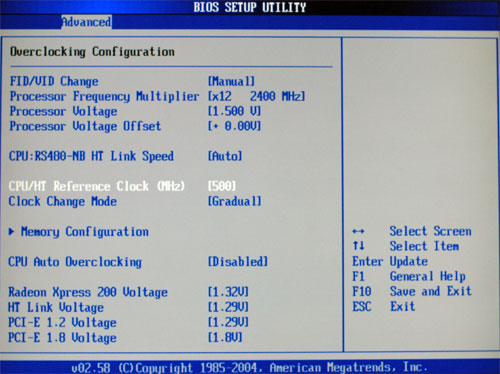
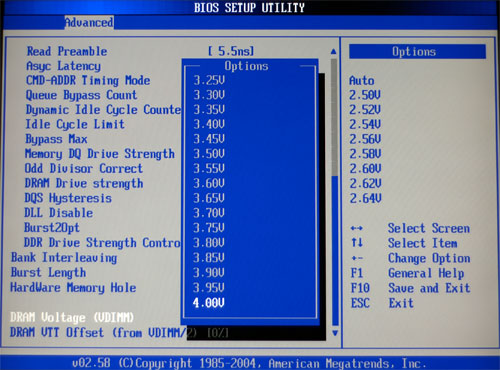

Click to enlarge.

Click to enlarge.
You may have noticed that the Gigabyte that we previewed several months ago controlled Crossfire with a "paddle board" similar to what we are accustomed to on NVIDIA. The AMD Reference Board does not use a paddle-card and all switching is done in the BIOS. In fact, the AMD Reference Board is capable of full auto-switching of single or dual video cards with no adjustments required in the BIOS if left in "Auto" mode. A number of video switching options are available to motherboard manufacturers.
Originally published at https://www.anandtech.com/show/1800 (Wayback Machine).