Power, Heat and Noise
Power
When testing the power usage of this card, we found that it wasn't nearly as power-hungry as the EVGA e-GeForce 7800 GTX KO. This is worth mentioning because of the match in performance between the two. As you can see, at the factory clock of 490MHz and 1.3GHz, we measured the power load at 274 watts; the same as the BFG GeForce 7800 GTX OC out of the box. When we overclocked the card to 500MHz and 1.32HGz, we get a power load of 277 watts, the same as the overclocked MSI NX7800 GTX. For reference, the power load was 148 watts while the system was idle.
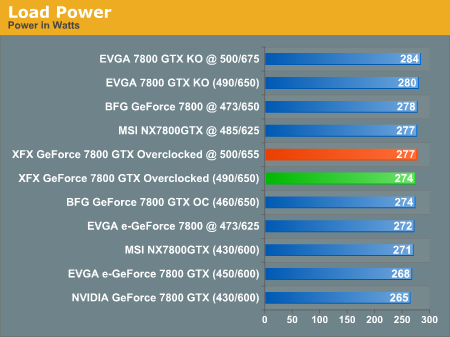
Keep in mind that the way we test the power usage of these cards is by measuring the wattage of the entire system at the wall outlet, then comparing the differences. These numbers don't represent the exact wattage of the graphics cards. Rather, they are simply meant to give us a general idea of how much power a card generates at different speeds.
Heat
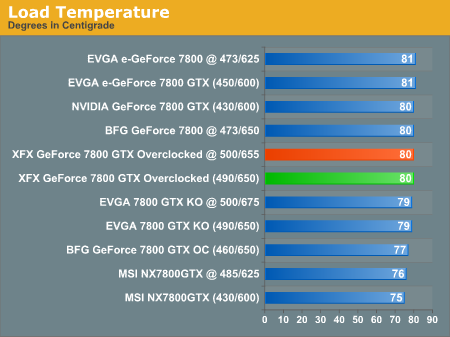
As it turns out, this card did run a bit on the hot side. It ran slightly hotter than the EVGA e-GeForce 7800 GTX KO, though it was only a degree warmer. 80 C puts it in a tie for hottest card with the non-KO eVGA and the overclocked BFG 7800 GTX. We suspected that it would generate more heat in relation to the other cards because of the higher overclock, but it wasn't really much worse. It may not do as well as the EVGA KO in hotter climates because of the unmodified heat sink, but the single degree difference is tough to call significant. MSI of course continues to lead the temperature category, though again a 2 degrees C difference isn't huge. For reference, the idle temperature for the card was 47 degrees C.
Noise
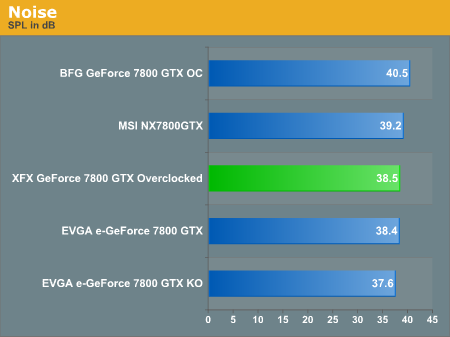
As with most of these cards, we didn't notice anything remarkable about how much noise the card made. In relation to the other 7800's, we see that it falls somewhere in the middle, but leans a little more toward the quieter cards. Again, it will be very difficult to tell a difference in the loudness of these cards simply by ear, but we feel that it's worth seeing how these cards compare to each other in as many areas as we can.
