
Intel NUC11TNBi5 and Akasa Newton TN Fanless Case Review: Silencing the Tiger
Networking and Storage Aspects
Networking and storage are aspects that may be of vital importance in specific PC use-cases. The Intel NUC11TNKi5 comes with a 2.5 GbE port that carries over to the Newton TN build too. However, the WLAN solution - Intel Wireless AX201 - needs an additional purchase. An U.FL IPEX MHF4 to RP-SMA antenna connector adapter cable bundled with Wi-Fi antennae (such as the one here) is needed. The WLAN interface is available to the OS even without this add-on, but the signal pick up is too weak to be of any practical use. The Newton TN has antenna holes in the rear panel to accommodate the RP SMA connector.
On the storage side, our review sample of the NUC11TNKi5 was configured with a high-performance Samsung SSD 980 PRO. We carried that over to the fanless Newton TN build. From a benchmarking perspective, we provide results from the WPCstorage test of SPECworkstation 3.1. This benchmark replays access traces from various programs used in different verticals and compares the score against the one obtained with a 2017 SanDisk 512GB SATA SSD in the SPECworkstation 3.1 reference system.
| SPECworkstation 3.1.0 - WPCstorage SPEC Ratio Scores | |||
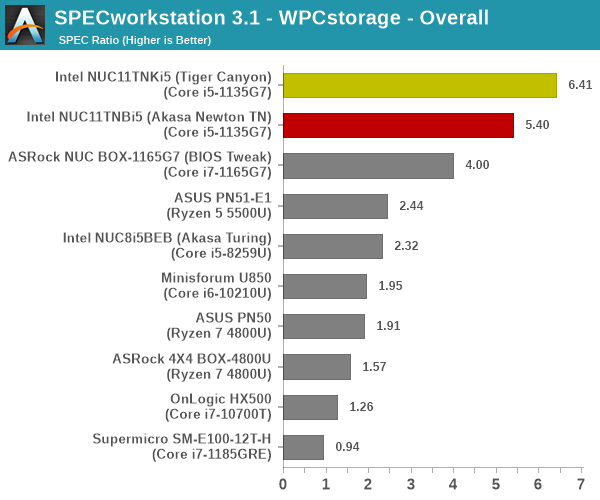
The graphs above present results for different verticals, as grouped by SPECworkstation 3.1. The storage workload consists of 60 subtests. Access traces from CFD solvers and programs such as Catia, Creo, and Soidworks come under 'Product Development'. Storage access traces from the NAMD and LAMMPS molecular dynamics simulator are under the 'Life Sciences' category. 'General Operations' includes access traces from 7-Zip and Mozilla programs. The 'Energy' category replays traces from the energy-02 SPECviewperf workload. The 'Media and Entertainment' vertical includes Handbrake, Maya, and 3dsmax. Given that the comparison is between a wide range of SSDs in the systems - including both Gen 3 and Gen 4 NVMe, as well as SATA , the relative numbers for most workloads are not surprising.
The disappointing aspect, however, is the loss of performance in moving from an actively cooled system to the passively cooled one. One would assume the cause to be SSD throttling, based on the temperatures observed in the AIDA64 SST. To get to the bottom of the issue, we ran the benchmark while monitoring key parameters with HWInfo.
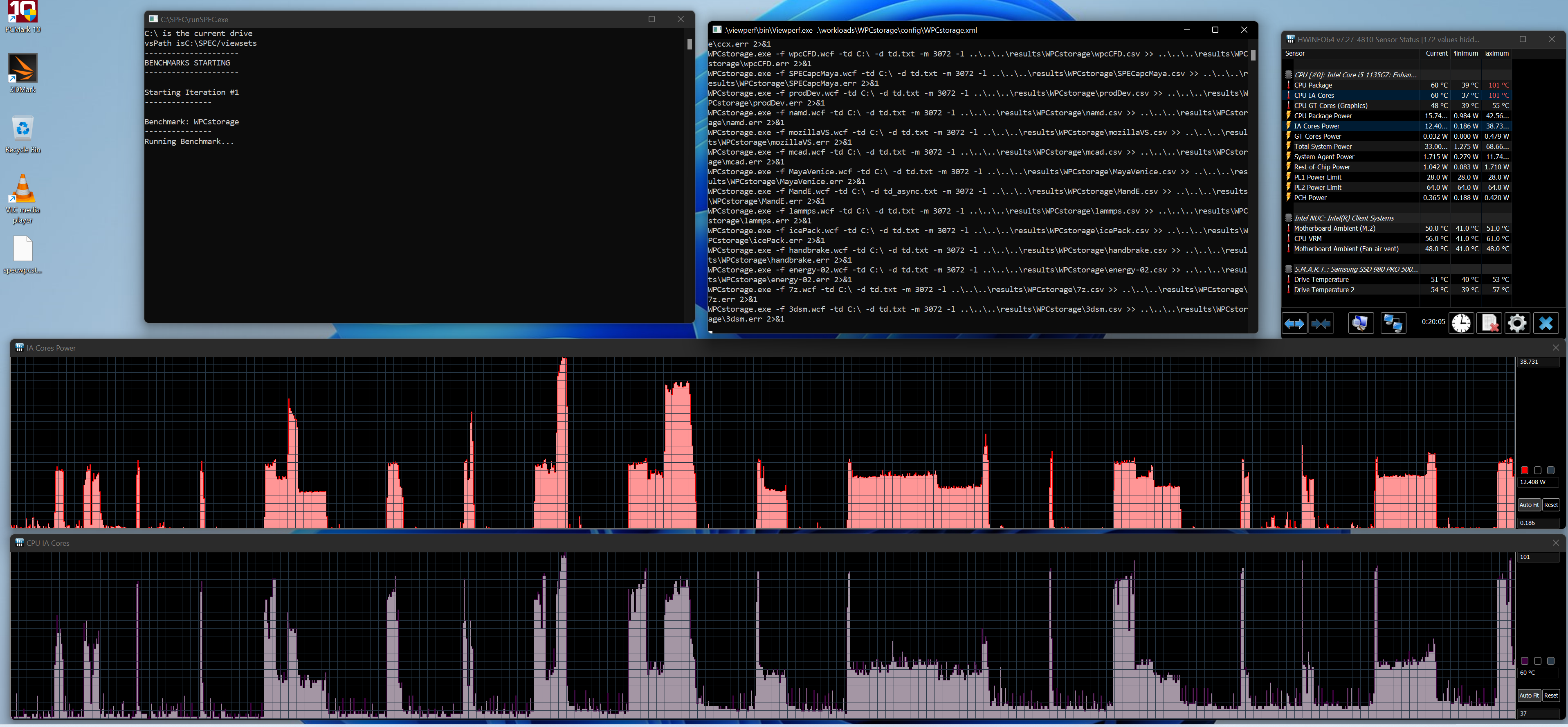
Strangely, the loss of performance appears to be due to sudden spikes in the CPU package temperature. The SSD itself remains quite cool, with a maximum of just 57C.
Originally published at https://www.anandtech.com/show/17502/intel-nuc11tnbi5-and-akasa-newton-tn-fanless-case-review-silencing-the-tiger (Wayback Machine).