
Affordable Dual Core from AMD: Athlon 64 X2 3800+
- Posted in
- CPUs
AMD's Efficiency Advantage?
Before we get to the actual barrage of performance tests, there is one issue that we have been wanting to tackle for quite some time now.AMD has often argued that their dual core architecture is inherently more efficient than Intel's, primarily because of their System Request Queue (SRQ). All core-to-core transfers occur via this queue instead of over a main, shared FSB, which is the case in the Pentium D.
Johan put AMD's architecture to the test by measuring the latency of cache-to-cache transfers in AMD's dual core chips vs. Intel's. The results were quite impressively in favor of AMD's architecture. Cache-to-cache transfers on Intel's dual core CPUs took over twice as long as on AMD's dual core CPUs, but at that time, we could not find any real world benefit to the architecture.
Armed with a bit more time, we went through all of our benchmarks and specifically focused on those that received the most performance gain from dual core architectures. Using these multithreaded and/or multitasking benchmarks, we looked at the performance improvements that the dual core processors offered over their single core counterparts. For AMD, making this comparison was easy; we took the Athlon 64 X2 3800+ and compared it to its single core equivalent, the Athlon 64 3200+. For Intel, the comparison is a bit more complicated. The inclusion of Hyper Threading makes the single-core to dual-core jump a little less impressive in some cases, thanks to the fact that virtually all single-core Pentium 4 processors these days can execute two threads simultaneously. Thus, for Intel, we had to look at HT enabled, dual core and dual core with HT enabled, all compared to single core performance to get a complete picture of Intel's multithreaded performance scaling.
Remember that all performance increases are with reference to a single core processor, and in the case of Intel, we are talking about a single core Pentium 4 with HT disabled. More specifically, we used a Pentium D 830 (3.0GHz) for the dual core tests and compared it to its single core counterpart - the Pentium 4 530 (3.0GHz).
First, we have our Winstone 2004 benchmark suite; we omitted Business Winstone 2004, since it shows virtually no performance boost from dual core CPUs and instead, focused on Multimedia Content Creation Winstone 2004 and the Multitasking Winstone tests.
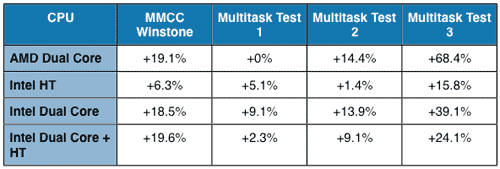
It is also worth noting that although Hyper Threading improves performance with a single core, enabling HT on the dual core CPU actually yields lower overall performance than if we had left it off (+24.1% vs. +39.1%). Johan explained exactly why situations like this exist on the Pentium D in his "Quest for More Processing Power".
Next up is the SYSMark 2004 suite. In all but two of the tests, AMD scales slightly better than Intel when going to dual core. The scaling advantages aren't huge, but they are tangible in some of the tests.
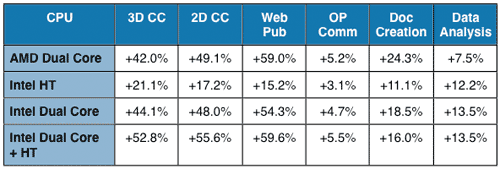
Once again, while Hyper Threading itself tends to impress, HT + dual core gives us a mixed bag of results, sometimes outperforming dual core alone while falling behind other times.
Finally, we have our application-specific benchmarks; here, we have AMD scaling better than Intel in 3 out of the 5 tests, but then in the remaining 2, Intel scales better.
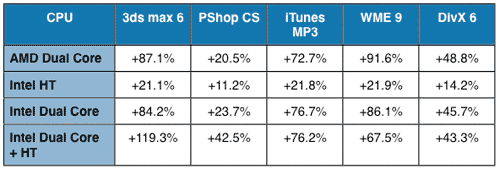
While the Athlon 64 X2 does have much better cache-to-cache transfer latencies than the Pentium D, it appears as if for the most part, those advantages don't surface in real-world desktop usage. That being the case, the Athlon 64 X2 3800+ must outperform the Pentium D 830 based on the performance advantages of its individual cores in order to win this battle, not based on any dual core architectural efficiencies. So, does it?
Originally published at https://www.anandtech.com/show/1745 (Wayback Machine).