
Supermicro SYS-E100-12T-H Review: Fanless Tiger Lake for Embedded Applications
System Performance: Miscellaneous Workloads
Standardized benchmarks such as UL's PCMark 10 and BAPCo's SYSmark take a holistic view of the system and process a wide range of workloads to arrive at a single score. Some systems are required to excel at specific tasks - so it is often helpful to see how a computer performs in specific scenarios such as rendering, transcoding, JavaScript execution (web browsing), etc. This section presents focused benchmark numbers for specific application scenarios.
3D Rendering - CINEBENCH R23
We use CINEBENCH R23 for 3D rendering evaluation. R23 provides two benchmark modes - single threaded and multi-threaded. Evaluation of different PC configurations in both supported modes provided us the following results.
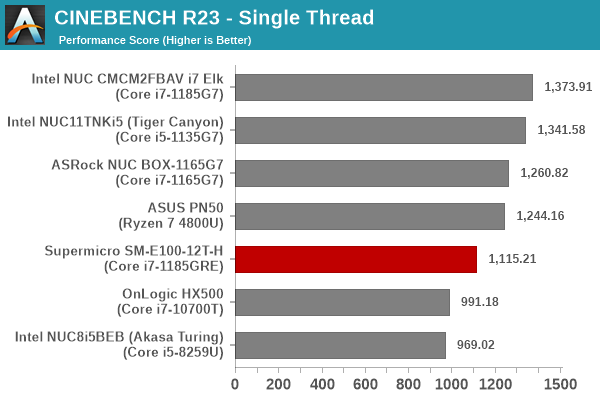
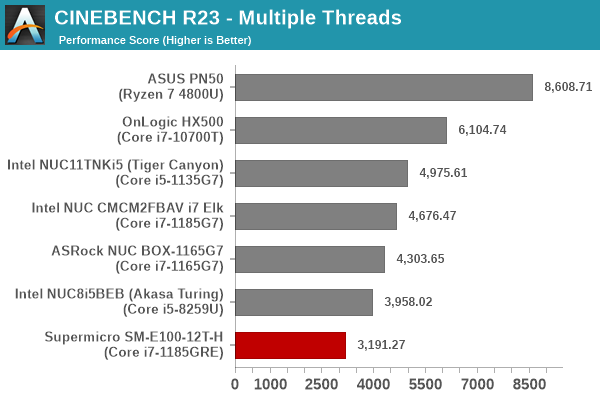
The improvement in single-threaded performance over Coffee Lake is evident in the first graph, with the SYS-E100-12T-H outclassing both the OnLogic HX500 and Bean Canyon NUC despite the higher TDP of the latter. However, with multi-threading in the picture, the extra cores and higher TDP allow them to claw back the advantage. Overall, the multi-threaded performance case is largely dictated by number of cores and the available power headroom.
Transcoding: Handbrake 1.5.1
Handbrake is one of the most user-friendly open source transcoding front-ends in the market. It allows users to opt for either software-based higher quality processing or hardware-based fast processing in their transcoding jobs. Our new test suite uses the 'Tears of Steel' 4K AVC video as input and transcodes it with a quality setting of 19 to create a 720p AVC stream and a 1080p HEVC stream.
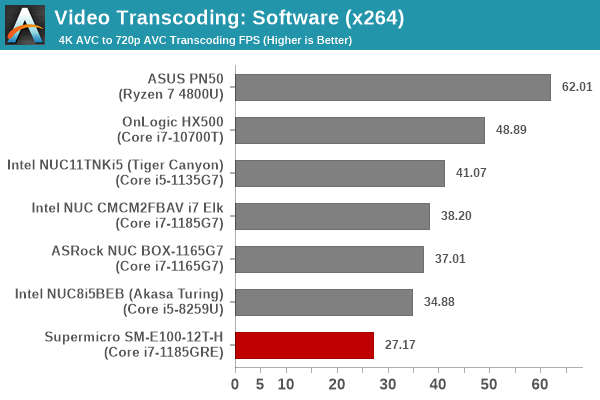
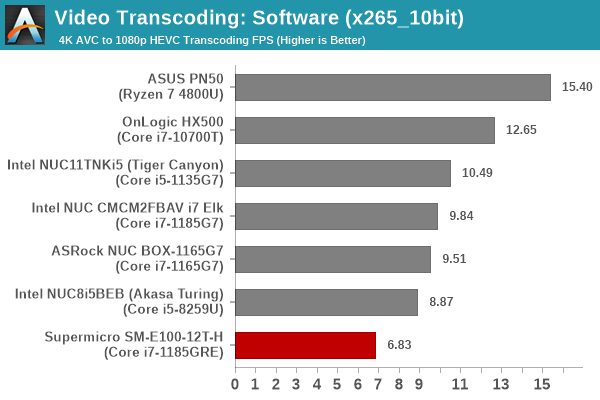
A large number of cores and high power budgets help in software transcoding. The SYS-E100-12T-H is comparatively weak in those aspects. So, it comes as no surprise that other systems edge ahead of it in both x264 and x265 encoding tasks.
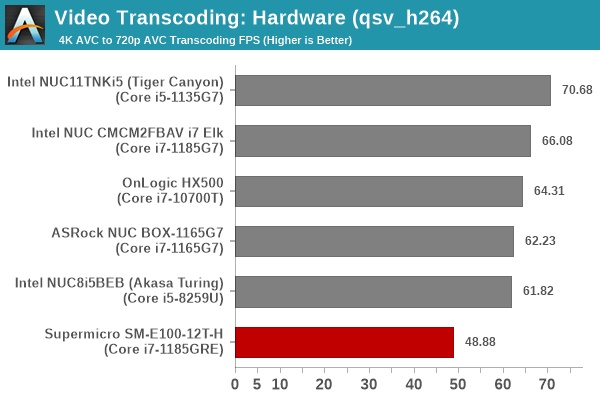
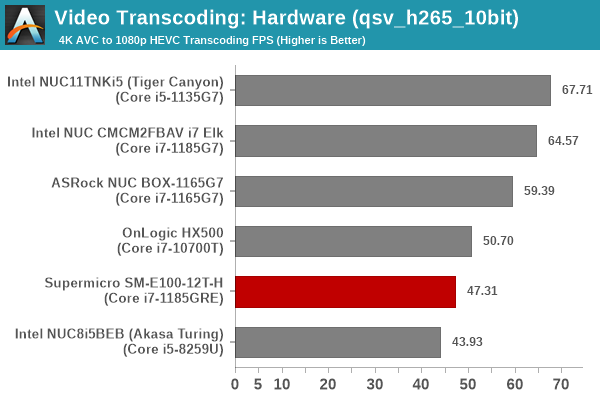
Intel seems to have made some improvements in HEVC transcoding with QuickSync in moving from Coffee Lake to Tiger Lake. We can see a slight improvement in the rate for the SM-E100-12T-H over the Bean Canyon NUC. Otherwise, while the FPS numbers are good, they are still slightly behind the numbers of other systems because of the available power budget.
Archiving: 7-Zip 21.7
The 7-Zip benchmark is carried over from our previous test suite with an update to the latest version of the open source compression / decompression software.
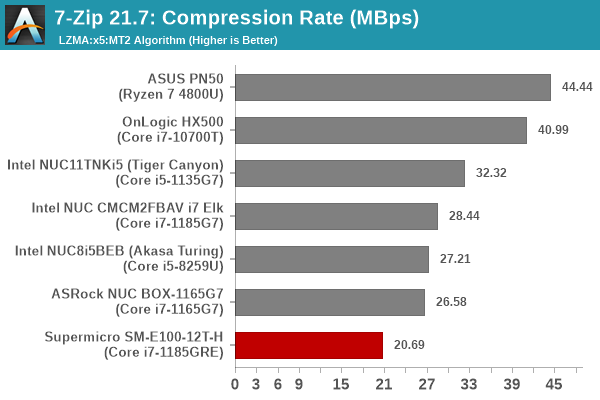
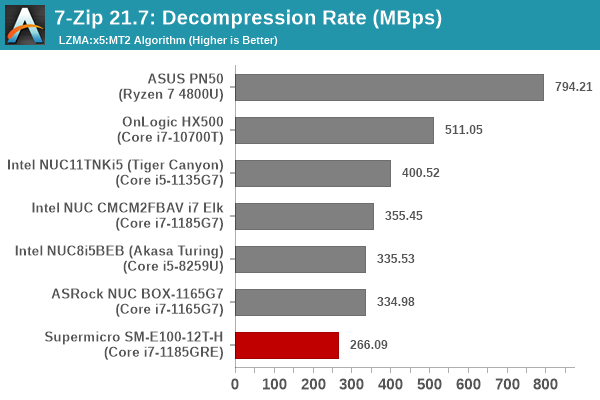
This test is again a measure of the number of cores and power budget availability. Unfortunately, the SYS-E100-12T-H is a bit weak in both aspects on a comparative basis.
Web Browsing: JetStream, Speedometer, and Principled Technologies WebXPRT4
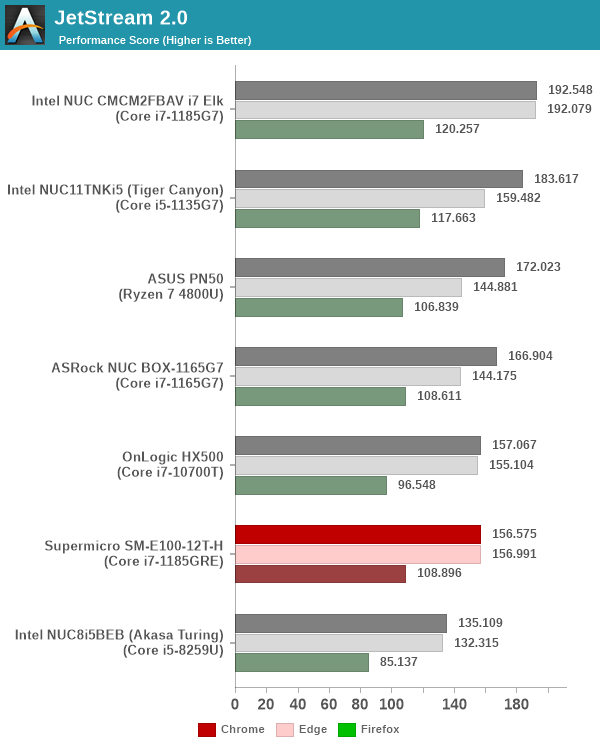
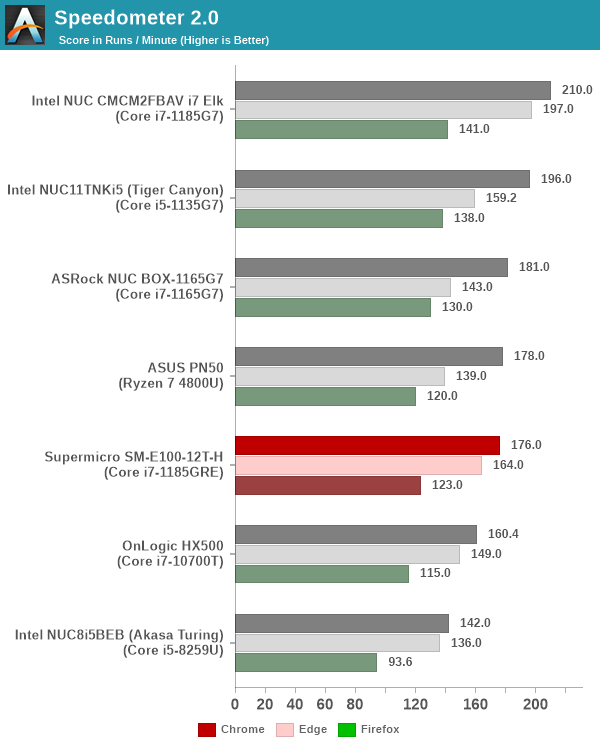
Web browser-based workloads have emerged as a major component of the typical home and business PC usage scenarios. For headless systems, many applications based on JavaScript are becoming relevant too. In order to evaluate systems for their JavaScript execution efficiency, we are carrying over the browser-focused benchmarks from the WebKit developers used in our notebook reviews. Hosted at BrowserBench, JetStream 2.0 benchmarks JavaScript and WebAssembly performance, while Speedometer measures web application responsiveness.
From a real-life workload perspective, we also process WebXPRT4 from Principled Technologies. WebXPRT4 benchmarks the performance of some popular JavaScript libraries that are widely used in websites.
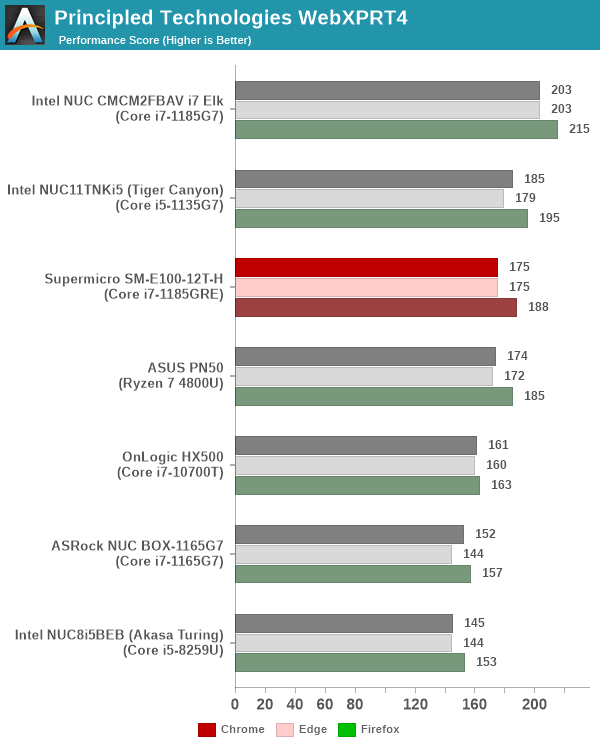
The Tiger Lake-based systems round out the top spots in the real-world workloads, while the gap with other systems in the artificial JetStream and Speedometer tests is relatively narrow.
Application Startup: GIMP 2.10.30
A new addition to our systems test suite is AppTimer - a benchmark that loads up a program and determines how long it takes for it to accept user inputs. We use GIMP 2.10.30 with a 50MB multi-layered xcf file as input. What we test here is the first run as well as the cached run - normally on the first time a user loads the GIMP package from a fresh install, the system has to configure a few dozen files that remain optimized on subsequent opening. For our test we delete those configured optimized files in order to force a fresh load every second time the software is run.
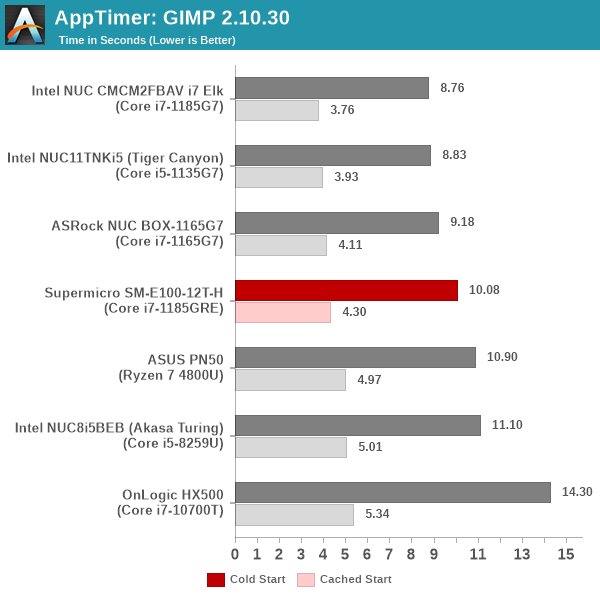
As it turns out, GIMP does optimizations for every CPU thread in the system, which requires that higher thread-count processors take a lot longer to run. So the test runs quick on systems with fewer threads, however fast cores are also needed. This combination works out well for the Tiger Lake-based systems, as they grab the top spots in this workload.
Originally published at https://www.anandtech.com/show/17424/supermicro-syse10012th-review-fanless-tiger-lake-for-embedded-applications (Wayback Machine).