
Athlon 64 Revision E: Unofficial DDR500 Support
- Posted in
- CPUs
The Test
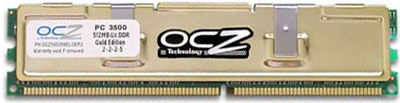
As we’ve already mentioned, we used the DFI LANParty UT nForce4 Ultra-D motherboard, with the 704 BIOS installed to enable support for the new memory dividers.Our memory of choice was the OCZ PC3500 Gold Edition GX, which can run at up to DDR500 at 2-2-2-5 timings at 3.3V. The beauty of this memory is that we can run at the same memory timings from DDR400 all the way up to DDR500, which is exactly what we wanted for this review.
We picked the X2 4800+ to see if the fastest dual core CPU can use the extra memory bandwidth. We chose the X2 4200+ to see if a reduction in L2 cache made the extra memory bandwidth more useful. And finally, we used the FX-57 to see if the highest stock clocked Athlon 64 processor could put the extra memory bandwidth to use.
Our usual CPU test suite was reduced significantly in order to weed out applications that would definitely not show any performance improvement. If you don’t see a particular test here that we’ve used in the past, it’s most likely because it showed an even smaller improvement than what we’ve seen here. This wasn’t done to make the new memory dividers look better, but rather to make the testing more manageable; once you see the results, you’ll understand why just focusing on this small sample is more than enough to get a good idea of how the performance will be impacted as a whole.
We used the latest nForce 6.53 and ForceWare 77.72 drivers for our test bed, and paired it with the newly released GeForce 7800 GTX.
Originally published at https://www.anandtech.com/show/1731 (Wayback Machine).