
Athlon 64 Revision E: Unofficial DDR500 Support
- Posted in
- CPUs
Enabling Support for the new Dividers
BIOS support for the new dividers must be enabled by your motherboard manufacturer. Apparently, AMD has been sharing the information with motherboard manufacturers if they ask, on how to implement it, but it is not given out by default.For our tests, we used DFI’s LANParty UT nForce4 Ultra-D, whose 704_22V6 BIOS dated 7/06/2005 supports the new dividers.
Not all of the configurations are supported by the LANParty UT nForce4 Ultra-D. Below is a table of what is supported by the board:
| CPU | Clock Speed | Memory Dividers Supported by the DFI nF4 Ultra-D | |||
| 13/12 | 7/6 | 5/4 | 4/3 | ||
| AMD Athlon 64 FX-57 | 2.8GHz | 215MHz | - | 233MHz | - |
| AMD Athlon 64 3800+ | 2.4GHz | - | 218MHz | 240MHz | - |
| AMD Athlon 64 3500+ | 2.2GHz | - | 220MHz | 244MHz | - |
| AMD Athlon 64 3200+ | 2.0GHz | - | 222MHz | 250MHz | - |
| AMD Athlon 64 X2 4800/4600+ | 2.4GHz | - | 218MHz | 240MHz | - |
| AMD Athlon 64 4200/4400+ | 2.2GHz | - | 220MHz | 244MHz | - |
The dividers appear in the BIOS based on your selected clock speed, and appear as both an estimated DDR frequency as well as the actual memory divider that you are selecting. Because of the variation in actual DDR frequency, the estimated frequency is often wrong. For example, the FX-57 using the 5/4 divider results in a DDR466 speed, while the BIOS incorrectly refers to the 5/4 divider as enabling DDR500.
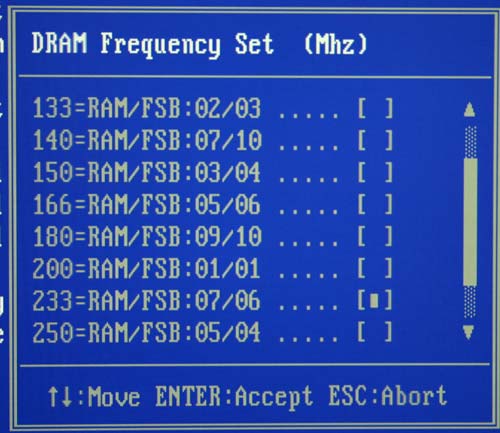
There are other motherboards with BIOS support for these new dividers, such as the ABIT Fatal1ty AN8-SLI with its latest BIOS. You can expect most enthusiast motherboard manufacturers to follow suit, if they haven’t already.
Originally published at https://www.anandtech.com/show/1731 (Wayback Machine).