
HP L2335: Low Response Time and High Resolution LCD
- Posted in
- Displays
Internals
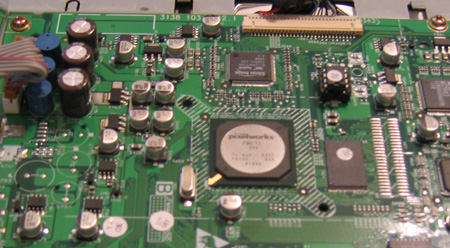
After benchmarking both monitors, we opened them up to get a more in-depth look at the individual apparatuses. As a general disclaimer, we suggest that you do not open your displays as you will certainly void the warranty and probably destroy the panel.Like in most big displays (with the exception of the Apple Cinema displays), the inverter is housed inside the display. You can see it below on the left side of the image. You'll notice a Silicon Image chipset controlling the DVI interface and another one for the TMDS controller (near the top). The L2335 also features a PixelWorks PW172 digital signal processor; a chipset found almost exclusively in this LCD. PixelWorks did a good job emulating almost all of the exact same features found on the Genesis gm1601, but there is no split screen capability.

Click to enlarge.
LG.Philips LCD LM230W02
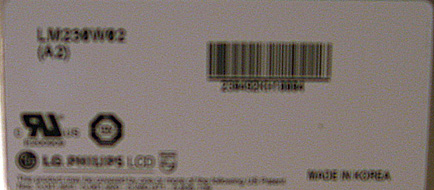
LG.Philips recently redesigned their website, and it's worth exploring around for a few minutes if you have some time. The LG.Philips LCD LM230W02 is something that we have mentioned a few times already in the review; no surprise, given the company's track record.The largest difference between the LM230W02 panel and a panel that we have looked at in the past (like the LM201W01 featured in the Dell 2005FPW) is the move from Low Voltage Differential Signaling (LVDS) to Transition Minimized Differential Signaling (a Silicon Image technology). Like the LM201W01, this panel boasts a 7ms Tr and 9ms Tf response time and 12ms gray-to-gray transient average times. Here is another interesting PDF documenting some of the really low level features of the display. Page 18 is probably the most useful page, documenting the specific gray-to-gray response times for various hues.
Originally published at https://www.anandtech.com/show/1729 (Wayback Machine).