
The Quest for More Processing Power, Part Three: "Multi core of Intel and AMD compared"
- Posted in
- CPUs
...and why SMT can be impressive!
If you want to know what is going to happen in the future, it is always a good idea to look at the big iron. After all, many of the techniques that are now popular in low budget x86 CPUs originated from there: SIMD (Cray-1, ILLIAC IV), 64 bit (MIPS R4000) and CMP (IBM Power 4) are just a few examples.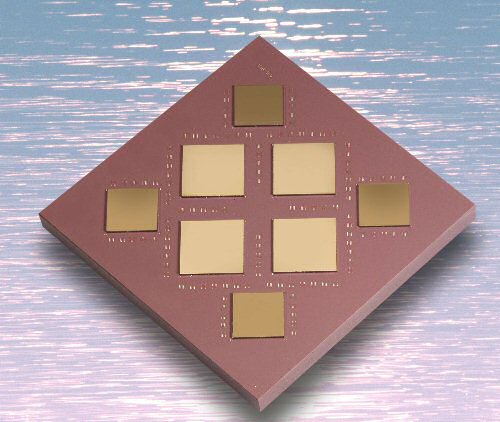
This SMT makes much more effective use of processor resources than multi-core. If only one thread is running, and there is a lot of instruction level parallelism, it has all the execution resources to its disposal and the CPU acts as a massive parallel superscalar CPU. If two or more threads are running, they can make optimum use of the available execution slots. For each percentage that the die size increases, SMT gives you more than one percentage of performance back. In contrast, a second core doubles the die size, but rarely improves performance with more than 70%. SMT can be a superb feature to boost the performance of a multi-core CPU without increasing the die size too much.
Bringing it all together...
Intel and AMD are playing different trump cards while getting their next generation of quad core designs ready for the server market. It is clear, however, that clock speed will only increase slowly, and will no longer be the most important performance indicator.Intel can leverage their experience with the power saving features of the P-m to design quad core CPUs with remarkably low TDP. SMT might well be one of Intel’s most important weapons to enable relatively high IPC per core. The fact that the current implementation called Hyperthreading offers only mediocre performance improvements is not a reason to believe that SMT will not have a bright future. SMT added to a high IPC core might even give Intel the edge in the server market. The shared L2-cache in the next generation multi-core CPUs (Merom, Conroe, Woodcrest, Whitefield) should also eliminate Intel’s high cache to cache latency.
AMD’s current dual core architecture is vastly superior to Intel’s. The more than twice as fast cache-to-cache communication does not pay off in all multithreaded applications, but it should give AMD a scaling advantage in OLTP and some rendering and HPC applications. It will be very easy for AMD to make communications between the cores even faster, by attaching a shared L2-cache to the SRQ. AMD can also leverage their knowledge and experiences with the on die northbridge to lower the latency and increase the bandwidth of the memory subsystem.
I like to express my thanks to the following people who helped to make this article possible:
- Michael S.
- Matty Bakkeren, Trevor E. Lawless, Markus Weingartner and Christian Staudinger (Intel)
- Anand Lal Shimpi
- Chris Rijk (Ace’s hardware)
- David Van Dromme (Iwill Benelux Helpdesk)
- Ruben Demuynck (Technical University Kortrijk)
References
[1] Hyper-Threading Technology Architecture and Microarchitecturehttp://www.intel.com/technology/itj/2002/volume06issue01/art01_hyper/p01_abstract.htm
Originally published at https://www.anandtech.com/show/1685 (Wayback Machine).