
IDF Spring 2005 - Day 3: Justin Rattner's Keynote, Predicting the Future
- Posted in
- Trade Shows
The Super Resolution demo
With the proliferation of broadband comes the increase in expectations for the quality of media you find on the internet. Unfortunately, not everyone has a good digital camera and not everyone has a good digital video camera. Especially with more and more cell phones coming with integrated cameras, movies made on them are usually pretty poor quality when viewed at 2x their size.
At the same time, we've all seen TV shows like 24 or CSI where someone sitting at a keyboard can simply "sharpen that up" and make even the blurriest, lowest resolution image clear enough to pick out someone's face. We all usually scoff at the idea and complain about how unrealistic things like that are, but in reality, there is some truth to what's going on.
There are a set of algorithms that look at images and perform motion analysis on a pixel basis as well as statistical analysis on a per frame basis to help enhance the resolution of an image or a movie. In today's keynote, this technique is referred to as Super Resolution (no comment).
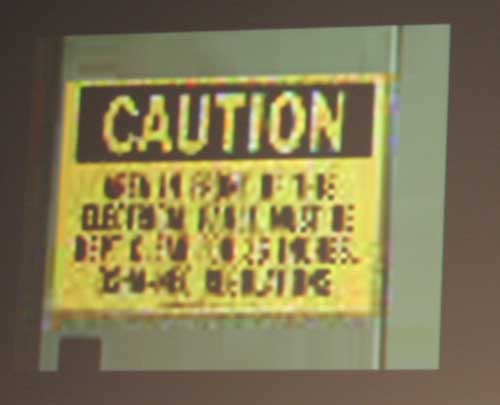
The demo was of a loop of about 3 seconds of low resolution video of a caution sign, you can see the original video cap below:
Take on a camera phone, the video was then cleaned up using these Super Resolution techniques to result in the following:
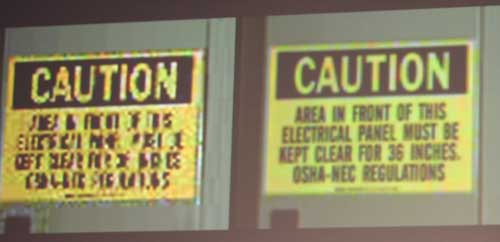
The results were nothing short of impressive - but why the demo? It took the current generation microprocessors about 1 minute to clean up that 3 second video, to do a full length conversion on more difficult material would require around 1000x the compute power current platforms offer. Rattner used Super Resolution as an example of what multi-core CPUs by 2015 will be able to enable.
Originally published at https://www.anandtech.com/show/1635 (Wayback Machine).