
IDF Spring 2005 Day 1 - Gelsinger Speaks, nForce4 Intel and more
- Posted in
- Trade Shows
Parallelism, Parallelism, Parallelism
Pat has been on a parallelism kick for a long time now, when AMD was talking about 64-bit and on-die memory controllers, all Pat was interested in was parallelism, more specifically, thread level parallelism. It’s taken a few years but Pat is finally seeing his exciting technology come to fruition given that next year Intel expects 80% of its total shipments to be multi-core enabled.
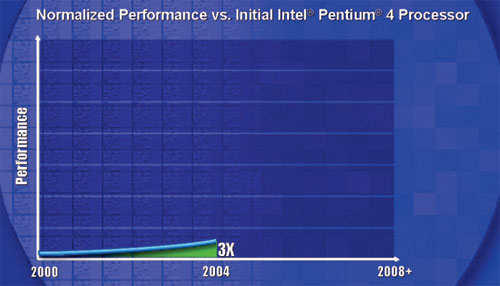
Pat put together an interesting graph showing the performance boost we’ve seen during the lifetime of the Pentium 4 from inception to present day, showing that the current generation Pentium 4 is about 3x the speed of the first Pentium 4:
Assuming heavy adoption of multithreaded software and workloads, this is where Pat sees performance going in the future due to multi-core:
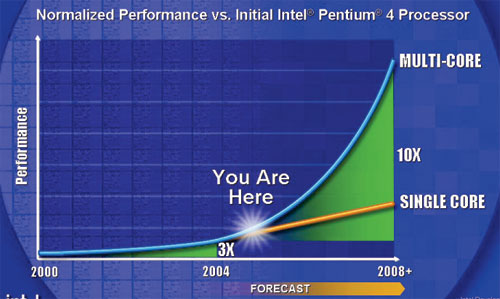
It’s a very optimistic chart, but Pat Gelsinger isn’t one to exaggerate. Given that the entire industry is behind multi-core CPUs, it wouldn’t be too far fetched to see significant performance gains due to multi-core between now and the end of the decade.
We mentioned before that Intel predicted 8-thread CPUs by the end of the decade, but now we have some more information about that prediction thanks to Pat’s presentation:
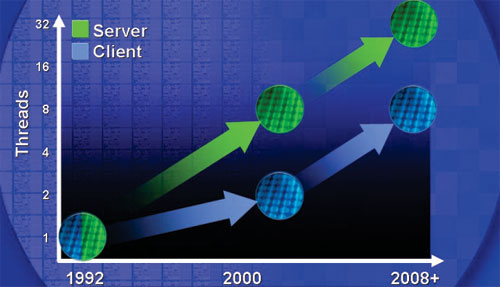
In mainstream client PCs, Intel will be shipping CPUs capable of executing two simultaneous threads in 2005; these will be the Pentium D (dual core) and the regular Pentium 4 with Hyper Threading (2 logical processors). Note that Intel isn’t including the Pentium Extreme Edition in this figure which is able to execute 4 threads simultaneously, as it is not a mainstream client processor. On the server side Intel is targeting 8 threads per CPU in 2005/2006.
Towards the end of the decade, Intel is pushing for 8 threads on clients - most likely meaning that mainstream PCs will have four independent cores, each with Hyper Threading technology (or 8 simpler cores instead). And on the server, we’re looking at 32 threads per chip by the end of the decade.
Originally published at https://www.anandtech.com/show/1632 (Wayback Machine).