
Price Guides November 2004: Video and Memory
- Posted in
- Guides
Video Cards - ATI
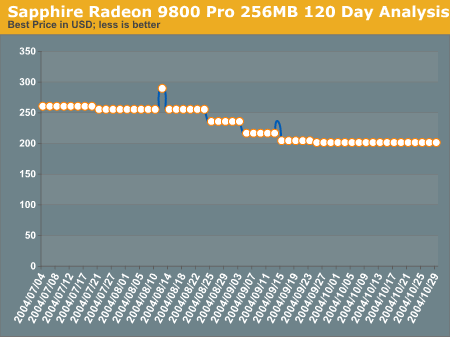
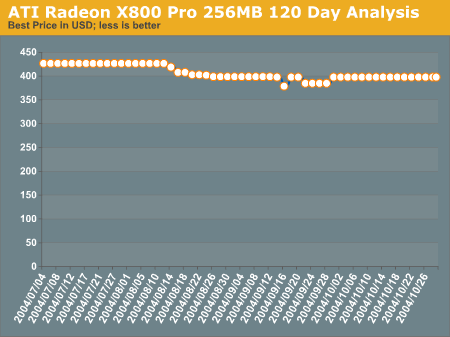
ATI and NVIDIA have been back and forth over the performance crown in graphics cards for quite some time and, while there can't be any definite "winner" with the number of variables involved, the competition has made for some great advances, which all translate into a better gaming experience for the masses.Cards such as the Sapphire Radeon 9800 Pro 256MB may seem to be getting a little long in the tooth, but they are still speedy, reliable and affordable. All of these attributes make for a great combination for a well-powered gaming rig. It's true that you could spring for an X800 and get a performance increase about twofold, but the price for that luxury scales right along, and with the supply of these newer cards still limited, they can reach prices in excess of $500. Don't take that the wrong way though. If you have the money, a card like the X800 Pro or Platinum is definitely the way to go to get the most performance that money can buy. In time, these prices will come down like is always the case with bleeding-edge technology as it matures, but it will certainly be a while until we can find X800's in the $200 range.
If you're gaming on a budget, then we do still recommend the Sapphire Radeon 9600XT. With completely acceptable performance in titles like UT2004, Battlefield: 1942, and even newer beasts like Far Cry, the 9600 still has some life left in it, albeit not for too much longer. The X700 and even X600 are both poised to take over the budget market as PCI Express continues to penetrate the desktop environment. As PCI Express becomes more readily available and affordable, expect the best options for ATI graphics to start with an "X".
When building a system for anything but gaming or anything else too graphically intensive, onboard video is often the poison of choice. However, even in non-gaming systems with the best components, you may find yourself in a situation where onboard video isn't available. In such a case, the ATI Radeon 9000 (64MB version) is a very cost-effective solution. At less than $40, you shouldn't expect amazing gaming performance, but eye candy (courtesy of Windows XP) and the likes will not be a lagging problem. Before anyone says that this kind of card is overkill for someone who isn't gaming, keep in mind that as operating systems mature, so do their graphical interfaces. It won't be long before Windows will require a DX9 capable card just for basic operations. Also, try running Windows XP on a Voodoo 3 2000 PCI and see how well the login screen lags when hovering from account to account. It quickly becomes apparent that 2D support is not as wimpy as it once was.
Originally published at https://www.anandtech.com/show/1527 (Wayback Machine).