
The AMD Radeon RX 5500 XT Review, Feat. Sapphire Pulse: Navi For 1080p
Synthetics
While we’ve already had our an in-depth at Navi with the launch of the RX 5700 series earlier this year, new GPUs within the family sometimes expose bottlenecks that we haven’t seen before. So our synthetic tests can help to highlight these bottlenecks, as well as any other changes that the GPU designers may have made in the process of scaling down their GPUs.
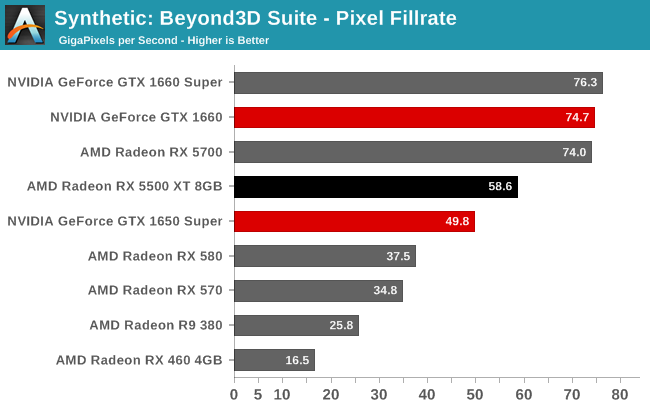
The RX 5500 XT does surprisingly well in our pixel fillrate benchmark. Even though it only has half the ROPs and half of the memory bandwidth of the more powerful RX 5700, it’s able to deliver ~79% of the pixel fillrate in this test. This is much better than I was expecting. It may be a sign that AMD’s ROP partitions aren’t seeing great scaling from 32 to 64 pixels per clock, or alternatively that AMD has made some significant efforts in keeping the RX 5500 XT from diving too hard due to its more limited resources.
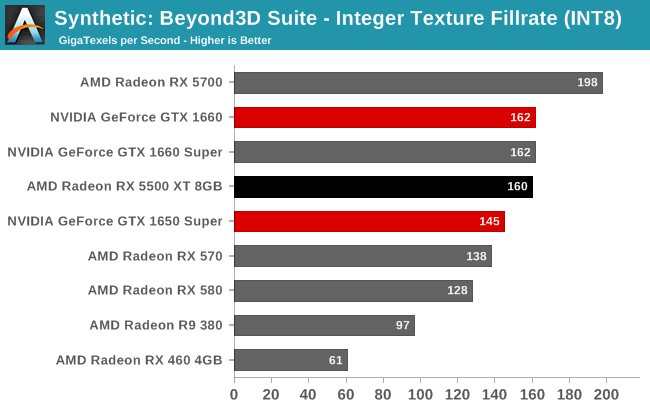
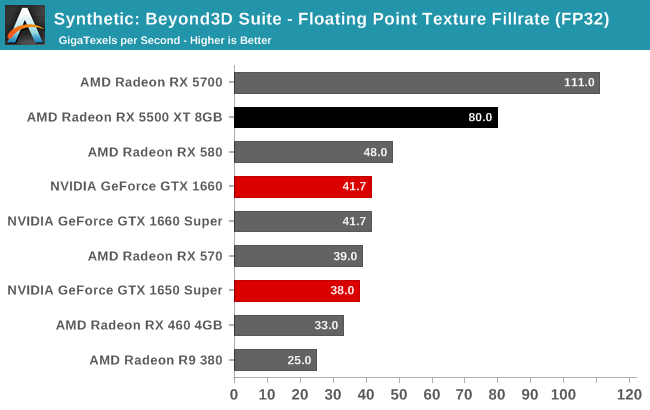
Meanwhile texture fillrates are more in line with our expectations. The RX 5500 XT has 14 fewer CUs than the RX 5700 but a slightly higher clockspeed, and its results reflect that.
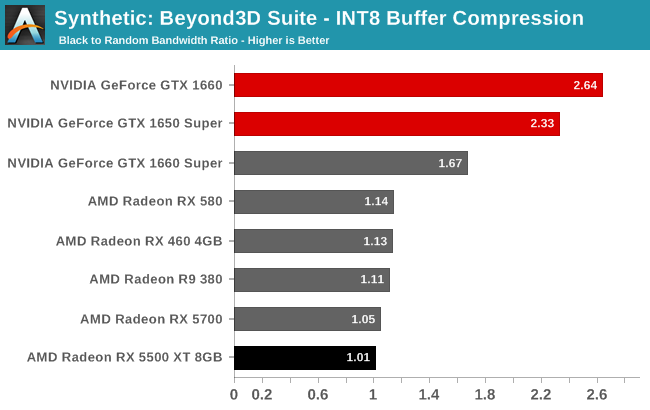
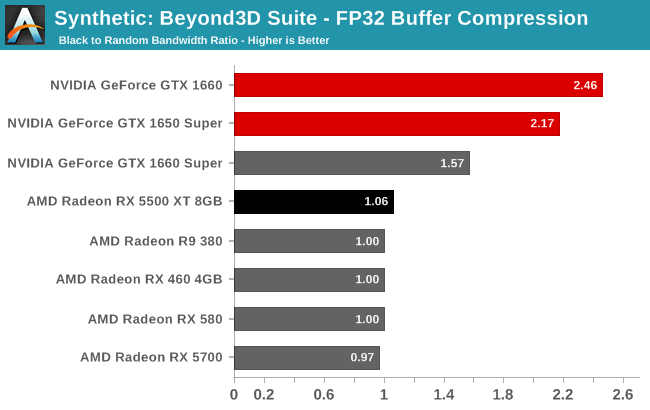
Our buffer compression ratios are also relatively consistent with what we’ve seen on the RX 5700 cards. AMD does have capable delta color compression technology; however it seems to struggle under intensive synthetic workloads. Under lighter workloads we see better compression ratios, but lower throughput overall.
Originally published at https://www.anandtech.com/show/15206/the-amd-radeon-rx-5500-xt-review (Wayback Machine).