
The TeamGroup L5 LITE 3D (480GB) SATA SSD Review: Entry-Level Price With Mainstream Performance
Mixed I/O Performance
Our tests of mixed read/write IO vary the workload from pure reads to pure writes at 10% increments. Each mix is tested for up to 1 minute or 32GB of data transferred. The mixed random IO test uses a queue depth of 4 while the mixed sequential IO test uses a queue depth of 1. The tests are confined to a 64GB span of the drive, and the drive is given up to one minute of idle time in between each mix tested.
 |
|||||||||
| Mixed Random IO | Mixed Sequential IO | ||||||||
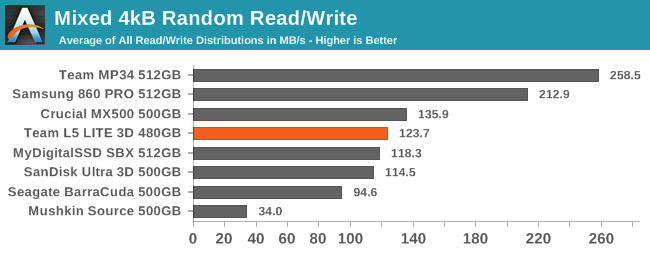
The mixed sequential IO performance of the TeamGroup L5 LITE 3D is as good as any other SATA drive, and on the mixed random test it's only slightly slower overall than the Crucial MX500, the fastest TLC SATA drive in this bunch.
 |
|||||||||
| Mixed Random IO | Mixed Sequential IO | ||||||||
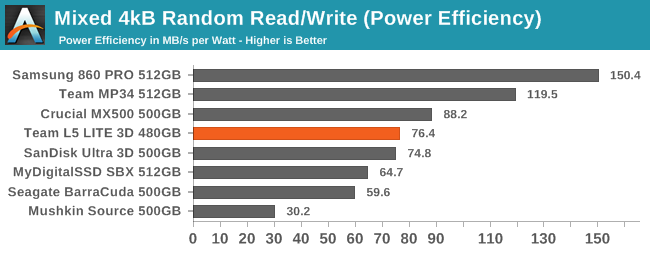
The power efficiency of the L5 LITE 3D during the mixed IO tests is average or slightly better. In both cases there's a TLC SATA drive with a substantial efficiency advantage, and the Samsung 860 PRO sets a high bar for efficiency.
 |
|||||||||
| Mixed Random IO | |||||||||
| Mixed Sequential IO | |||||||||
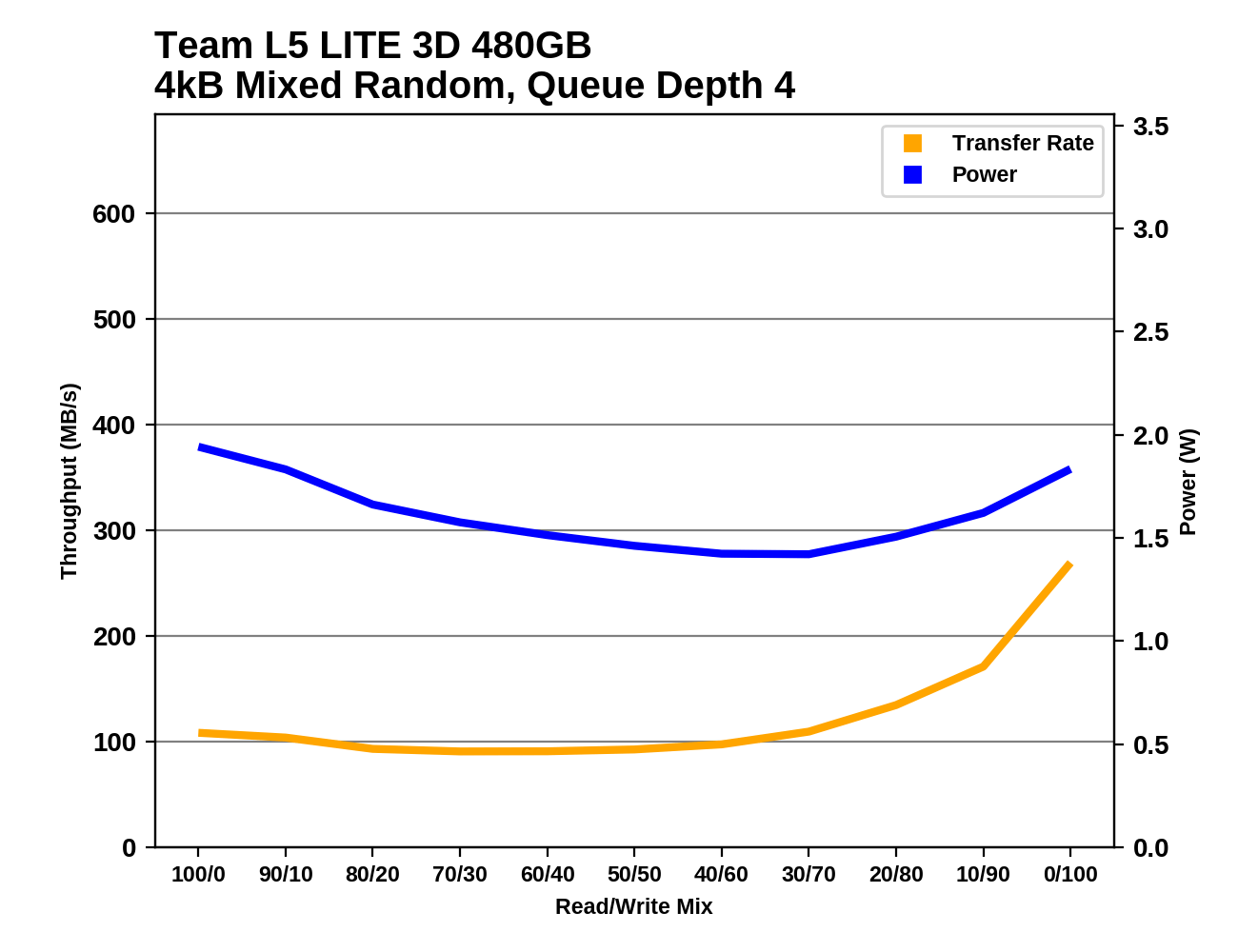
The performance profiles for the L5 LITE 3D on the mixed IO tests are both fairly typical for mainstream SATA drives. The random IO performance is fairly flat until the workload is at least 70% writes, then it starts to pick up the pace. The sequential IO performance is more of a gradual decline as the workload shifts more toward writes.
Idle Power Measurement
SATA SSDs are tested with SATA link power management disabled to measure their active idle power draw, and with it enabled for the deeper idle power consumption score and the idle wake-up latency test. Our testbed, like any ordinary desktop system, cannot trigger the deepest DevSleep idle state.
Note: We recently upgraded our power measurement equipment and switched to measuring idle power on our Coffee Lake desktop, our first SSD testbed to have fully-functional PCIe power management. The below measurements are all new, and are not a perfect match for the older measurements in our previous reviews and the Bench database.
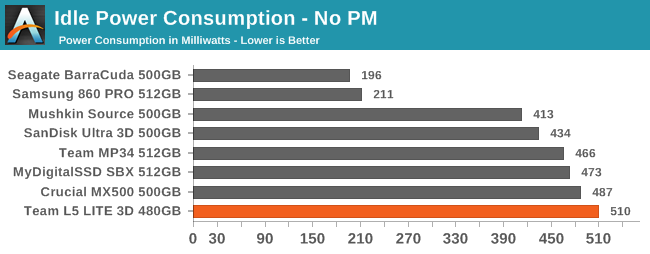
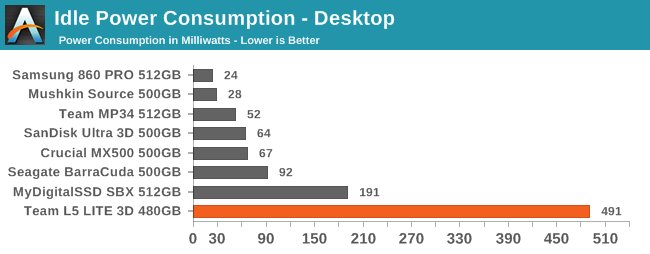
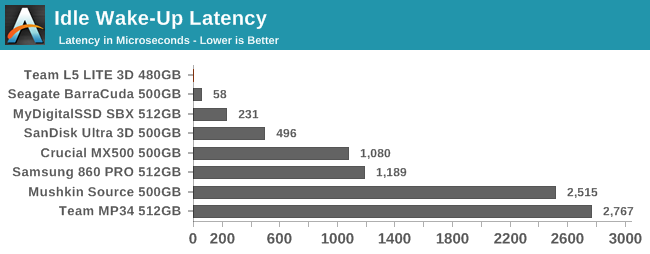
The active idle power consumption of the TeamGroup L5 LITE 3D is higher than most SSDs, but not by much. Unfortunately, enabling power management barely has any effect. The L5 LITE 3D doesn't appear to have functional SATA Link Power Management. The only upside here is that without working power management, there's no extra latency when waking up. (It's possible that DevSleep power management might work on the L5 LITE 3D, but that feature cannot be tested on a desktop system.)
Originally published at https://www.anandtech.com/show/14874/the-team-l5-lite-3d-sata-ssd-review (Wayback Machine).