
Intel's Xeon Cascade Lake vs. NVIDIA Turing: An Analysis in AI
Who Will Win the Next Enterprise Market?
At their last investors day, one of NVIDIA’s slides made it clear what the next battle in the enterprise space will be all about: data analytics. Note how an expensive dual Xeon “Skylake” Scalable is considered as baseline. That is quite a statement; reducing one of the latest Intel powered systems to a completely outperformed humble baseline.
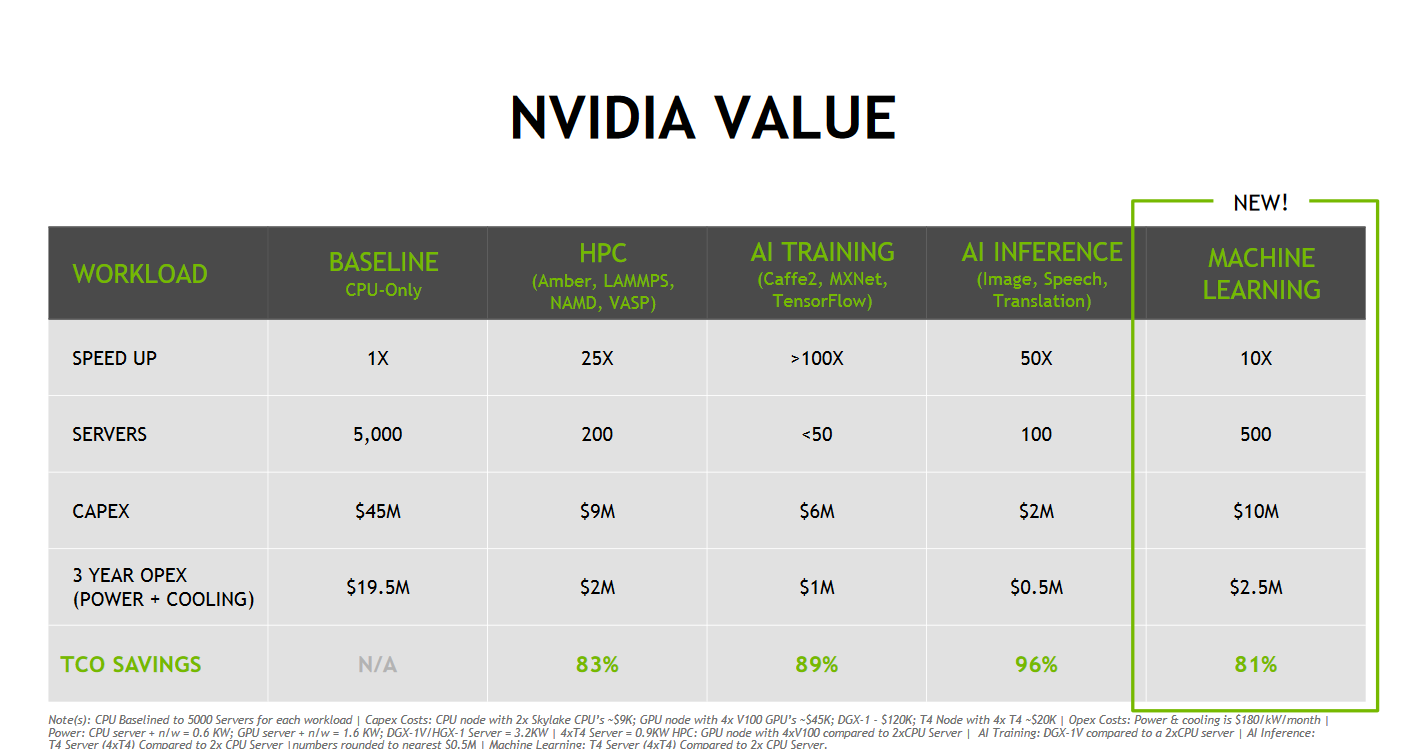
NVIDIA’s entire business model revolves around the theory that buying expensive hardware like DGXs and Teslas is good for your TCO (“the more you buy, the more you save”). Don’t buy 5000 servers, buy 50 DGXes. Despite the fact that a DGX consumes 5 times more power, and costs $120k instead of $9k, you will be much better off. Of course, this is marketing at its best – or at its worst, depending on how you look at it. But even if the numbers are slightly exaggerated, it is a strong message: “from our deep learning stronghold to the Intel’s current growth market (Inference, HPC and machine learning), we will beat Intel by a large margin”.
Not convinced? This is how NVIDIA and IDC see the market evolving.
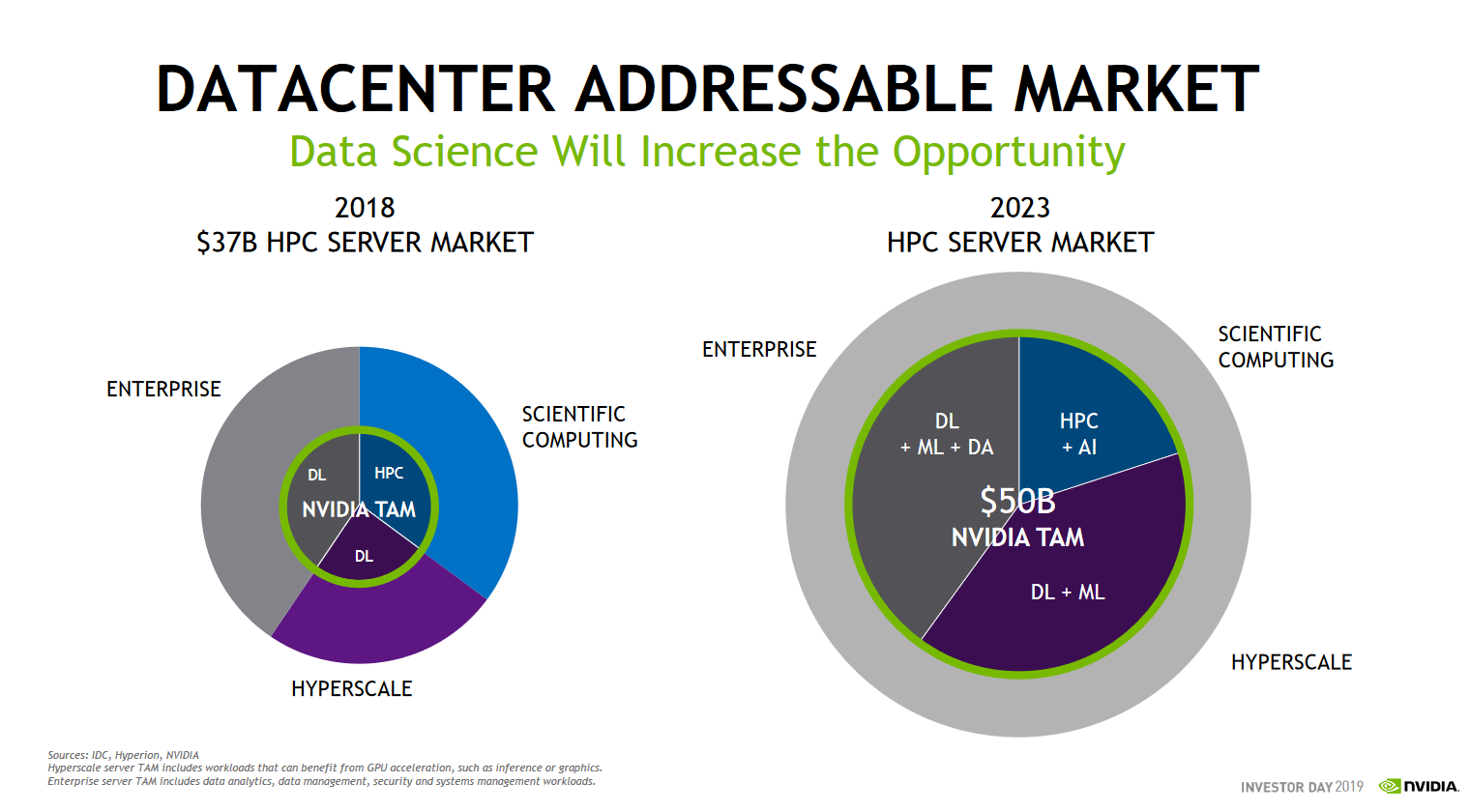
Currently the compute intensive or high-performance sub-market is about $37 billion out of a total $100 billion market. NVIDIA believes that this sub-market will double by 2023 and that they will be able to address $50 billion. In other words, the data analytics market – in a broad sense – will be almost half of the complete server market.
Even if this is an overestimation, it is clear that times are changing, and the stakes are very high. Neural networks are much better suited to GPUs, but if Intel can make sure that most of data pipeline runs better on CPUs and you only need a GPU for the most intensive and scalable neural networks, it will push NVIDIA back to a more niche role. On the other hand, if NVIDIA can accelerate a much larger part of the data pipeline, it will conquer markets that mostly belong to Intel and expand rapidly. And in the midst of this heated battle, IBM and AMD must make sure they get their share of the market. IBM will be offering better NVIDIA GPU based servers, and AMD will try building the right software ecosystem.
Originally published at https://www.anandtech.com/show/14466/intel-xeon-cascade-lake-vs-nvidia-turing (Wayback Machine).