
Intel's Xeon Cascade Lake vs. NVIDIA Turing: An Analysis in AI
NVIDIA’s Answer: RAPIDS Bring GPUs to More Than CNNs
NVIDIA’s has proven more than once that it can outmaneuver the competition with excellent vision and strategy. NVIDIA understands that getting all neural networks to scale as CNNs is not going to be easy, and that there are a lot of applications out there that are either running on other methods than neural networks, or which are memory intensive rather than compute intensive.
At GTC Europe, NVIDIA launched a new data science platform for enterprise use, built on NVIDIA’s new “RAPIDS” framework. The basic idea is that the GPU acceleration of the data pipeline should not be limited to deep learning.
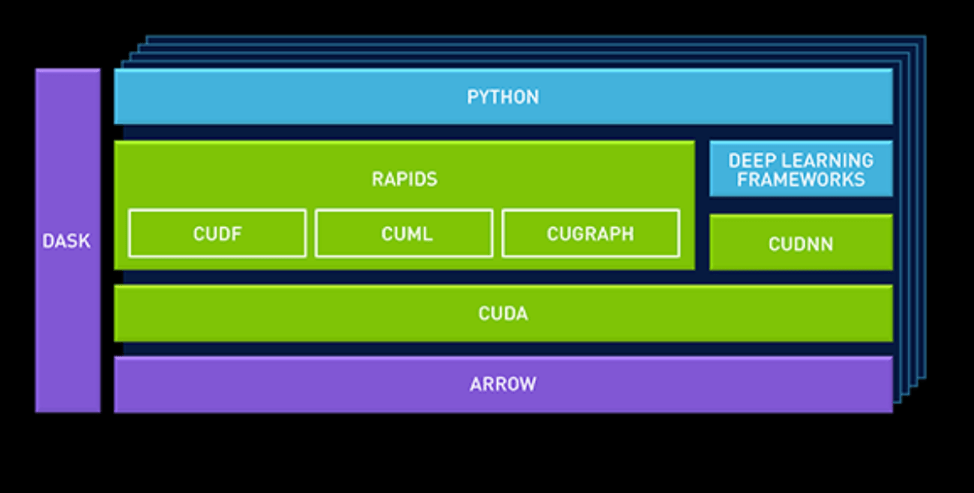
CuDF, for example, allows data scientists to load data into GPU memory and batch process it, similar to Pandas (the python library for manipulating data). cuML is a currently limited collection of GPU-accelerated machine learning libraries. Eventually most (all?) machine learning algorithms available in Scikit-Learn toolkit should be GPU accelerated and available in cuML.
NVIDIA also added Apache Arrow, a columnar in-memory database. This is because GPUs operate on vectors, and as a result favor a columnar layout in memory.
By leveraging Apache arrow as a “central database”, NVIDIA avoids a lot of overhead.
Making sure that there are GPU accelerated versions of the typical Python libraries such as Sci-Kit and Pandas is one step in right direction. But Pandas is only suited for the lighter “data science exploration” tasks. By working with Databricks to make sure that RAPIDS is also used in the heavy duty, distributed “data processing” framework Spark, NVIDIA is taking the next step, breaking out of the "Deep learning mostly" role and towards "NVIDIA in the rest of the data pipeline".
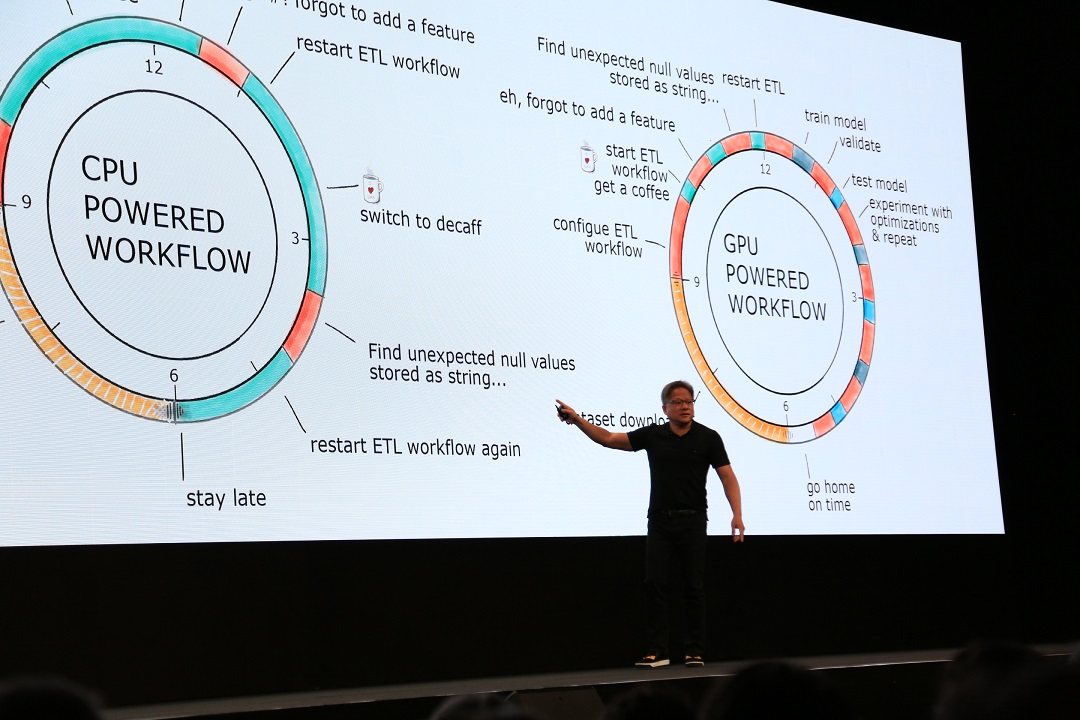
However, the devil is in the details. Adding GPUs to a framework that has been optimized for years to make optimal use of CPU cores and the massive amounts of RAM available in servers is not easy. Spark is built to run on a few tens of powerful server cores, not thousands of wimpy GPU cores. Spark has been optimized to run on clusters of server nodes, making it seem like one big lump of RAM memory and cores. Mixing two kinds of memory – RAM and GPU VRAM – and keeping the distributed compute nature of Spark intact will not be easy.
Secondly, cherry picking the most GPU-friendly machine learning algorithms is one thing, but making sure most of them run fine in GPU-based machine is another thing. Lastly, GPUs will still have less memory than CPUs for the foreseeable future; and even coherent platforms won’t solve the problem that system RAM is a fraction of the speed of local VRAM
Originally published at https://www.anandtech.com/show/14466/intel-xeon-cascade-lake-vs-nvidia-turing (Wayback Machine).