
The Intel Optane Memory H10 Review: QLC and Optane In One SSD
- Posted in
- SSDs
- Storage
- Intel
- M.2
- NVMe
- Silicon Motion
- 3D XPoint
- Optane
- QLC NAND
- Optane Memory
- Whiskey Lake
- SM2263
Sequential Read Performance
Our first test of sequential read performance uses short bursts of 128MB, issued as 128kB operations with no queuing. The test averages performance across eight bursts for a total of 1GB of data transferred from a drive containing 16GB of data. Between each burst the drive is given enough idle time to keep the overall duty cycle at 20%.
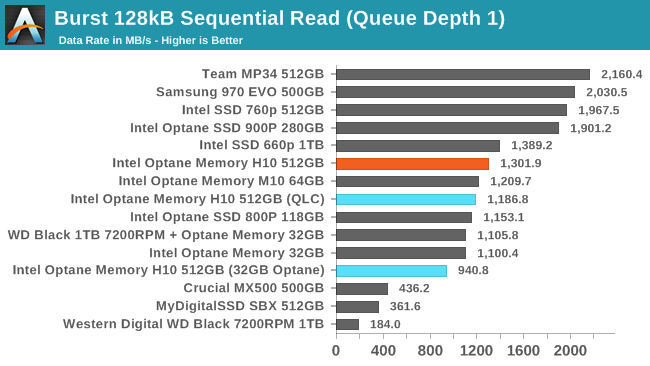
The burst sequential read performance of the Optane Memory H10 is much lower than what the high-end TLC-based drives provide, but it is competitive with the other low-end NVMe drives that are limited to PCIe 3 x2 links. The Optane Memory caching is only responsible for about a 10% speed increase over the raw QLC speed, so this is obviously not one of the scenarios where the caching drivers can effectively stripe access between the Optane and NAND.
Our test of sustained sequential reads uses queue depths from 1 to 32, with the performance and power scores computed as the average of QD1, QD2 and QD4. Each queue depth is tested for up to one minute or 32GB transferred, from a drive containing 64GB of data. This test is run twice: once with the drive prepared by sequentially writing the test data, and again after the random write test has mixed things up, causing fragmentation inside the SSD that isn't visible to the OS. These two scores represent the two extremes of how the drive would perform under real-world usage, where wear leveling and modifications to some existing data will create some internal fragmentation that degrades performance, but usually not to the extent shown here.
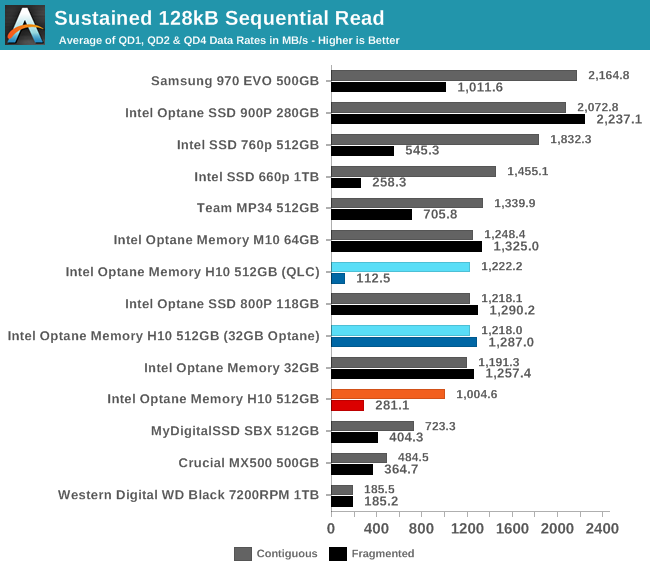
On the longer sequential read test, the Optane caching is still not effectively combining the performance of the Optane and NAND halves of the H10. However, when reading back data that was not written sequentially, the Optane cache is a significant help.
 |
|||||||||
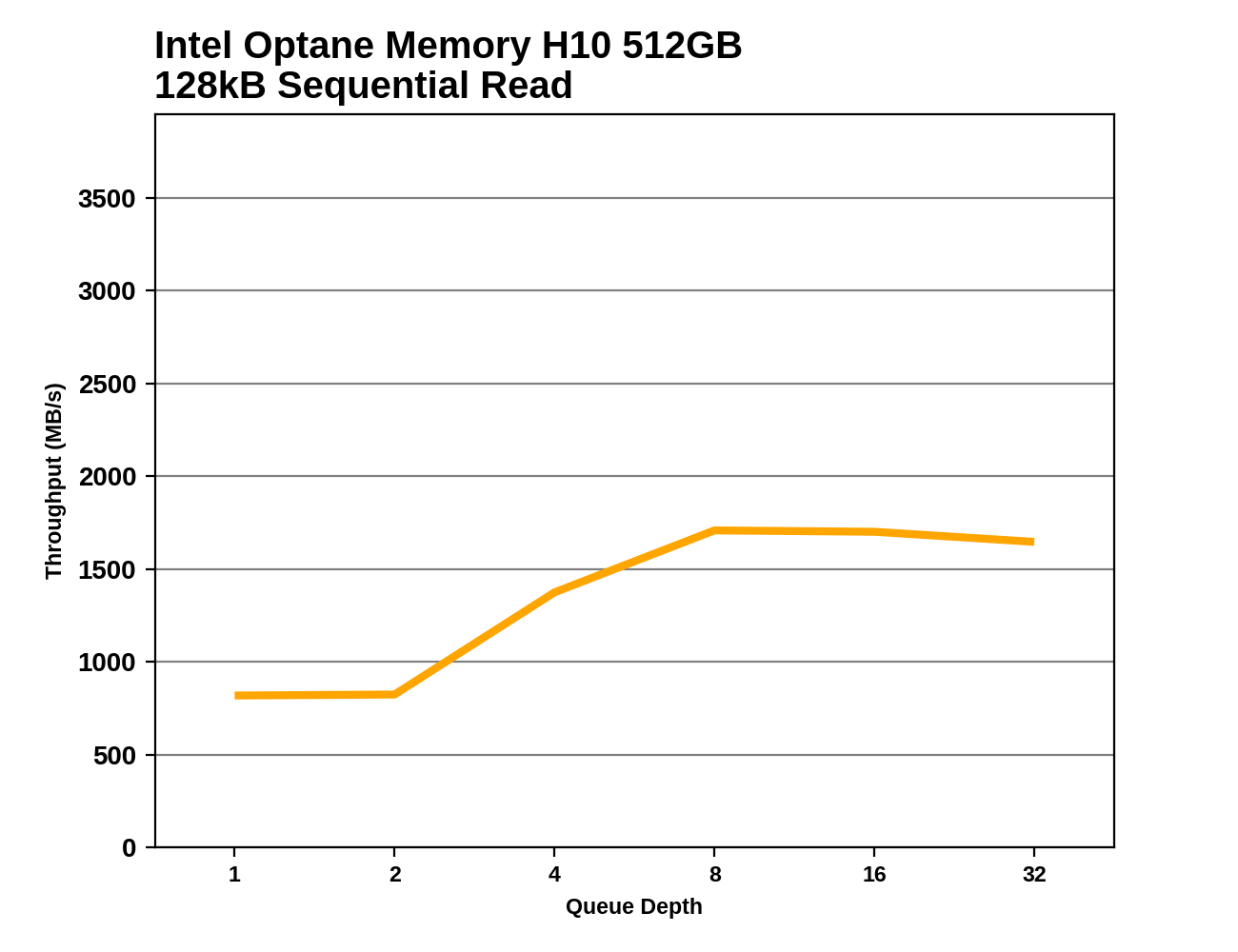
The Optane cache is a bit of a hindrance to sequential reads at low queue depths on this test, but at QD8 and higher it provides some benefit over using just the QLC.
Sequential Write Performance
Our test of sequential write burst performance is structured identically to the sequential read burst performance test save for the direction of the data transfer. Each burst writes 128MB as 128kB operations issued at QD1, for a total of 1GB of data written to a drive containing 16GB of data.
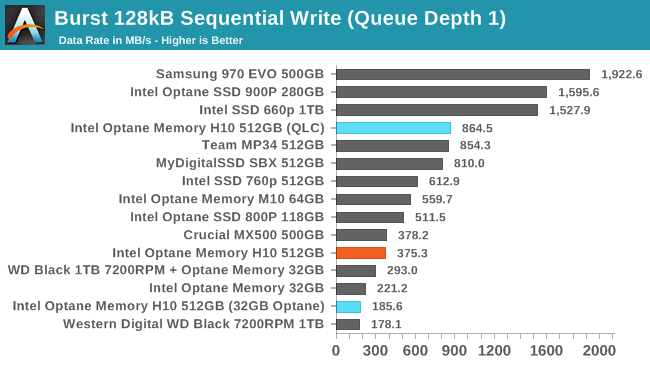
The burst sequential write speed of 32GB of Optane on its own is quite poor, so this is a case where the QLC NAND is significantly helping the Optane on the H10. The SLC write cache on the H10's QLC side is competitive with those on the TLC-based drives, but when the caching software gets in the way the H10 ends up with SATA-like performance.
Our test of sustained sequential writes is structured identically to our sustained sequential read test, save for the direction of the data transfers. Queue depths range from 1 to 32 and each queue depth is tested for up to one minute or 32GB, followed by up to one minute of idle time for the drive to cool off and perform garbage collection. The test is confined to a 64GB span of the drive.
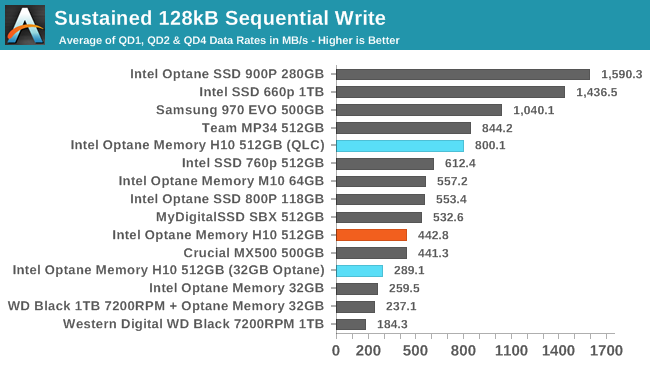
The story is pretty much the same on the longer sequential write test, though some of the other low-end NVMe drives have fallen far enough that the Optane Memory H10's score isn't a complete embarrassment. However, the QLC portion on its own is still doing a better job of handling sustained sequential writes than the caching configuration.
 |
|||||||||
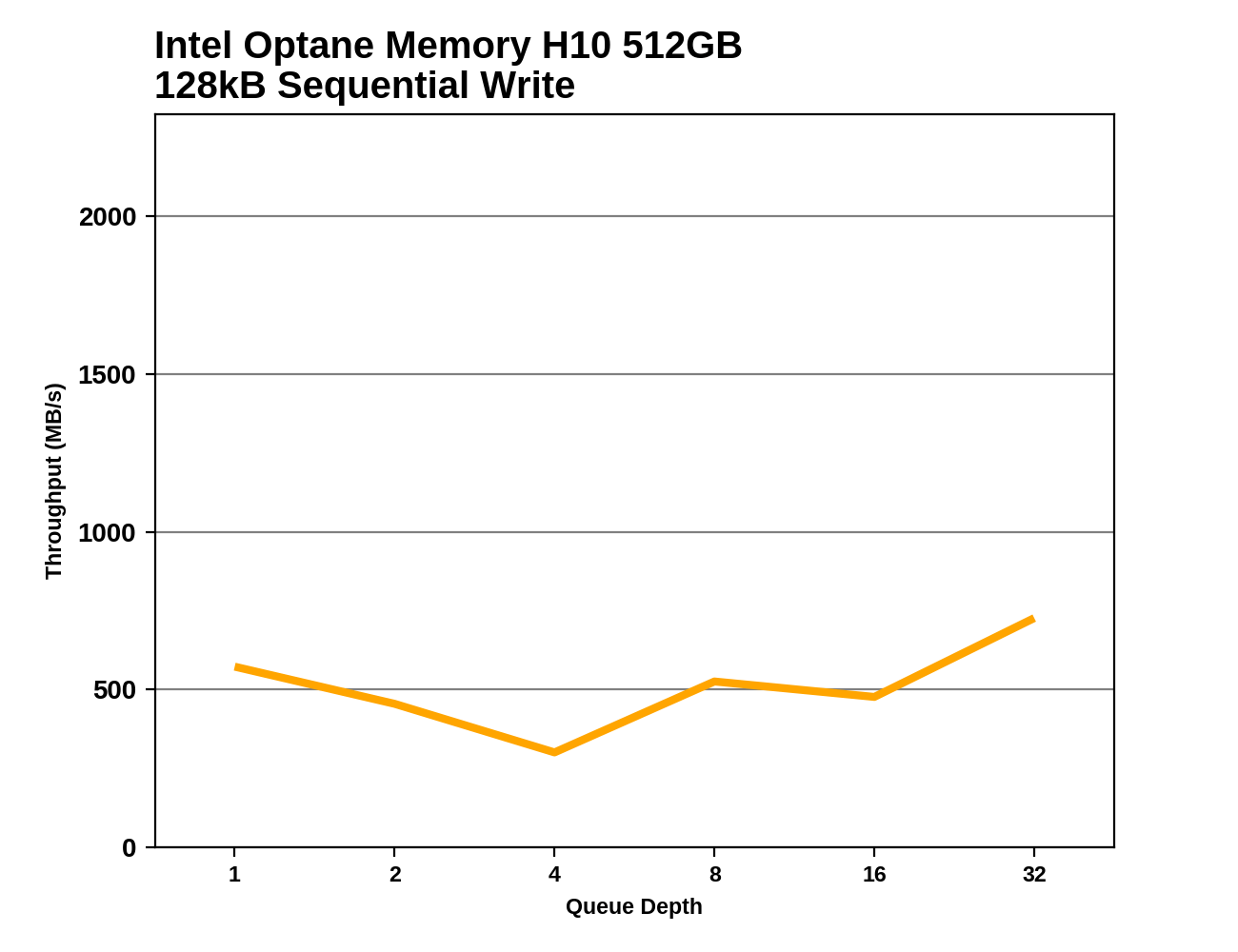
There's no clear trend in performance for the H10 during the sustained sequential write test. It is mostly performing between the levels of the QLC and Optane portions, which means the caching software is getting in the way rather than allowing the two halves to work together and deliver better performance than either one individually. It's possible that with more idle time to clear out the Optane and SLC caches we would see drastically different behavior here.
Originally published at https://www.anandtech.com/show/14249/the-intel-optane-memory-h10-review-two-ssds-in-one (Wayback Machine).