
The Intel Optane Memory H10 Review: QLC and Optane In One SSD
- Posted in
- SSDs
- Storage
- Intel
- M.2
- NVMe
- Silicon Motion
- 3D XPoint
- Optane
- QLC NAND
- Optane Memory
- Whiskey Lake
- SM2263
Random Read Performance
Our first test of random read performance uses very short bursts of operations issued one at a time with no queuing. The drives are given enough idle time between bursts to yield an overall duty cycle of 20%, so thermal throttling is impossible. Each burst consists of a total of 32MB of 4kB random reads, from a 16GB span of the disk. The total data read is 1GB.
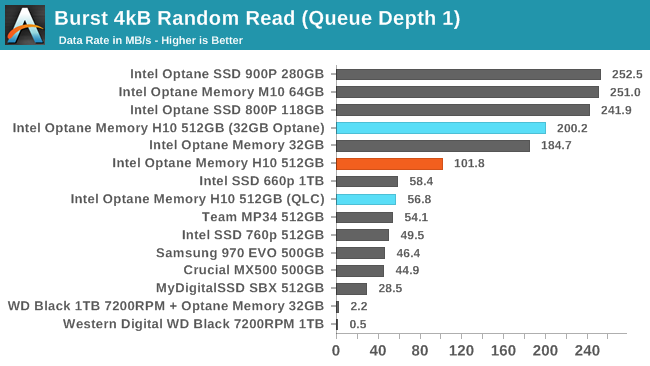
The burst random read test easily fits within the Optane cache on the Optane Memory H10, so it outperforms all of the flash-based SSDs, but is substantially slower than the pure Optane storage devices.
Our sustained random read performance is similar to the random read test from our 2015 test suite: queue depths from 1 to 32 are tested, and the average performance and power efficiency across QD1, QD2 and QD4 are reported as the primary scores. Each queue depth is tested for one minute or 32GB of data transferred, whichever is shorter. After each queue depth is tested, the drive is given up to one minute to cool off so that the higher queue depths are unlikely to be affected by accumulated heat build-up. The individual read operations are again 4kB, and cover a 64GB span of the drive.
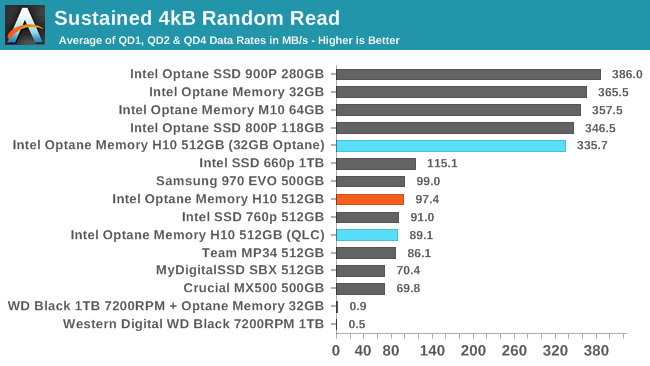
On the longer random read test that covers a wider span of the disk than the Optane cache can manage, the H10's performance is on par with the TLC-based SSDs.
 |
|||||||||
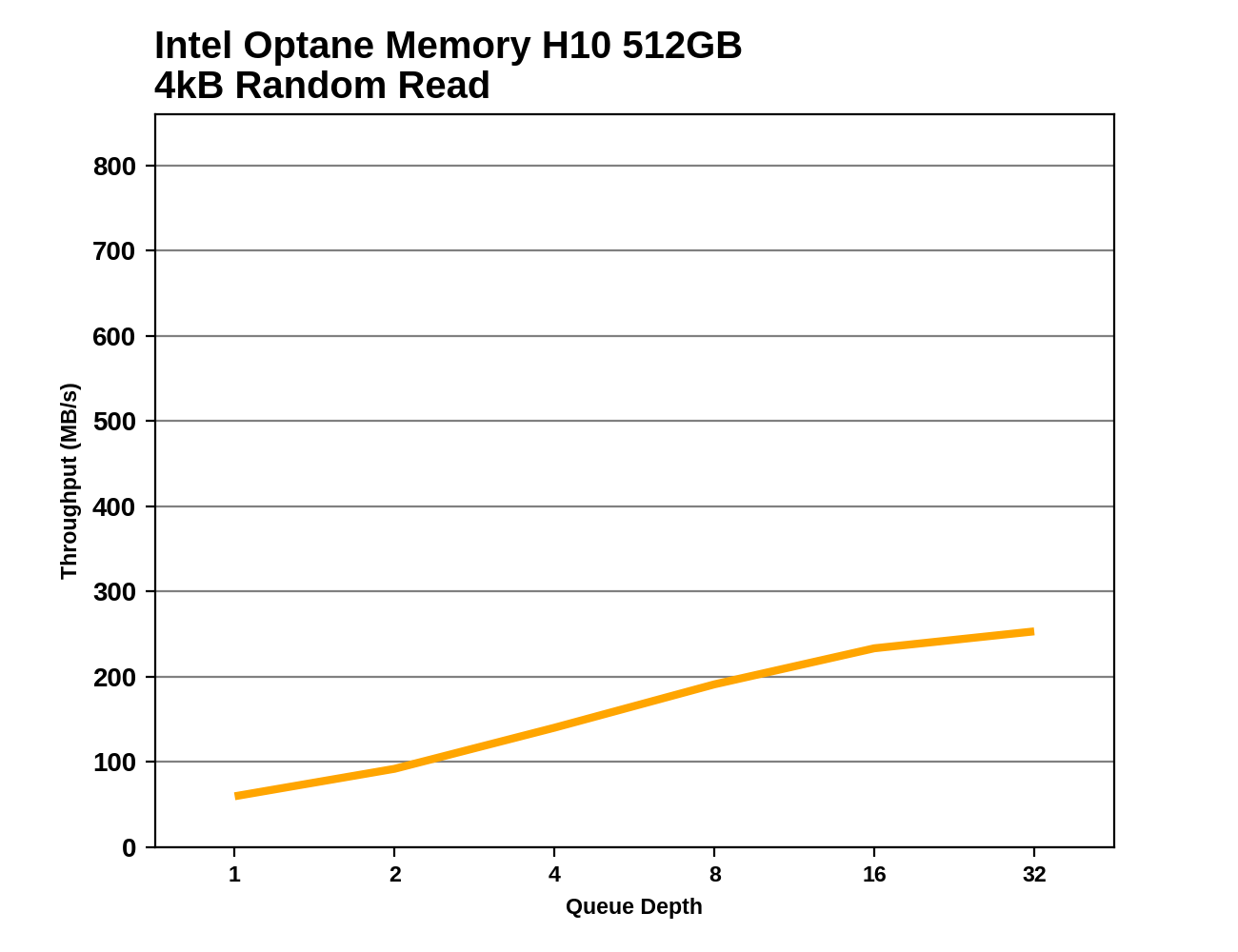
The Optane cache provides little benefit over pure QLC storage at lower queue depths, but at the higher queue depths the H10 with caching enabled starts to develop a real lead over the QLC portion on its own. Unfortunately, but the time queue depths are this high, the flash-based SSDs have all surpassed the H10's random read throughput.
Random Write Performance
Our test of random write burst performance is structured similarly to the random read burst test, but each burst is only 4MB and the total test length is 128MB. The 4kB random write operations are distributed over a 16GB span of the drive, and the operations are issued one at a time with no queuing.
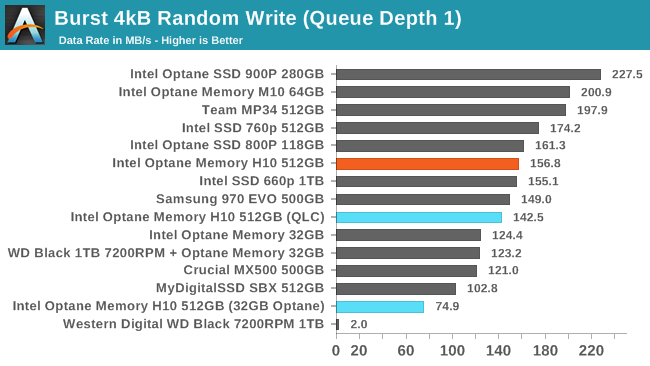
The burst random write performance of the H10 with caching enabled is better than either half of the drive can manage on its own, but far less than the sum of its parts. A good SLC write cache on a TLC drive is still better than the Optane caching on top of QLC.
As with the sustained random read test, our sustained 4kB random write test runs for up to one minute or 32GB per queue depth, covering a 64GB span of the drive and giving the drive up to 1 minute of idle time between queue depths to allow for write caches to be flushed and for the drive to cool down.
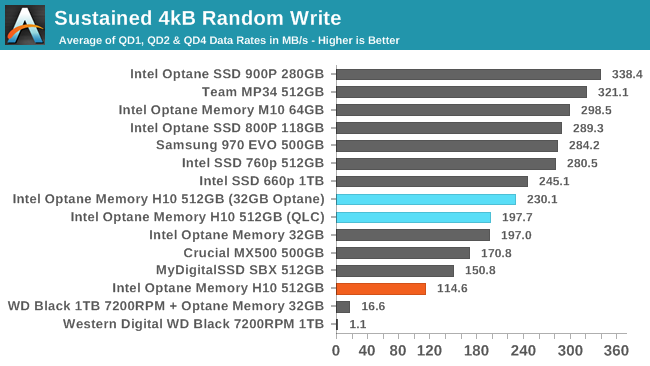
On the longer random write test that covers a much wider span than the Optane cache can handle, the Optane Memory H10 falls behind all of the flash-based competition. The caching software ends up creating more work that drags performance down far below what the QLC portion can manage with just its SLC cache.
 |
|||||||||
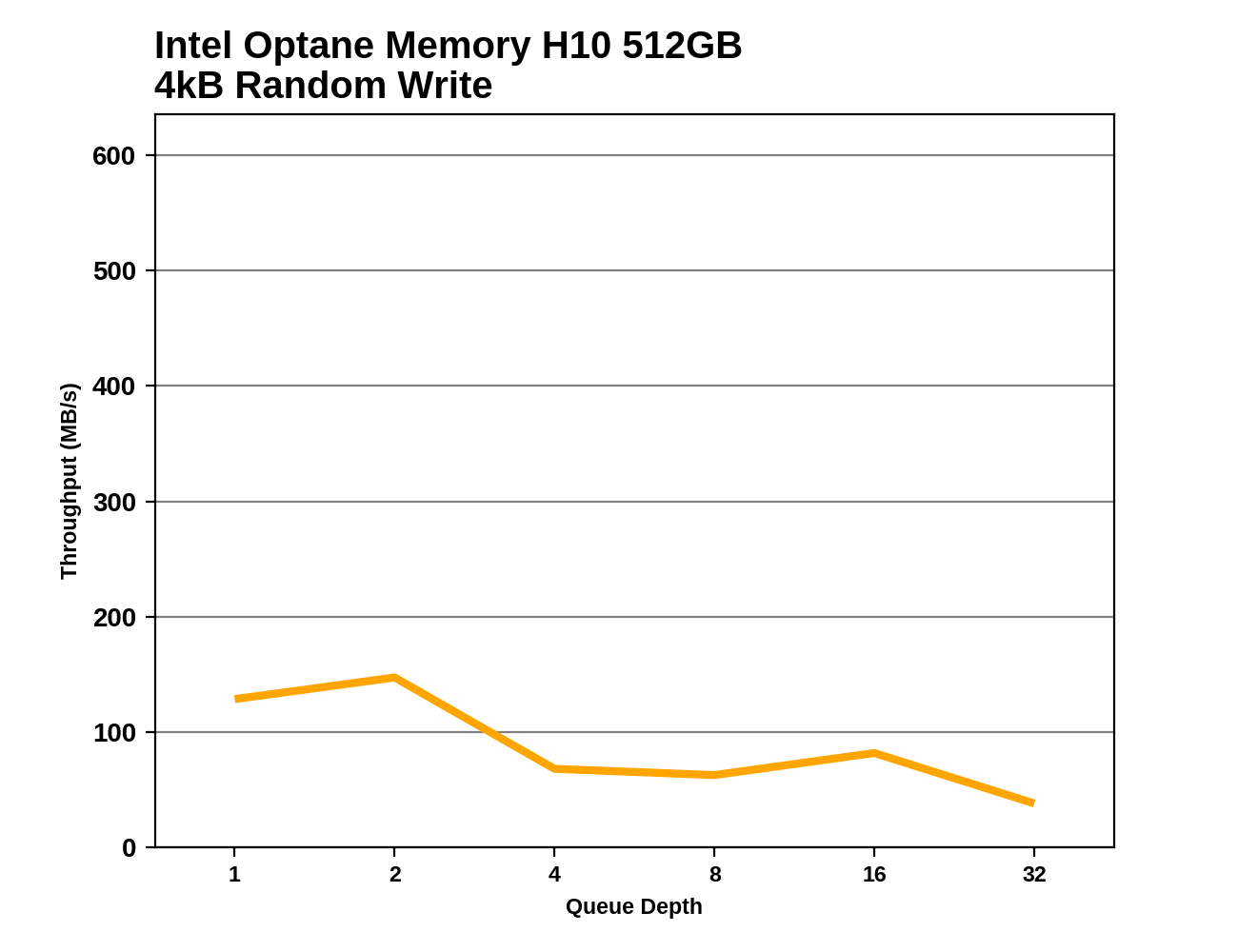
Random write performance on the Optane Memory H10 is unsteady but generally trending downward as the test progresses. Two layers of caching getting in each others way is not a good recipe for consistent sustained performance.
Originally published at https://www.anandtech.com/show/14249/the-intel-optane-memory-h10-review-two-ssds-in-one (Wayback Machine).