
The Silicon Power P34A80 SSD Review: Phison E12 With Newer Firmware
Sequential Read Performance
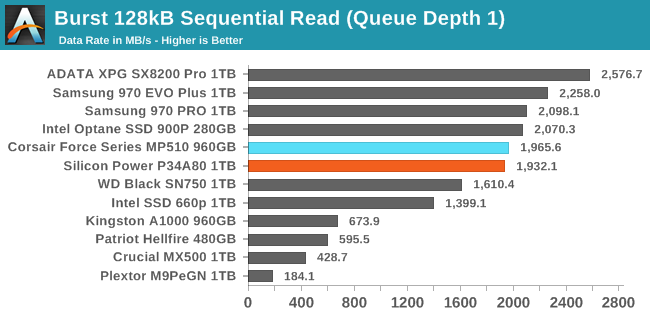
Our first test of sequential read performance uses short bursts of 128MB, issued as 128kB operations with no queuing. The test averages performance across eight bursts for a total of 1GB of data transferred from a drive containing 16GB of data. Between each burst the drive is given enough idle time to keep the overall duty cycle at 20%.
(burst)
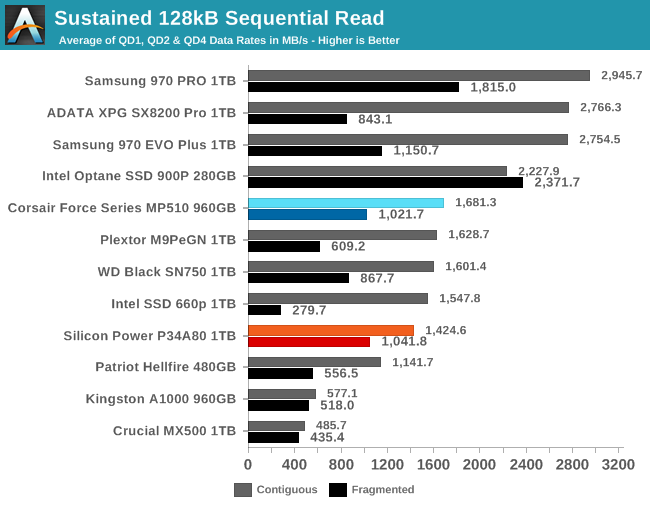
Our test of sustained sequential reads uses queue depths from 1 to 32, with the performance and power scores computed as the average of QD1, QD2 and QD4. Each queue depth is tested for up to one minute or 32GB transferred, from a drive containing 64GB of data. This test is run twice: once with the drive prepared by sequentially writing the test data, and again after the random write test has mixed things up, causing fragmentation inside the SSD that isn't visible to the OS. These two scores represent the two extremes of how the drive would perform under real-world usage, where wear leveling and modifications to some existing data will create some internal fragmentation that degrades performance, but usually not to the extent shown here.
The Silicon Power P34A80 is very slightly slower than the Corsair MP510 on the burst sequential read test, but still performs adequately for a high-end NVMe drive with just shy of 2GB/s at QD1.
 |
|||||||||
| Power Efficiency in MB/s/W | Average Power in W | ||||||||
On the longer sequential read test that brings in some higher queue depths, the P34A80's regression relative to the Corsair MP510 with older firmware is a bit larger, and some entry-level NVMe drives like the QLC-based Intel 660p are able to offer similar performance. But the Phison E12 drives still offer quite good performance for sequential reads of data that was not written sequentially and may be fragmented within the SSD itself.
 |
|||||||||
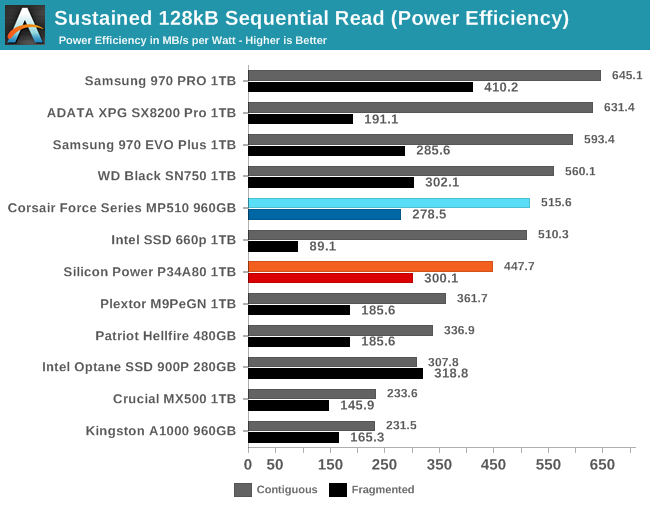
The power efficiency of the P34A80 during the sequential read test is a step down from what the Corsair MP510 offers, but is still as good or better than a typical SATA drive.
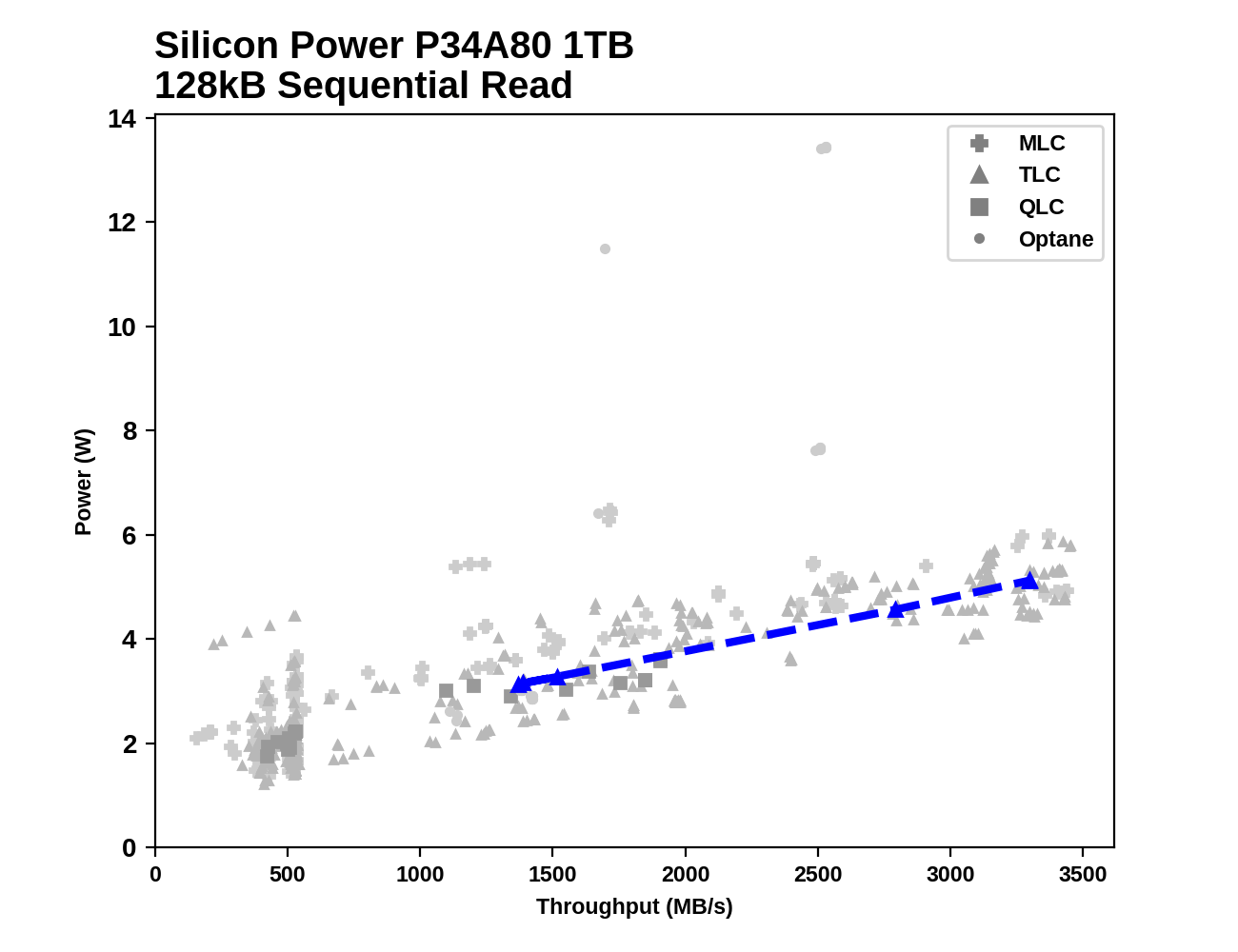
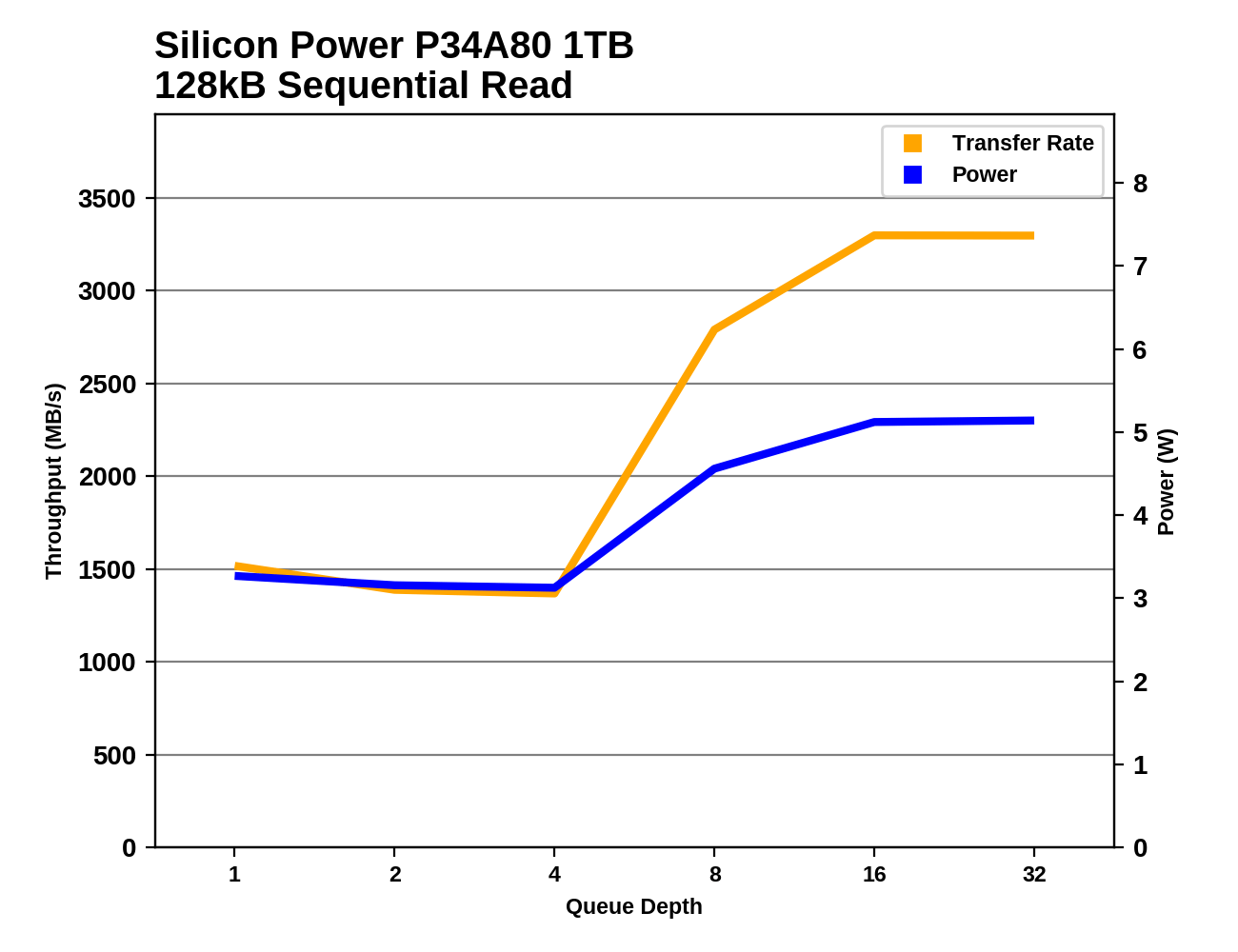
The performance and power consumption of the P34A80 on the sequential read test don't set it apart from the crowd: at high queue depths it offers similar performance to many other competitors with average power consumption, and at lower queue depths its efficiency is also fairly typical.
Sequential Write Performance
Our test of sequential write burst performance is structured identically to the sequential read burst performance test save for the direction of the data transfer. Each burst writes 128MB as 128kB operations issued at QD1, for a total of 1GB of data written to a drive containing 16GB of data.
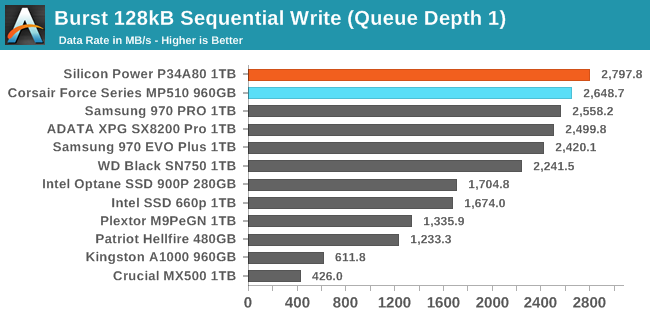
The Silicon Power P34A80 slightly improves on the already excellent burst sequential write performance that the Phison E12 offered in the Corsair MP510. As with random writes, it appears that the E12 controller has the fastest SLC write cache currently available.
Our test of sustained sequential writes is structured identically to our sustained sequential read test, save for the direction of the data transfers. Queue depths range from 1 to 32 and each queue depth is tested for up to one minute or 32GB, followed by up to one minute of idle time for the drive to cool off and perform garbage collection. The test is confined to a 64GB span of the drive.
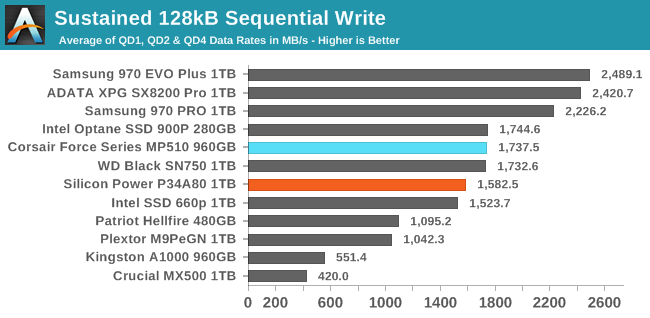
When some higher queue depths and longer test durations are considered, the P34A80 no longer impresses, and is actually slightly slower than the Corsair MP510, while the top tier is comprised of Samsung and Silicon Motion-based drives.
 |
|||||||||
| Power Efficiency in MB/s/W | Average Power in W | ||||||||
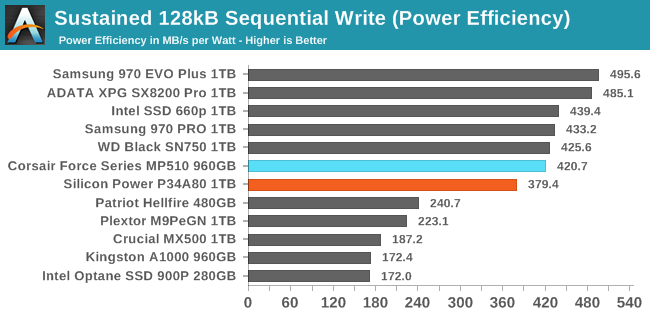
The power efficiency of the P34A80 is also a bit worse than the Corsair MP510, but still pretty close to the current standard for high-end NVMe SSDs and significantly better than SATA drives or many entry-level NVMe drives.
 |
|||||||||
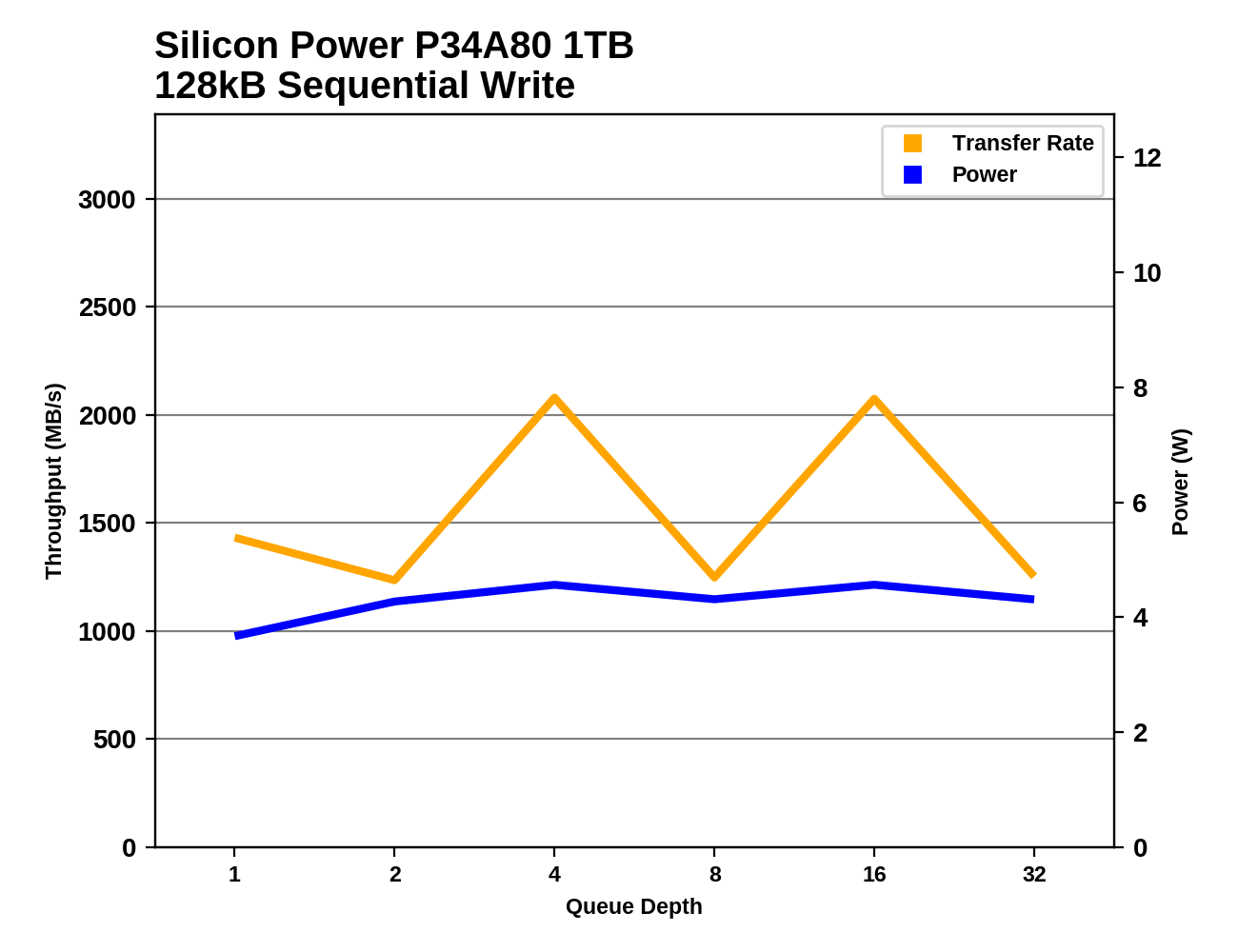
The Silicon Power P34A80's performance oscillates over the course of the sequential write test, as the SLC cache is inadequately sized to handle the 32GB per queue depth this test writes. The Corsair MP510 behaves similarly, while the rest of the drives in this batch have more consistent performance even when they are a bit slower than the Phison E12 drives.
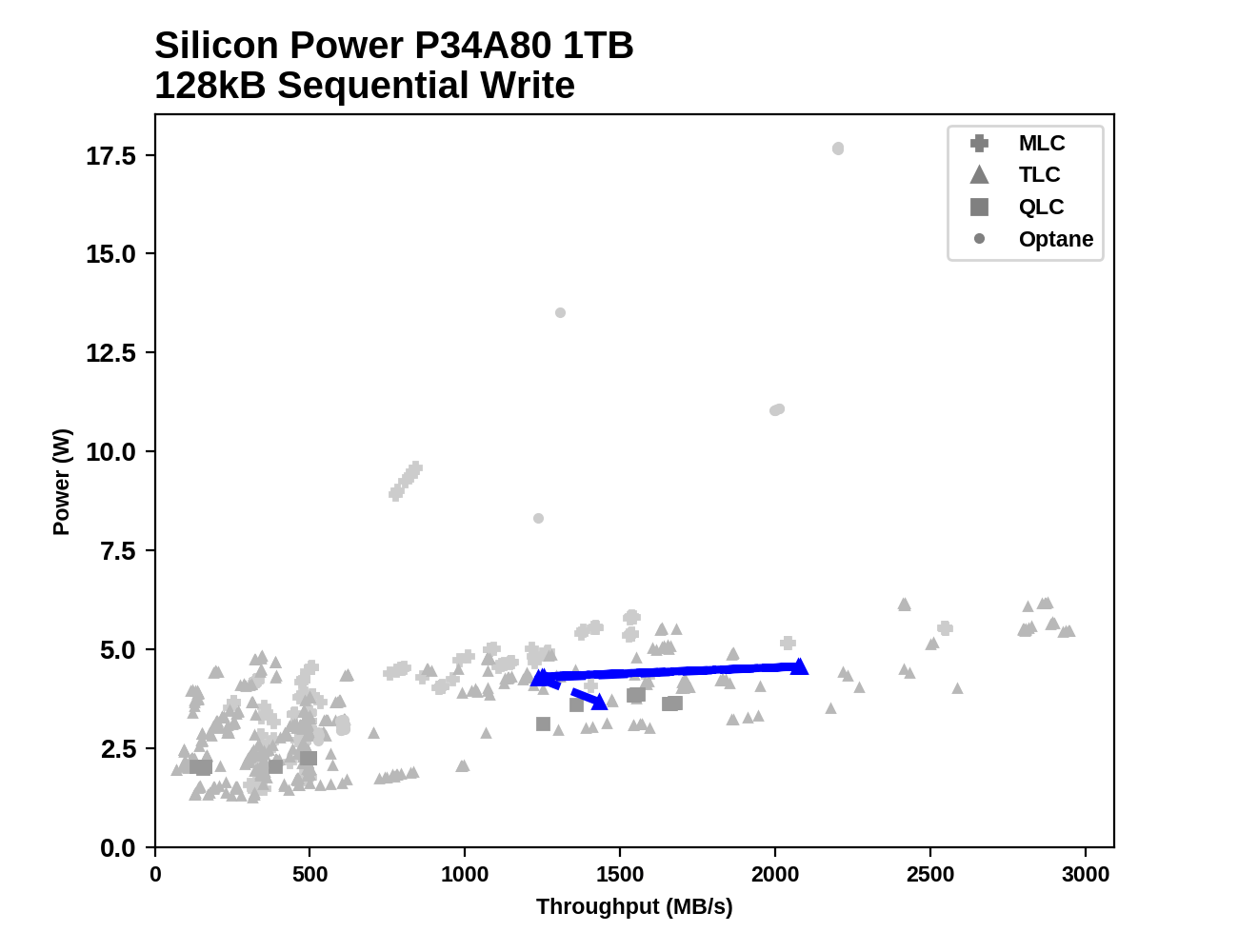
The P34A80 never hits particularly high sequential write speeds during this test, but at least the performance hit of filling its SLC cache doesn't hurt power efficiency much. It's certainly not the most efficient NVMe drive for sequential writes, but its power consumption isn't atypically high.
Originally published at https://www.anandtech.com/show/13955/the-silicon-power-p34a80-ssd-review-phison-e12-with-newer-firmware (Wayback Machine).