
The Silicon Power P34A80 SSD Review: Phison E12 With Newer Firmware
Random Read Performance
Our first test of random read performance uses very short bursts of operations issued one at a time with no queuing. The drives are given enough idle time between bursts to yield an overall duty cycle of 20%, so thermal throttling is impossible. Each burst consists of a total of 32MB of 4kB random reads, from a 16GB span of the disk. The total data read is 1GB.
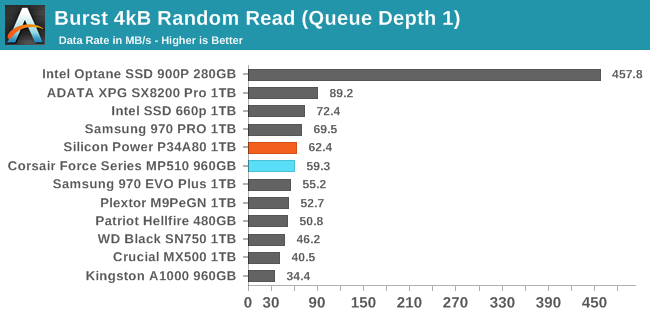
The QD1 burst random read performance of the Silicon Power P34A80 is slightly faster than the Corsair MP510 with older firmware. This is a new record for Toshiba/SanDisk 3D NAND, but it still falls well short of the random read performance we've been seeing lately from the combination of Intel/Micron NAND and Silicon Motion NVMe controllers.
Our sustained random read performance is similar to the random read test from our 2015 test suite: queue depths from 1 to 32 are tested, and the average performance and power efficiency across QD1, QD2 and QD4 are reported as the primary scores. Each queue depth is tested for one minute or 32GB of data transferred, whichever is shorter. After each queue depth is tested, the drive is given up to one minute to cool off so that the higher queue depths are unlikely to be affected by accumulated heat build-up. The individual read operations are again 4kB, and cover a 64GB span of the drive.
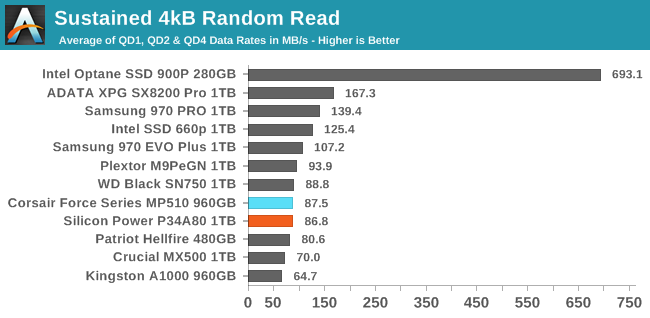
Adding in some higher queue depths doesn't help the P34A80 much: like the Corsair MP510 with older firmware, it ends up being one of the slowest high-end NVMe drives for random reads, only slightly faster than the Phison E7-based Patriot Hellfire.
 |
|||||||||
| Power Efficiency in MB/s/W | Average Power in W | ||||||||
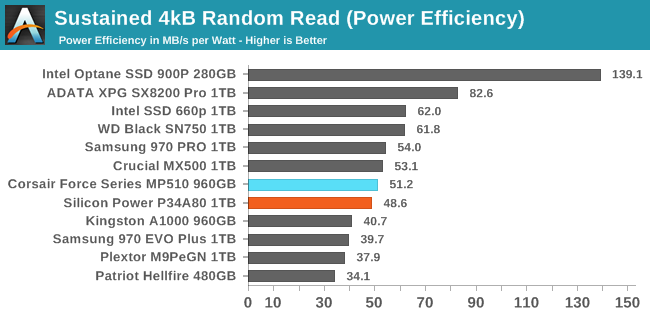
The P34A80 uses slightly more power than the Corsair MP510 on the random read test, so it ends up with a lower efficiency score that is still reasonable and better than several other high-end NVMe drives.
 |
|||||||||
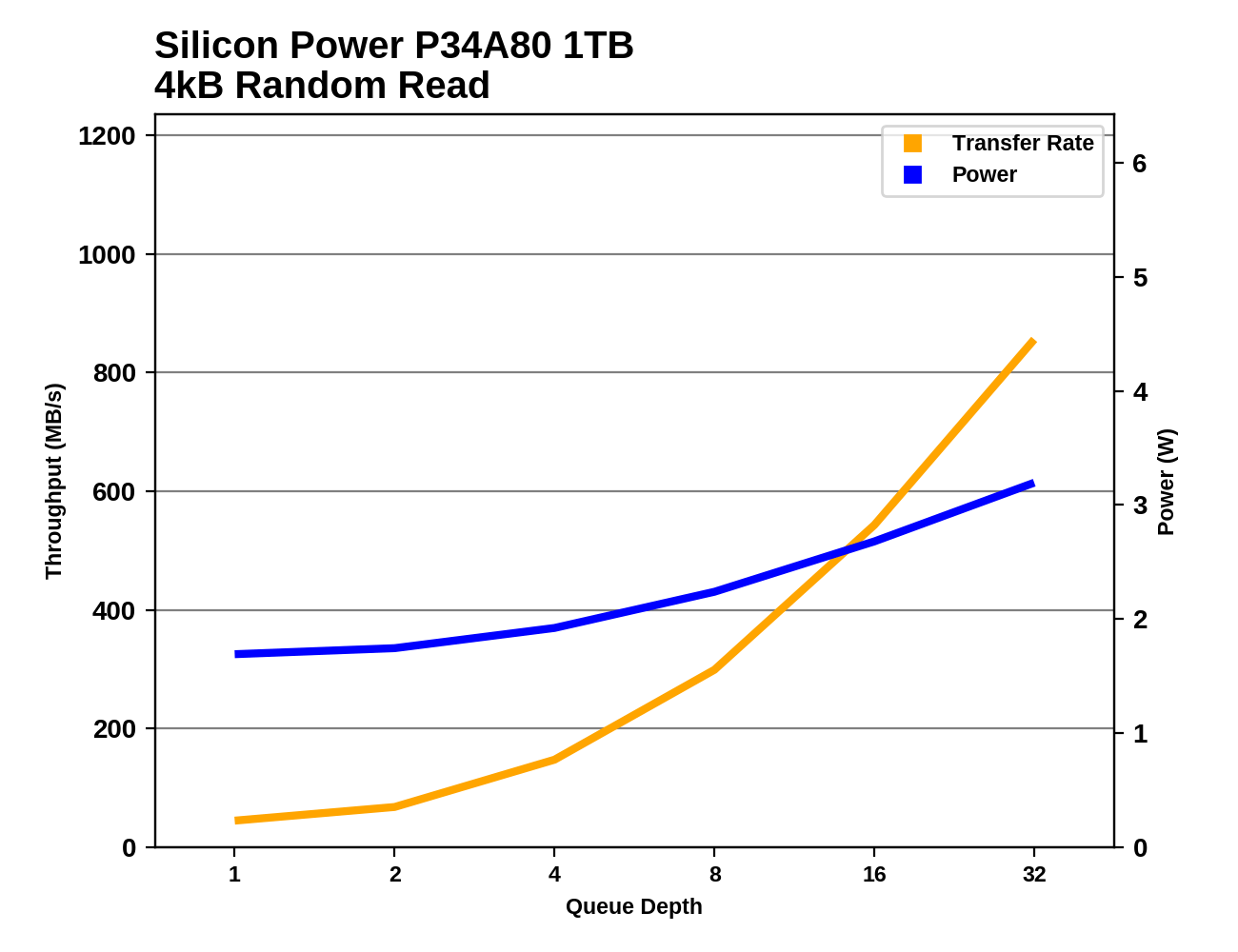
At mid to high queue depths, the WD Black SN 750 takes a clear lead among drives using the same Toshiba/SanDisk 3D NAND as the P34A80, and the WD Black's lower power consumption across the board emphasizes that there's room for improvement over the Phison E12, and that firmware tweaks aren't enough to close the gap.
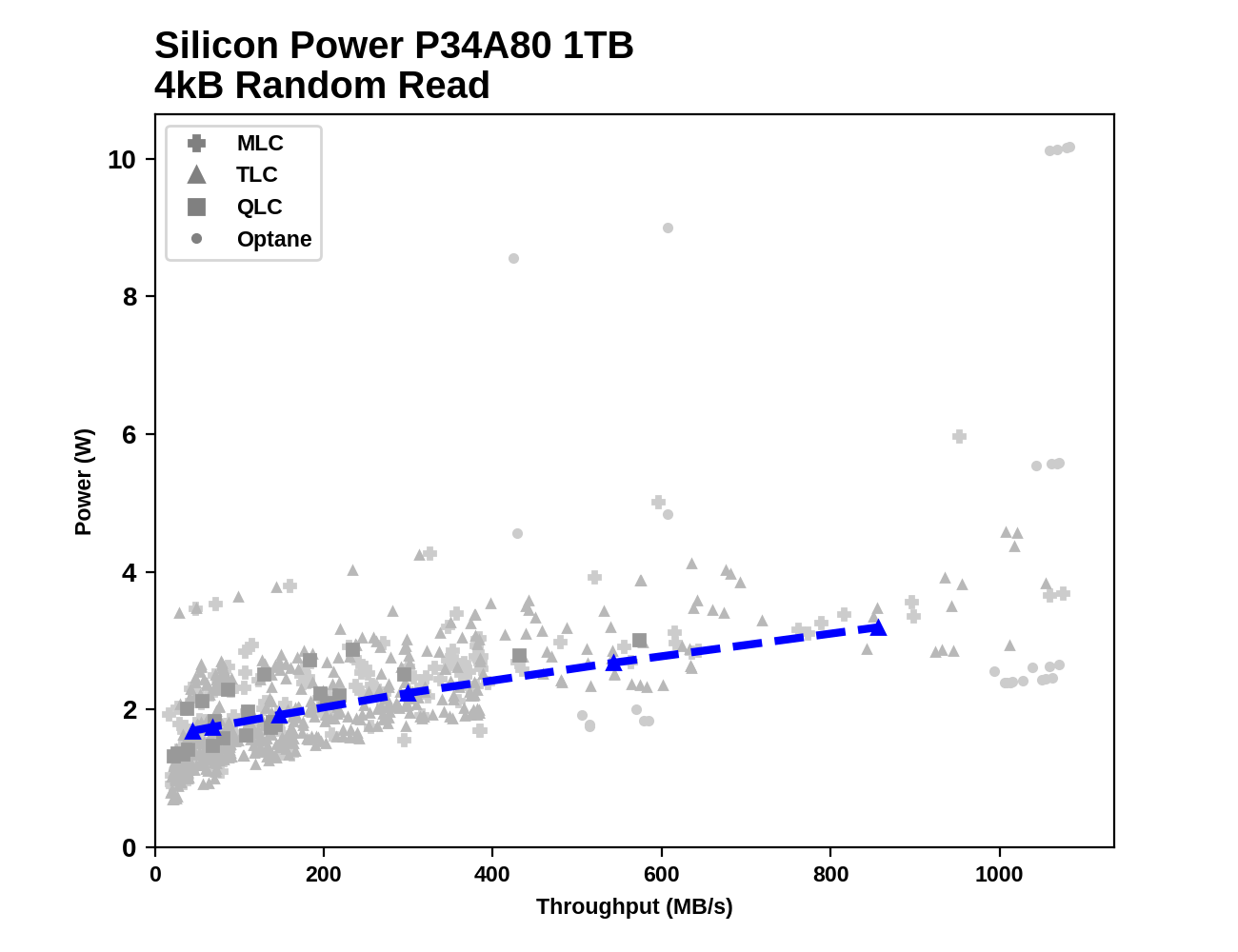
Comparing the P34A80 against the rest of the consumer SSDs that have completed this test, the power efficiency during random reads is fairly middle of the road across the entire range of queue depths, and it is clear that there are quite a few options providing higher peak performance even from TLC NAND.
Random Write Performance
Our test of random write burst performance is structured similarly to the random read burst test, but each burst is only 4MB and the total test length is 128MB. The 4kB random write operations are distributed over a 16GB span of the drive, and the operations are issued one at a time with no queuing.
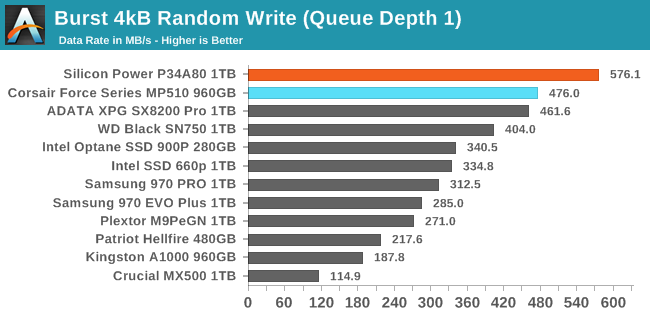
The Silicon Power P34A80 delivers a substantial 21% improvement in QD1 burst random write performance, which the Phison E12 already held the record for. With this new firmware, Phison now clearly has the fastest SLC write cache.
As with the sustained random read test, our sustained 4kB random write test runs for up to one minute or 32GB per queue depth, covering a 64GB span of the drive and giving the drive up to 1 minute of idle time between queue depths to allow for write caches to be flushed and for the drive to cool down.
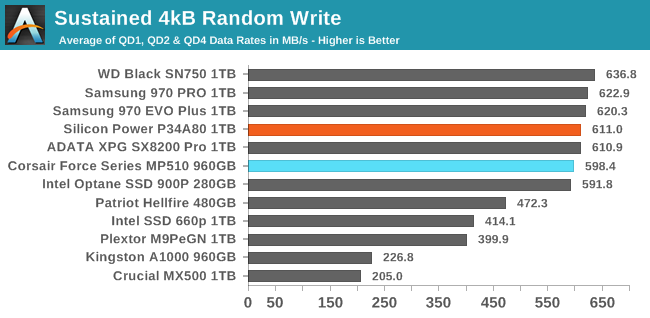
When higher queue depths and longer test durations are thrown in, the competition is much closer among top tier drives. The P34A80 is still faster than the Corsair MP510 with older firmware, but both are outperformed by drives from Samsung and WD.
 |
|||||||||
| Power Efficiency in MB/s/W | Average Power in W | ||||||||
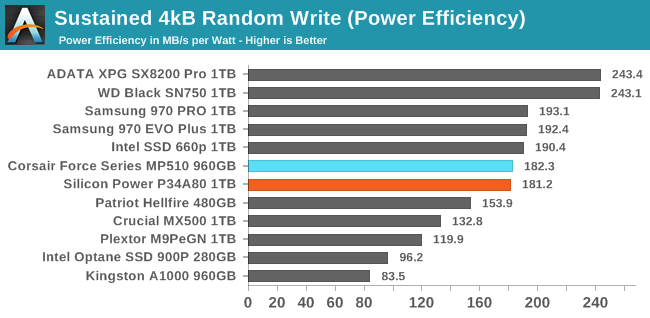
By a narrow margin, the P34A80 has the highest power draw among the flash-based SSDs in this batch, so its efficiency score on this test is a bit lower than most other high-end NVMe SSDs. The WD Black SN750 and ADATA SX8200 Pro stand out with considerably better efficiency, while the Samsung drives only score slightly better than the Phison E12 drives.
 |
|||||||||
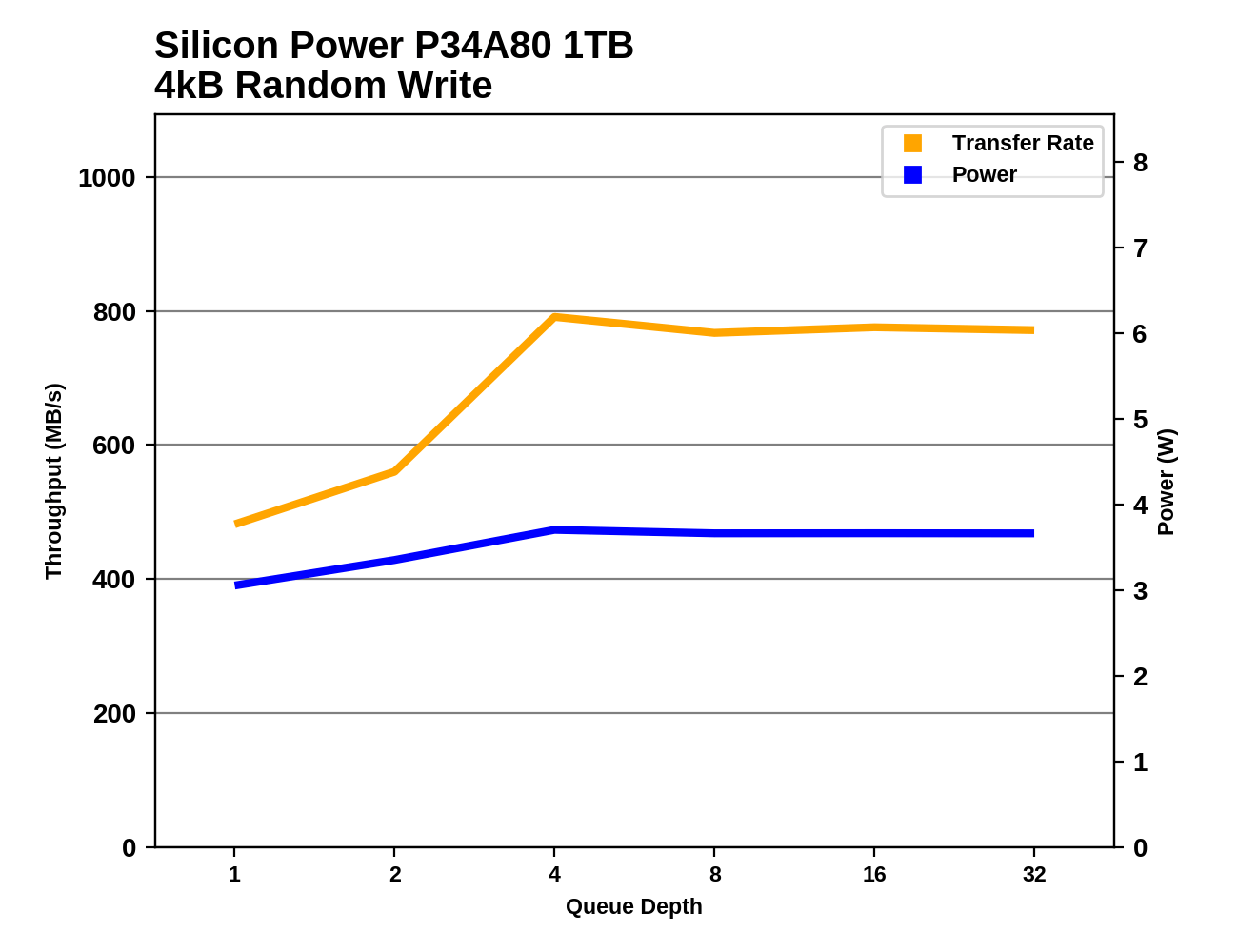
The random write performance of the P34A80 starts out with excellent performance for QD1, then peaks at QD4 and drops slightly thereafter, but is generally steady and remains fast through the rest of the test.
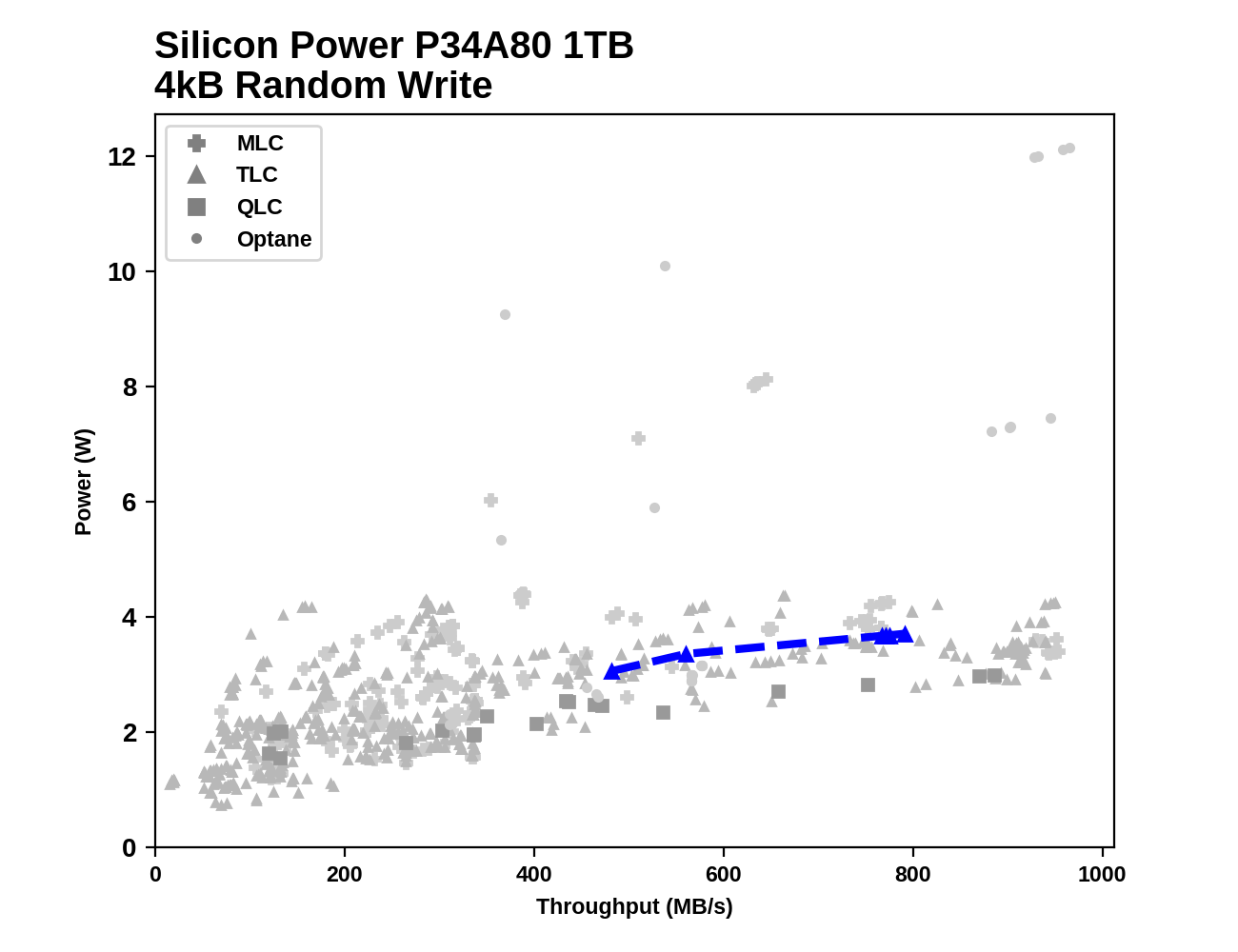
When viewed against the results for all the drives that have completed this test, the performance of the P34A80 at high queue depths is substantially slower than most high-end drives, and the power draw is higher as well.
Originally published at https://www.anandtech.com/show/13955/the-silicon-power-p34a80-ssd-review-phison-e12-with-newer-firmware (Wayback Machine).