
Canon's 300D (Digital Rebel) vs 10D: Battle of the DSLRs
- Posted in
- Digital Camera
The Design
|
|
|
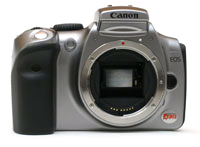
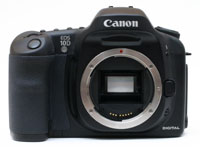
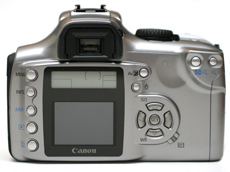
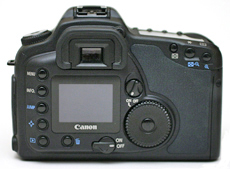
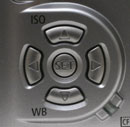
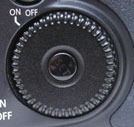
The first considerable difference that we noticed between these two cameras is the way they felt in our hands. The Rebel casing is made of a slick, silver plastic, while the 10D casing is constructed with magnesium alloy. Because of the metal construction of the 10D, it does weigh a little more (30.5 oz with battery) than the Rebel (23 oz with battery). The 10D is bulkier in general, as you can see by its dimensions, but it feels well balanced in our hands and even has a molded, rubberized grip for the trigger hand. The extra room in its height allows for the camera's main power switch to be located on the back of the camera instead of the top. Another interesting difference was Canon's decision to put the LCD panel on the back of the Rebel, situated right above the LCD monitor. The 10D's LCD panel is on the top right, following a far more traditional Canon SLR style. The navigation system utilized by the two cameras appears to be similar except for one change - the Rebel has four arrow buttons (cross keys) and a set button in the middle, where the 10D has a wheel (Quick Control Dial) with a set button in the middle. The Main Dial, situated just behind the shutter button also serves as a means to navigate the menus.
|
|
|
|
|
|
These two cameras have virtually the same CMOS sensor, sizing in at 22.7 mm x 15.1 mm. It is important to keep in mind that the Rebel and the 10D do not have full-size sensors like the Canon 1Ds (35.8 x 23.8 mm), for example. This means a magnification factor of 1.6x. In other words, using the same lens from your 35mm film Canon EOS 300 will give you a cropped version of the same picture with the 10D and the Rebel. This can be seen as a good and bad thing. It means that to get the results you would normally get from a regular wide angle lens, you would have to buy a very expensive, super wide angle lens. However, at the same time, it means that your old 300mm telephoto lens has just earned an extra 180mm coverage, giving you a whopping 480mm effective shooting ability. Again, it all depends on how you look at the situation.
Both the 10D and the Rebel use Compact Flash (Type I or II). Also, because they have a FAT32 file system, they are able to support larger-capacity cards such as the Lexar 4GB and the Hitachi Microdrive 4GB. This is a great advantage over other types of removable media-based cameras.
|
|
|
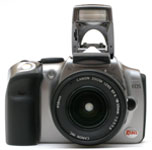
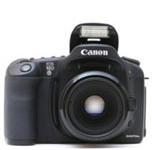
Both cameras have a pop-up flash with a release button on the front side, opposite the shutter button. The 10D has a motorized mechanism that releases the flash, while the Rebel relies on non-motorized spring action release. We measured the Rebel's flash at 2.25 cm higher than the 10D's. This difference gives the Rebel's flash an advantage when shooting with longer lenses. Because it is higher, it has more room to shoot over the lens instead of through it (which would create shadows on the subject).
One major addition to the Rebel was the compatibility of a new type of lens, called EF-S (Electrofocus Short Back Focus). Canon introduced this lens as an 18-55mm f3.5-5.6 to be packaged with the Digital Rebel. It should be noted that EF-S lenses are not compatible with other EF mount cameras such as the 10D. The EF-S mount is marked by a white dot on the front of the camera body indicating where to align the lens when attaching it. The 18-55mm lens boasts a perfected lens coating that is supposed to minimize reflections, which would guard against flaring and ghosting. The lens is also capable of focusing at distances as close as 0.28m. Basically, Canon is trying to compensate for the 1.6x magnification factor by distributing a wide angle zoom lens with the Rebel. For the purpose of this review, I will be using a 50mm f2.5 macro lens that uses an EF mount simply because it will fit on both cameras.
The controls for adjusting picture settings are a little different for each camera (mostly because of the subtraction of the wheel on the Rebel). The Main Dial is responsible on both cameras for adjusting the:
- Aperture in Av (Aperture Priority) mode
- Shutter speed in (Shutter Priority)Tv mode
- Shutter speed and aperture combination in P (Program AE) mode
- Shutter speed in Manual mode
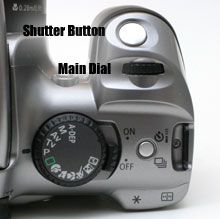
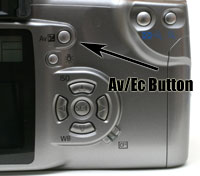
On the 10D, adjusting the aperture in Manual mode is just a simple turn of the Quick Control Dial. On the Rebel, you have to hold down the Av/Ec (Aperture value/Exposure compensation) button while you turn the Main Dial in order to adjust the aperture. While the button is within reach of my thumb, it is certainly more convenient on the 10D to spin the wheel.
One huge advantage that the 10D has over the Rebel is the option to adjust Custom Functions under the main menu. One such option is to enable mirror lockup. Mirror lockup is when the mirror flips up prior to exposure in order to help prevent vibrations normally caused by the mirror movement. Any wildlife photographer would need to utilize this feature to keep their images sharp while shooting with telephoto lenses. The same applies to macro photographers. Mirror lockup ability is not a feature of the Rebel. In addition to mirror lockup, you are given the option to separate AF (Auto Focus) from AE (Auto Exposure) lock (normally, they coincide), which is very helpful in circumstances where you want to have total control over the exposure lock (function 4). Another option allows you to control the activity of the AF-assist beam. In automatic modes, if the ambient light is too low, the flash will emit short preliminary flashes in order to attain focus. Sometimes, this can be frustrating if you are in situations where the extra flashing could impose on your subject. Luckily, custom function 5 gives you control of the nature of the assist beam. Another really cool feature is the option to enable auto reduction of the fill flash. Basically, this option is for situations when you are shooting outdoors with ambient light and you want to use the flash as a fill light to cancel out unneeded shadows. Enabling this option (function 14) will automatically weaken the flash if the ambient light levels are bright enough. This is to ensure a well exposed background while preventing the flash from washing out your subject. These are just a few of the 17 custom functions on the 10D.
Two more features that the 10D offers are the ability to select what type of metering and auto focus that you would like. For metering, you can choose between evaluative 35-area, partial (9% of viewfinder), and center-weighted average. The Rebel has the ability to do these metering modes too, but it automatically decides what is best and offers no input from the user. On the 10D, the user can choose between One Shot AF (for still subjects), AI Servo AF (to track moving subjects), or AI Focus AF (to let the camera switch from One Shot to Servo if it detects movement). Again, the Rebel has these features, but gives the user no control over them.
The 10D is capable of taking 9 consecutive frames at 3 fps, while the Rebel can take 4 consecutive frames at 2.5 fps. This advantage of the 10D may be more important to some photographers if they are likely to be shooting sports events or other fast-paced subjects.
Originally published at https://www.anandtech.com/show/1376 (Wayback Machine).