
The Supermicro C9Z390-PGW Motherboard Review: The Z390 Board With PLX and 10GbE
Supermicro C9Z390-PGW Conclusion
As it currently stands, the Supermicro C9Z390-PGW sits atop its product stack as flagship board of the SuperO brand. Other Z390 models from Supermicro include the C9Z390-CGW ($273) which is the model directly below, and a mini-ITX sized version, the C9Z390-CG-IW ($203) which represents a competitive option against other vendors small form factor offerings. Supermicro has stuck to what it's good at and included elements of its professional-grade motherboards with its use of TU-662/NP175 epoxy glass resin PCB for improved efficiency and better signal transmission throughout.
It's clear that the purely professional elements such as the epoxy resin PCB construction aren't the main focal point of what makes the C9Z390-PGW attractive to enthusiasts. The overall controller combination used by Supermicro is impressive and is led by the Broadcom PEX8747 PLX PCIe switch. Also included is an Aquantia AQC107 10-gigabit network controller, an Intel I219-V gigabit network controller, and an Intel 9560 802.11ac Wi-Fi adapter which uses the Z390 chipsets included CNVi. Along with this are two M.2 ports and two U.2 ports, supplimenting the storage. The SuperO brand focuses on gaming, and the PGW does include a Realtek ALC1220 audio codec which some consider being a 'gaming' feature which offers 7.1 HD audio through five 3.5 mm audio jacks and an S/PDIF optical output on the rear panel.
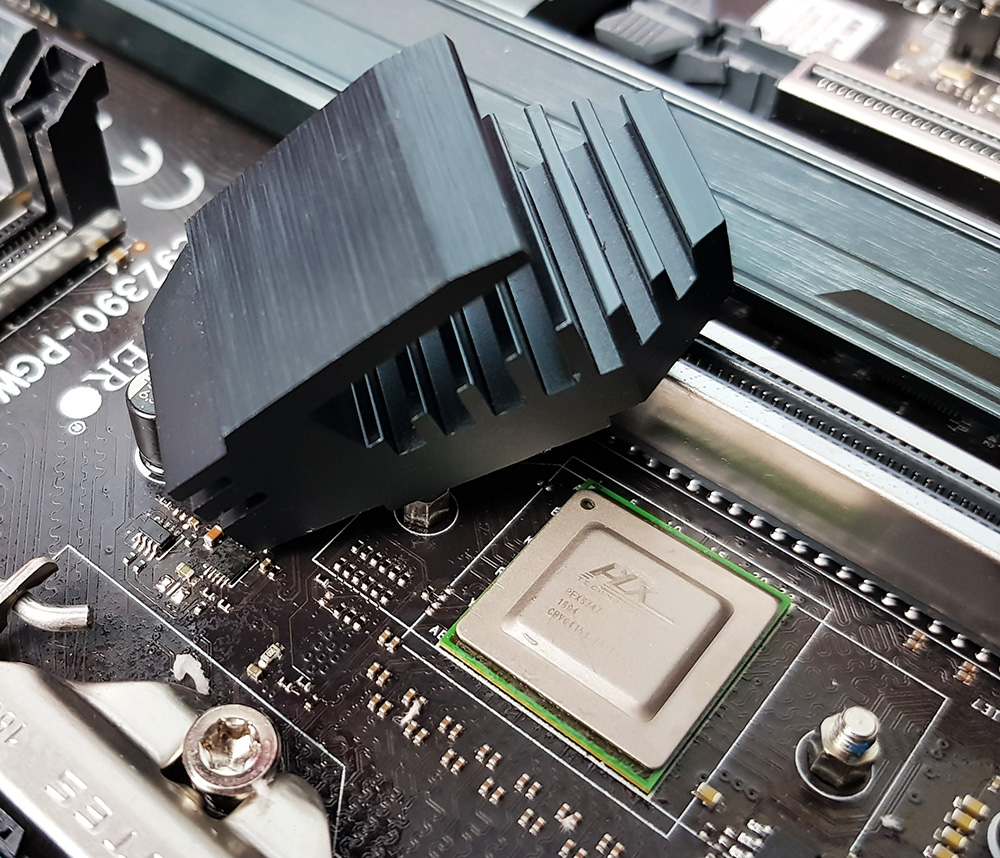
Broadcom PEX8747 PLX chip with heatsink on the Supermicro C9Z390-PGW Motherboard
With the inclusion of the Broadcom PEX8747 PLX chip, users can make use of the four full-length PCIe 3.0 slots which run at x16/-/x16/- or x8/x8/x8/x8. This is certainly useful for users looking to run additional PCIe co-processors in each slot. This is a positive for overclockers looking to make use of the improved IPC performance of the 8th and 9th generation Intel processors when benchmarking older NVIDIA graphics cards in four-way SLI such as the GTX 480 or GTX 580; some people actually still try and attempt to break four-way SLI records on HWBot. Outside of these, it's hard to see the use other than in cases where users are building a workstation which this board is somewhat suitable for.
Not only is the Supermicro C9Z390-PGW using a premium controller set, but the power delivery is also more than capable. It consists of two key elements which Supermicro has split down the middle; a 6+1 VCore section with an Infineon PXE1610 controlling the TDA21232 power stages and a 3+1 SoC section controlled by an Infineon PXM1310 PWM controller with TDA21240 power stages. There are no doubts that this setup is capable of pushing overclocks to their limits with ambient coolers, but any issues encountered by users are likely to come if they aren't accustomed to the firmware or used to boards with loose VDroop. The C9Z390-PGW has one of the loosest VDroops at default I've used so far on an LGA1151 board and it did hinder our overclocking attempts at higher core frequencies. Supermicro needs to work on updating its firmware as there are some antiquated elements such as the voltage input which doesn't use a decimal place format; this could cause confusion for users not familiar with this.

Touching more on the overall performance, the Supermicro C9Z390-PGW is competitive with a very strong showing in our POV-Ray benchmark. Nothing major was out of the ordinary, but the biggest caveat which is common with Supermicro's boards that we have tested so far is POST time; they just take too long to boot into Windows. Overclocking performance despite the above issues with the firmware was good with 5.1 GHz achieved with 1.45 V on the VCore which under load was 1.416 V; we did hit thermal throttling with this overclock with the core frequency being dialled down to 4.8 GHz.
A consolidation of very premium elements including the Aquantia AQC107 10G NIC, Broadcom PEX8747 PLX chip and Realtek ALC1220 make this highly attractive on paper. The crux however, is that the overall experience is let down ultimately by an oversight on its lack of SuperOBoost software on the product CD or the official product page. This is required to operate one of the primary features which are the RGB LED lighting, and certainly could have been better thought out.
All of this aside, the $371 price tag seems really good for the feature set on offer, and the performance as stated is competitive. Supermicro has, on the whole, stepped up to the plate with this design, and are now a real contender against the more established motherboard brands - easily the best motherboard from them that we've tested. If we had a 'most improved' award, the Supermicro C9Z390-PGW would get it.
AnandTech 9th Gen CPU and Z390 Motherboard Coverage
- The Intel 9th Gen Review: Core i9-9900K, Core i7-9700K and Core i5-9600K Tested
- The MSI MEG Z390 ACE Motherboard Review: The Answer To Your USB 3.1 Needs
- The ASRock Z390 Taichi Review: Jack of All Trades, Master of None
- Analyzing Core i9-9900K Performance with Spectre and Meltdown Hardware Mitigations
- Intel to Support 128GB of DDR4 on Core 9th Gen Desktop Processors
- Intel Z390 Motherboard Overview: 50+ Motherboards Analyzed
- GSkill Announces DDR4-4800 and DDR4-4500 Kits for Z390 Boards
Originally published at https://www.anandtech.com/show/13706/the-supermicro-c9z390-pgw-motherboard-review (Wayback Machine).