
The Birth of an Abit NF7 - A Factory Tour
- Posted in
- Motherboards
Assembly
On average, 1.4 out of 100 motherboards fail Rolly's quality assurance standards. These boards never leave the factory, but the cost of the components and manpower put into the motherboard are lost and translated onto the retail price. Efficiency of 98.6% is about average for a factory of this size. Although, Abit told us in the next several months that they are increasing funding to several projects,which should get this number closer to 99%. About 150 of the factory's 1400 employees are allocated solely to quality assurance testing.
Click to enlarge.

Click to enlarge.
Above, you can see a specialized machine electrically testing the newly stamped SMDs on the motherboard. It is assumed that the PCB from the OEM is working correctly, so this is the first electrical test in the assembly process. Unfortunately, this poor NF7 does not pass inspection, even after several tries. The inspector places this board in a separate bin and it is sent to a reworking station where it undergoes manual electrical testing under oscilliscopes. The much higher skilled workers who test individual components with scopes are trained to solder or strip down a board depending on whether or not it can be reworked. Only after this stage does a bad motherboard get completely pitched. A short clip of an engineer testing a defunct board can be viewed below.
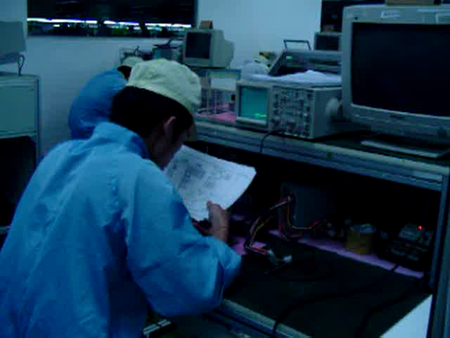
Right click to download.
After successfully passing the first visual and electrical inspection tests, the half completed motherboard moves down to the epoch of manual labor - the assembly line. Here, 30 to 40 workers sit on the assembly line and plug components too large for SMT into the motherboard. This includes components like PCI slots, DIMM slots, capacitors, audio connectors, and anything big enough to place easily with your fingers. All of these components slide into the holes predrilled into the PCB before it comes to the factory. As we mentioned in the ECS factory tour, assembly workers are primarily female. In this particular region of the world, women usually work for less and are proven to have higher concentration at tasks such as small component assembly.

Click to enlarge.

Click to enlarge.
Again, you can see above the amount of manual labor used to plug components into the motherboard. Every few stations or so, a worker uses a barcode scanner to scan the board into a centralized Oracle database. Each board is tracked stringently via this system, which is also connected globally. Managers in Abit's USA or Taiwan office can watch a board undergo each stage of construction in their office via the Oracle database interface. This system also provides excellent backtracking if a board is found later to have faulty components or poor assembly. The idea is to control quality with the highest standards, and then refine the process as quickly as possible so that no boards in the future are corrupted.
Originally published at https://www.anandtech.com/show/1350 (Wayback Machine).