
AOpen AK89 Max: From Ugly Duckling to Swan
- Posted in
- Motherboards
AOpen AK89 Max: Board Layout
Sleek and all-black have become the standard for recent AOpen boards, and the black AK89 Max looks great combined with the included black ide/floppy cables. The AK89 is a full-size ATX board with the standard 9 mounting holes.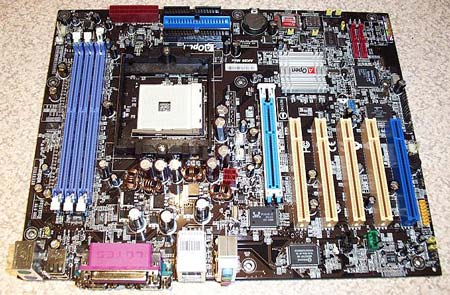
Layout of the AK89 is quite different from most standard ATX boards. The memory slots are located at the top of the board in a tower case instead of the more common location, right of the CPU. The CPU socket is also in the top center of the board. Despite the different layout, the AK89 worked quite well in our mid-tower case with everything very accessible. The extra space on the full-size ATX board removes most of the complaints that we had in the similar layout of the AOpen AK86-L.
Athlon 64 boards use a standardized ATX plus 12V connector arrangement that is identical to the power connector requirements of current Pentium 4 systems. We generally prefer the connectors together on the upper right of the board, but the AK89 has placed both the 20-pin ATX at the top right and the 4-pin 12V at the middle of the board left of the CPU socket. This arrangement actually works well with the CPU socket in the top center of the board. The heavy 20-pin is completely clear of the CPU and IDE/floppy connectors.
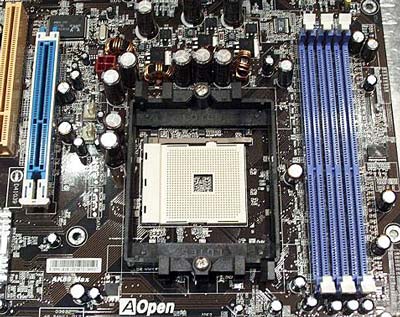
With the memory slots at the top of the board, there is no possible interference of the AGP slot. Adding and removing memory was very easy with this arrangement. There is nothing nearby to interfere with easy memory access. However, very small case designs with a power supply overhanging the CPU area on a standard board could be a big problem with this DIMM placement.
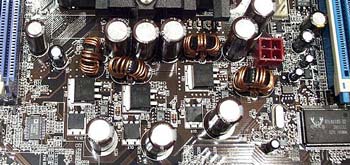
As a top-end board, the AK89 Max gets a top-end, 3-phase power design with 4 coils. We like the fact that AOpen also uses the large 3300µF capacitors for voltage stability. While the capacitors are near the Socket 754, we had no trouble mounting a huge Zalman 7000 for CPU cooling.
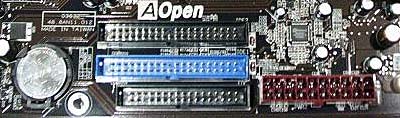
The Primary/Secondary IDE and floppy connectors are located on the preferred upper right of the board. This will not be a problem in almost any case design. The connectors are well clear of the memory slots, power connector, and expansion slots.
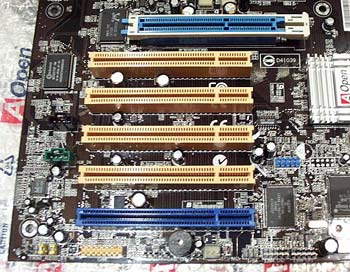
The slide for locking the 8X AGP slot was easy to use - even with huge overhanging cards like the GeForce FX5950U. Most boards use the push-to-release lock, but that design becomes difficult to use with a large card. The 5 PCI slots include a blue PCI slot with a separate power supply. Those with a power-hungry PCI card will appreciate the extra stability of the dedicated power design for this slot.
Originally published at https://www.anandtech.com/show/1303 (Wayback Machine).