
The Kingston A1000 NVMe SSD Review: Phison E8 Revisited
Sequential Read Performance
Our first test of sequential read performance uses short bursts of 128MB, issued as 128kB operations with no queuing. The test averages performance across eight bursts for a total of 1GB of data transferred from a drive containing 16GB of data. Between each burst the drive is given enough idle time to keep the overall duty cycle at 20%.
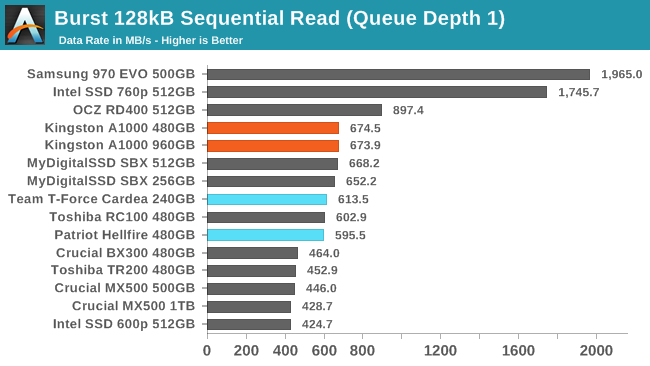
The burst sequential read performance of the Kingston A1000 can't match high-end NVMe SSDs, but as good as any other low-end NVMe SSD and significantly higher than what SATA drives can deliver. Performance is up slightly compared to the older Phison E7 drives that tried to be high-end for their time.
Our test of sustained sequential reads uses queue depths from 1 to 32, with the performance and power scores computed as the average of QD1, QD2 and QD4. Each queue depth is tested for up to one minute or 32GB transferred, from a drive containing 64GB of data.
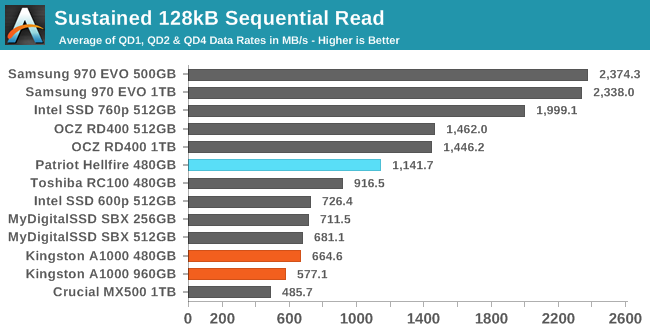
On the sustained sequential read test, the Kingston A1000's standing drops substantially, with performance now lower than almost all NVMe SSDs. The 960GB A1000 is clearly slower than the smaller model, likely due to the extra overhead of managing so many NAND flash dies on a four-channel controller.
 |
|||||||||
| Power Efficiency in MB/s/W | Average Power in W | ||||||||
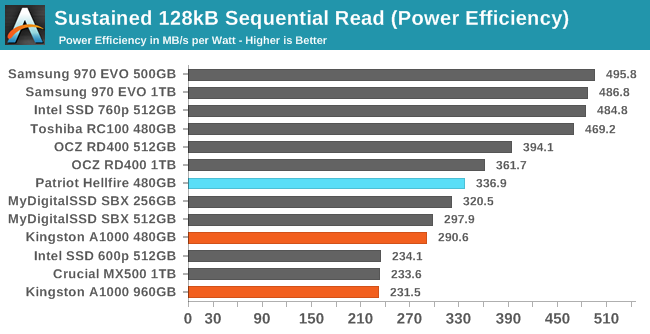
The power consumption of the A1000 is relatively low by NVMe standards, but given its performance the efficiency ends up being quite poor, especially for the 960GB model.
 |
|||||||||
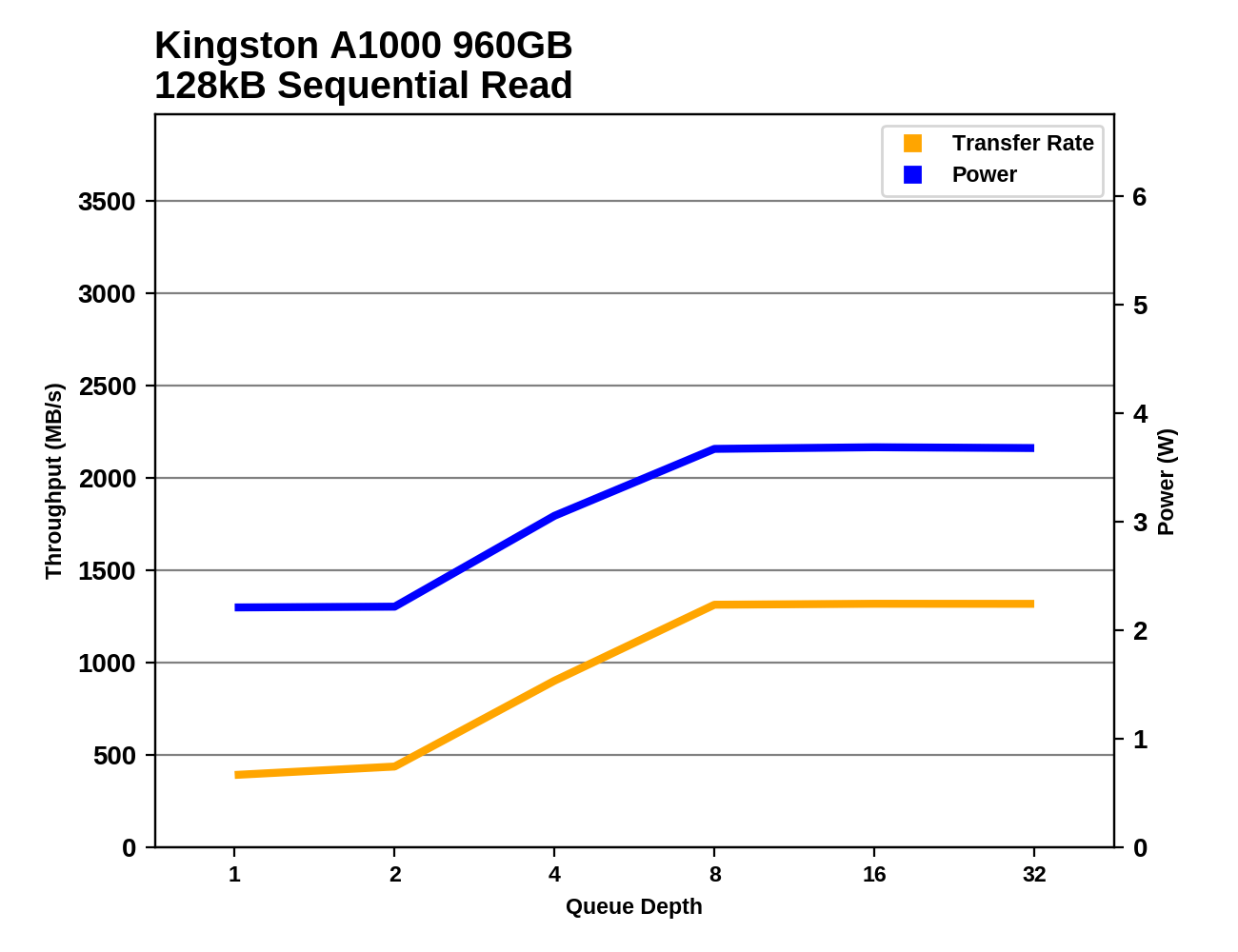
Quite a few SSDs show the same lack of scaling that the A1000 exhibits when increasing from QD1 to QD2. Beyond that, the A1000 scales up substantially to reach full speed at QD8, but it doesn't quite hit the advertised 1.5GB/s.
Sequential Write Performance
Our test of sequential write burst performance is structured identically to the sequential read burst performance test save for the direction of the data transfer. Each burst writes 128MB as 128kB operations issued at QD1, for a total of 1GB of data written to a drive containing 16GB of data.
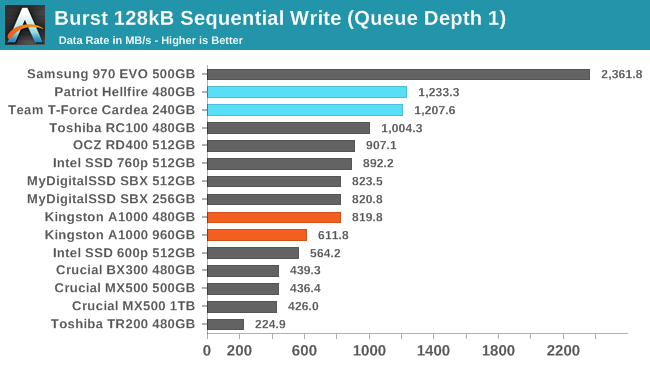
The larger 960GB Kingston A1000 has a much lower burst sequential write speed than the smaller model, which matches the MyDigitalSSD SBX. Even the slower A1000 is still significantly faster than a SATA SSD, but the high-end NVMe SSDs definitely deliver a different class of performance here. The Phison E7 drives are still quite competitive here and outperform all but Samsung.
Our test of sustained sequential writes is structured identically to our sustained sequential read test, save for the direction of the data transfers. Queue depths range from 1 to 32 and each queue depth is tested for up to one minute or 32GB, followed by up to one minute of idle time for the drive to cool off and perform garbage collection. The test is confined to a 64GB span of the drive.
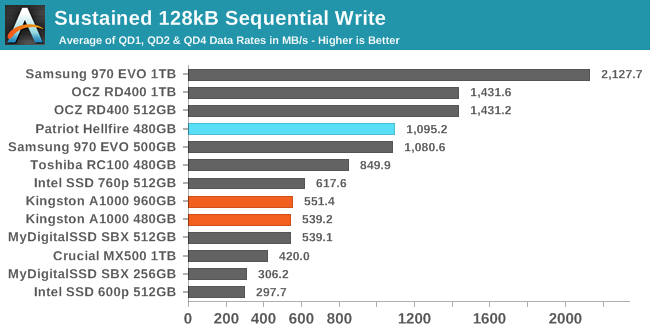
On the longer sequential write test, both capacities of the A1000 perform the same, and on par with the SBX. This puts them near the bottom for NVMe SSDs, but they're still staying beyond the reach of SATA SSDs. Performance is about half of what the Phisone E7 delivered with MLC NAND.
 |
|||||||||
| Power Efficiency in MB/s/W | Average Power in W | ||||||||
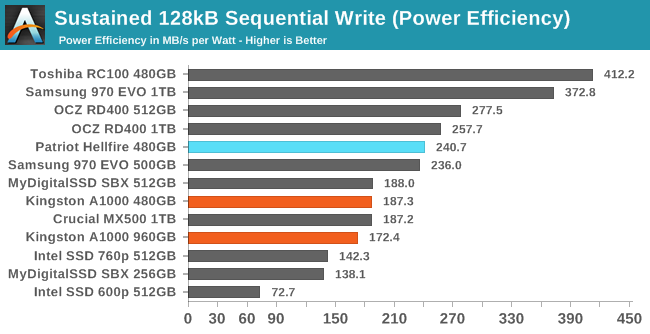
The power efficiency of the Kingston A1000 isn't great: it is only about as good as decent SATA drives for sequential writes. Many NVMe SSDs are able to deliver much better power efficiency for sequential workloads where their PCIe interfaces allow for performance far in excess of what SATA can handle. The Toshiba RC100 is the best example of this, delivering more than twice the data per Watt.
 |
|||||||||
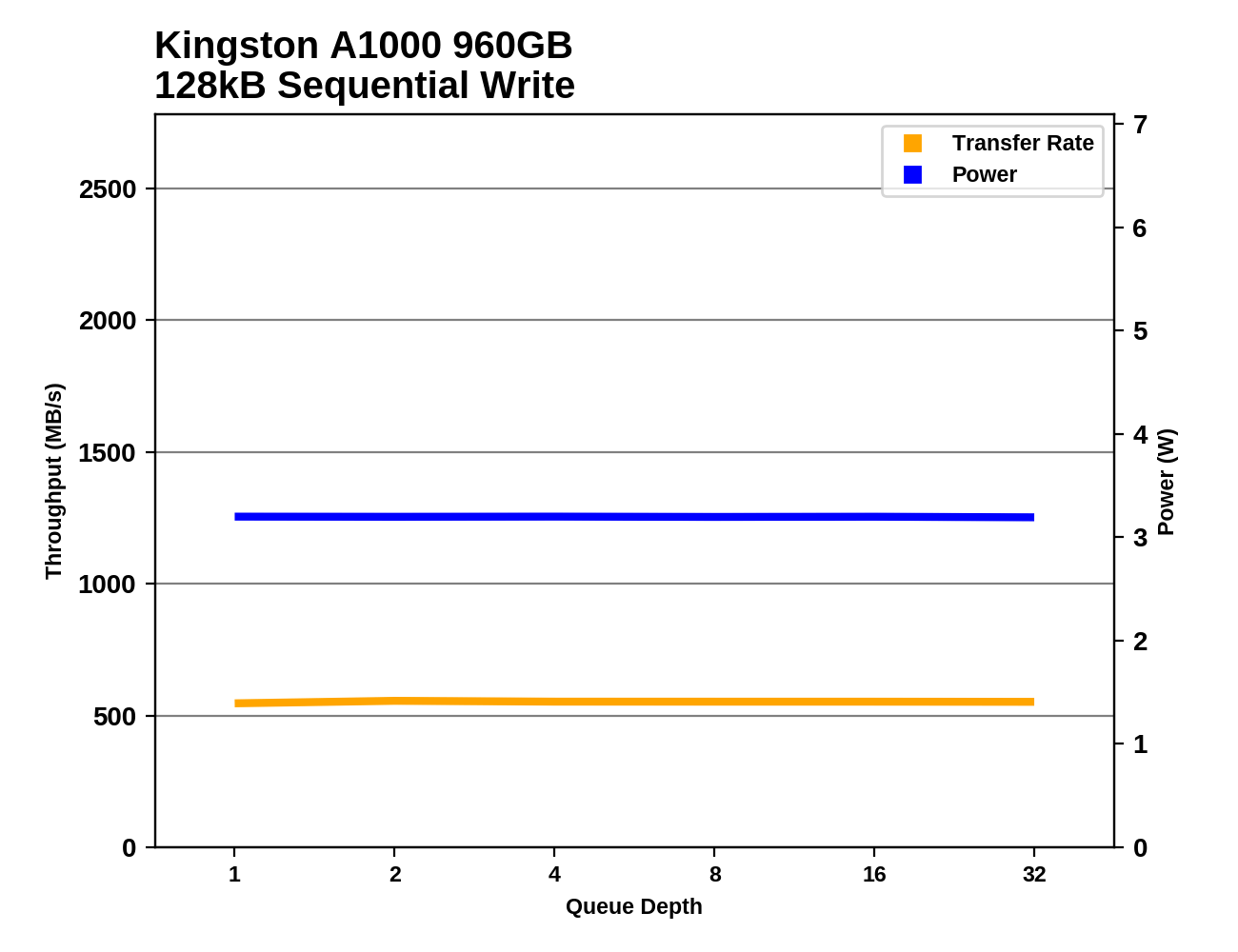
Sequential write performance from the Kingston A1000 is flat across the entire queue depth range, with full performance available at QD1 and no sign of problematic garbage collection cycles later in the test.
Originally published at https://www.anandtech.com/show/12991/the-kingston-a1000-nvme-ssd-review (Wayback Machine).