
The Kingston A1000 NVMe SSD Review: Phison E8 Revisited
AnandTech Storage Bench - Light
Our Light storage test has relatively more sequential accesses and lower queue depths than The Destroyer or the Heavy test, and it's by far the shortest test overall. It's based largely on applications that aren't highly dependent on storage performance, so this is a test more of application launch times and file load times. This test can be seen as the sum of all the little delays in daily usage, but with the idle times trimmed to 25ms it takes less than half an hour to run. Details of the Light test can be found here. As with the ATSB Heavy test, this test is run with the drive both freshly erased and empty, and after filling the drive with sequential writes.
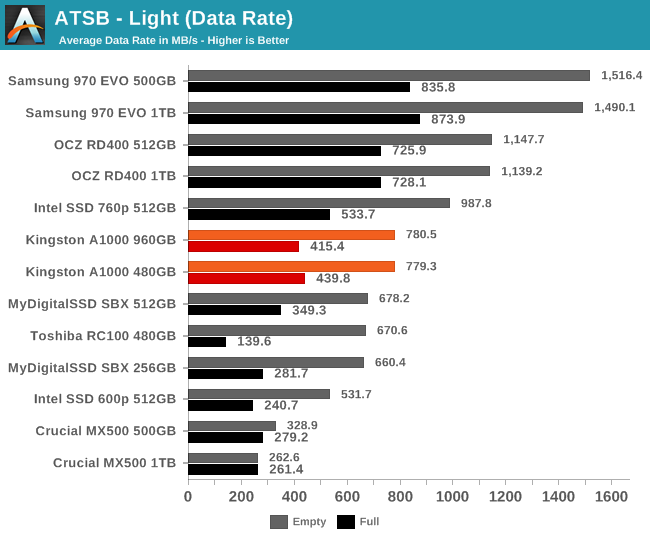
The average data rates from the Kingston A1000 on the Light test are a step up from the MyDigitalSSD SBX, both when the test is run on an empty drive and when the drive is full. The A1000 is clearly quite a bit faster than SATA drives, but for workloads this light the difference won't be very noticeable.
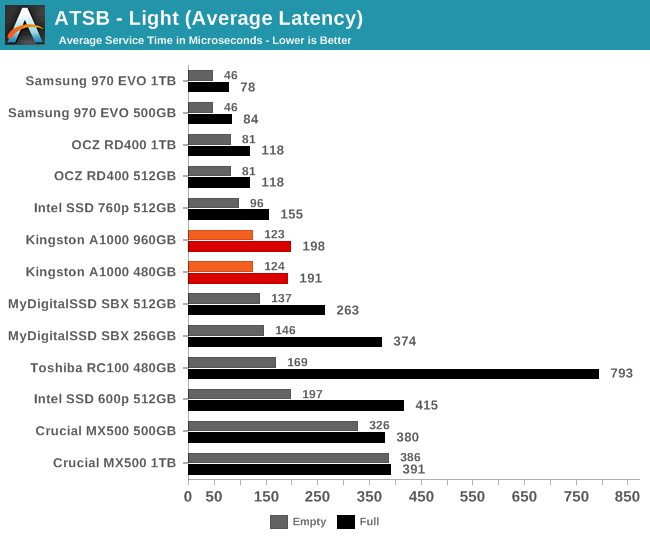
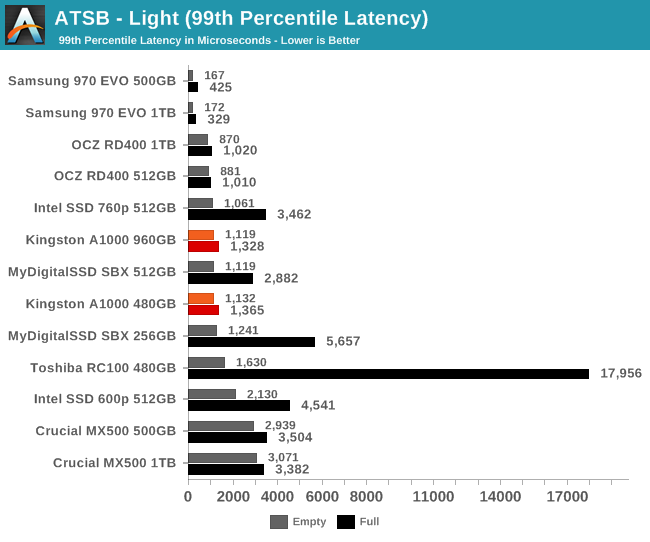
The extra spare area of the A1000 as compared with the SBX shows up clearly in the impact on full-drive latency, especially the 99th percentile latency. The A1000 has great QoS that looks much more like that of a high-end NVMe.
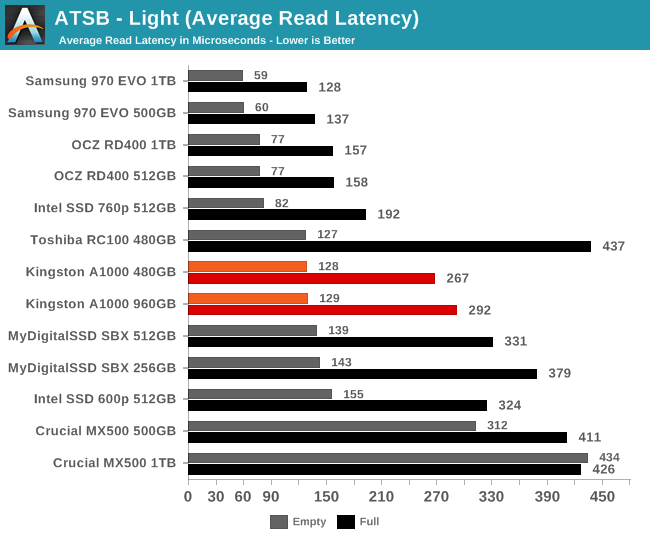
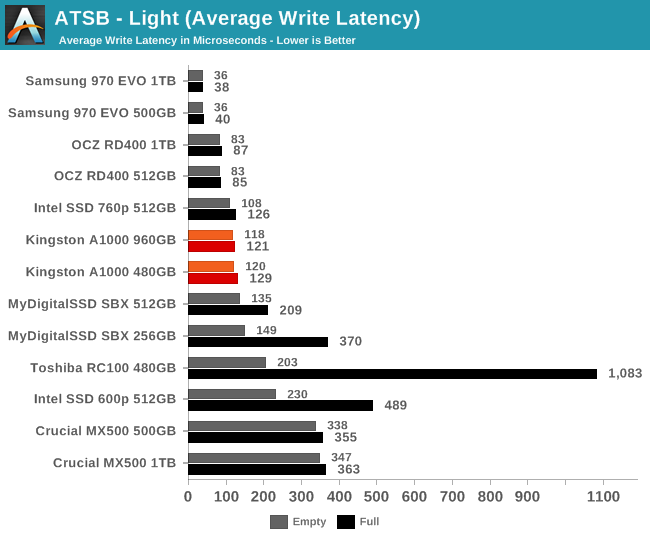
The average read latencies from the Kingston A1000 don't particularly stand out from the competition, but the average write latency is clearly better than other low-end NVMe SSDs, especially when the test is run on a full drive.
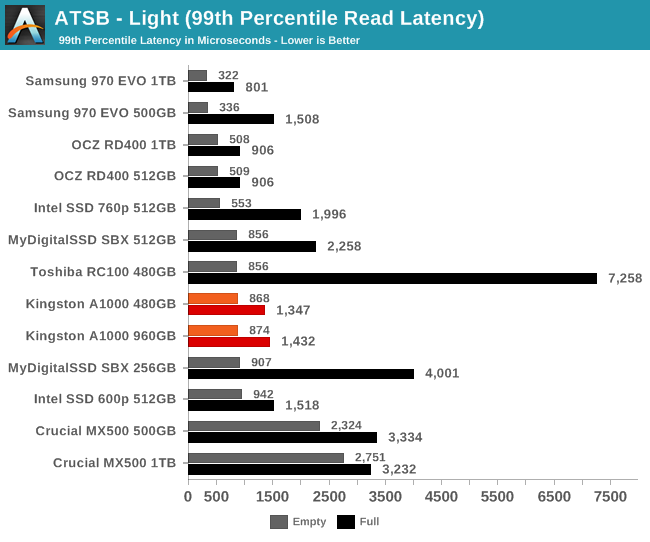
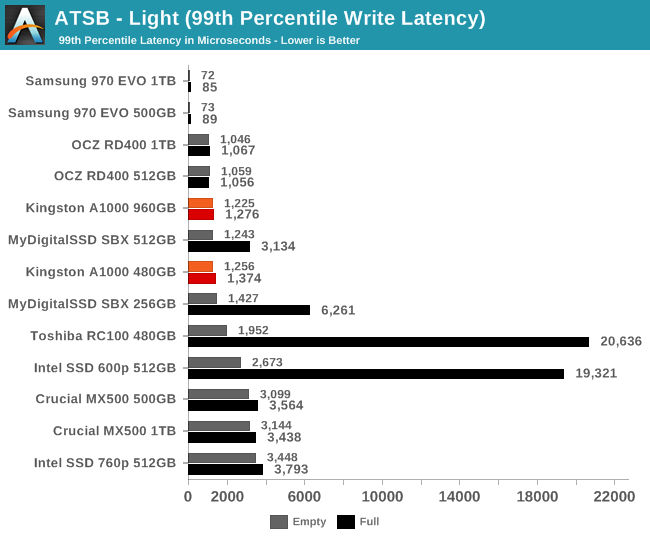
The 99th percentile read and write latency scores amplify the full-drive performance advantage of the Kingston A1000, to the point that even the read latency is noticeably better than its closest competition, and the write QoS is quite good.
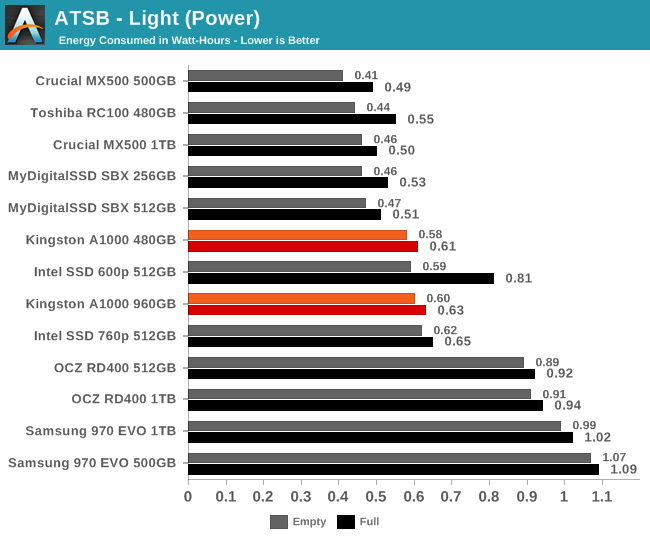
The MyDigitalSSD SBX and Toshiba RC100 were able to more or less match the Crucial MX500 SATA SSD for energy usage on the Light test, but the Kingston A1000 doesn't do as well. It is still more efficient than most NVMe drives, but not remarkably so.
Originally published at https://www.anandtech.com/show/12991/the-kingston-a1000-nvme-ssd-review (Wayback Machine).