
Marrying Vega and Zen: The AMD Ryzen 5 2400G Review
Power Consumption
For our power consumption metrics, we use a Prime 95 blend on fixed threads to generate a strong load, and then poll the internal power registers that determine power state calculations to get the power consumption. Each processor is different in how it reports its power, which depends on the level of control the processor has: some of the more advanced CPUs, such as Ryzen, will provide per-core power numbers, while the latest Intel CPUs only give a figure for the CPUs as a whole but also include DRAM controller and uncore power consumption.
An interesting element to the power consumption on the Ryzen APUs, due to the unified power delivery subsystem in play feeding the CPU and the integrated graphics, is that the power registers only report half the power consumption when probed (e.g. when 14W, shows 7W). As of yet, we are unsure if this has a knock-on effect on how the processor adjusts its turbo modes in response to power consumption. Nonetheless, a simple scaling factor gives the following results.
Total Package: The Whole Processor
For this data, we take the values of the processor as a whole, which includes all the interconnect, memory controllers, PCIe root complexes, etc. The system is still only loading the CPU cores with minimal effect on the rest of the system, however depending on how the power is managed, some of the sub-systems still remain enabled.
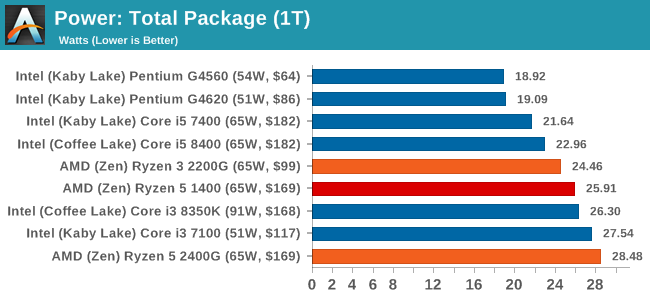
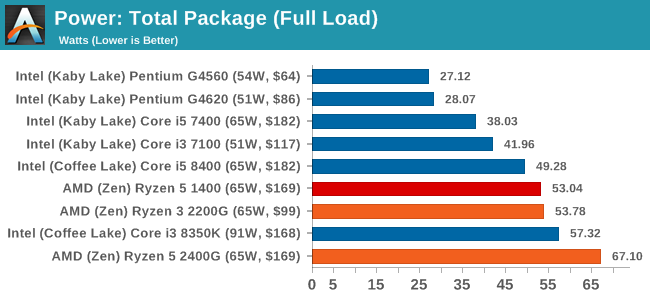
At full load, the difference between the Ryzen 5 and the other Ryzen CPUs shows that the 2400G is using more of its upper margin, compared to the 1400 which is rated at the same power (note TDP is only determined at the base frequency), but the extra frequency of the 2400G means that there is extra power draw overall. Part of this is due to the Infinity Fabric, which we will see below. But what these tests also underline is that in a quad-core configuration, the Intel CPUs are still very power efficient.
Cores Only: Pure Work
For the processors that split out the data, we can look at the power consumption of the cores on their own, without any of the sub-systems, like uncore, mesh, or infinity fabric. This usually paints a different picture to the package power.
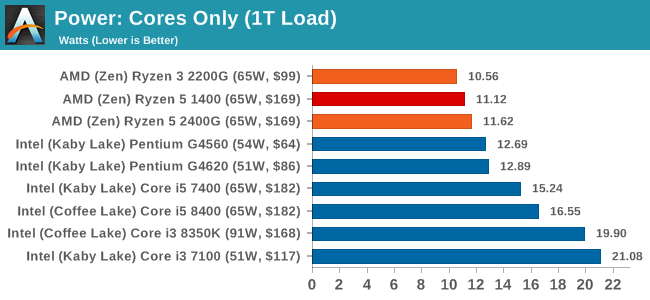
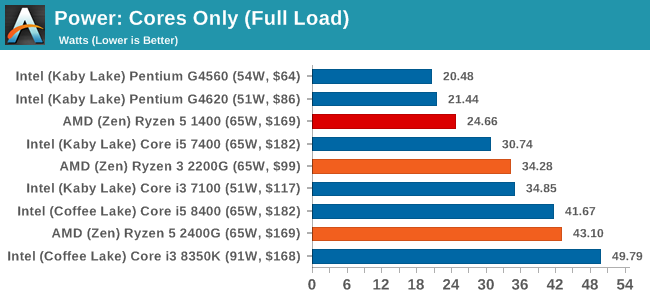
For the core only power, the Ryzen 5 2400G uses less power than the Core i3-8350K, despite the situation being reversed when considering the whole package. This means that Infinity Fabric takes a lot of power here, and the ring bus solution that Intel uses benefits from being simpler, and Intel can push more power to its individual cores.
Originally published at https://www.anandtech.com/show/12425/marrying-vega-and-zen-the-amd-ryzen-5-2400g-review (Wayback Machine).