
The MSI X299 XPower Gaming AC Review: Flagship Fantasy
Overclocking
Experience with the MSI X299 XPower Gaming AC
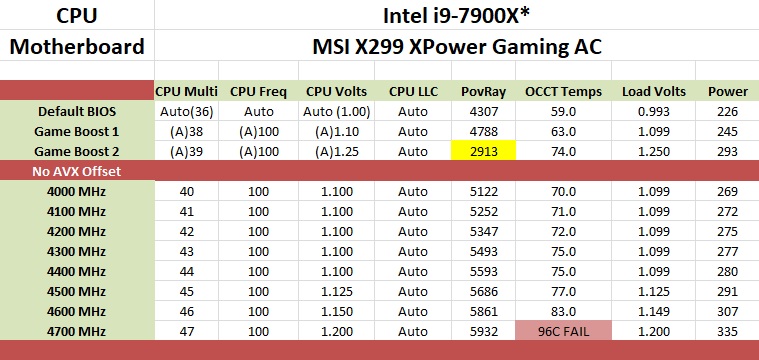
Overclocking the MSI X299 XPower Gaming AC was just as straightforward as most any other board. The BIOS options are easy to find and most items are on the first page or one level down making finding and changing options quick and painless. The VRM handled up to 4.7 GHz as we blasted up to our self-imposed 90C temperature limit. Running 4.5 GHz and 1.125V (1.9V Input), the VRMs peaked at 71°C in our extended stress test which is a good result. The board will not have trouble keeping the VRMs cool.
The Game Boost functionality which promises one-touch overclocking assuming you have the right cooling, was a disappointment here, as it has been on other MSI boards. The knob can go up to 11, however, we were only able to use the first level, just like we saw on the Gaming M7 ACK. At this setting, the single core limits are up to 4.4 GHz while all core AVX loads get a 200 Mhz bump to 3.8 GHz. This worked out well. It was when we moved to level 2 where things went awry. The voltage was set to 1.25V, a huge jump, for clocks to raise 100 Mhz all around (4.5 GHz single core 3.9 GHz all core AVX). We started to run POV-Ray and saw current throttling out of the gate which cut performance results nearly in half. Manually raising the current limit to the max via Intel XTU was not successful, but disabling power limits in the BIOS allowed us to get past that hurdle. The software setting 1.25V was simply too much for this cooling to handle and we were forced to stop there. In the end, Game Boost brought us one very minor step up from stock leaving the other seven options unusable without a significant bump in cooling performance, delidding, or both.
The board did not run into any issues with either the DDR4-2666 or the DDR4-3200 sets of RAM we use for testing. Like the other X299 boards, it was 'set XMP and go'. We were able to overclock past the XMP settings of our 3200 sticks and reached DDR4-3600 speeds without issue as well.
The Command Center software is one of the more complete windows based utilities offering monitoring and control over the system. There are options to set up custom fan curves, overclocking, and even memory (though I prefer to do so in the BIOS). For those concerned, it will display MOSFET temperatures (as does the BIOS).
The MSI X299 XPower Gaming AC is a more than capable overclocking motherboard. Game Boost needs to be tweaked to be more useful, but it has all the bells and whistles for manual overclocking and didn't balk during out testing. If extreme overclocking is your thing, the board has plenty of features such as voltage read points, slow mode, BCLK generator, and buttons on the motherboard for on the fly increases in BCLK or CPU ratio which most boards do not have.
Overclocking Methodology
Our standard overclocking methodology is as follows. We select the automatic overclock options and test for stability with POV-Ray and OCCT to simulate high-end workloads. These stability tests aim to catch any immediate causes for memory or CPU errors.
For manual overclocks, based on the information gathered from the previous testing, starts off at a nominal voltage and CPU multiplier, and the multiplier is increased until the stability tests are failed. The CPU voltage is increased gradually until the stability tests are passed, and the process repeated until the motherboard reduces the multiplier automatically (due to safety protocol) or the CPU temperature reaches a stupidly high level (90ºC+). Our test bed is not in a case, which should push overclocks higher with fresher (cooler) air.
Overclocking Results
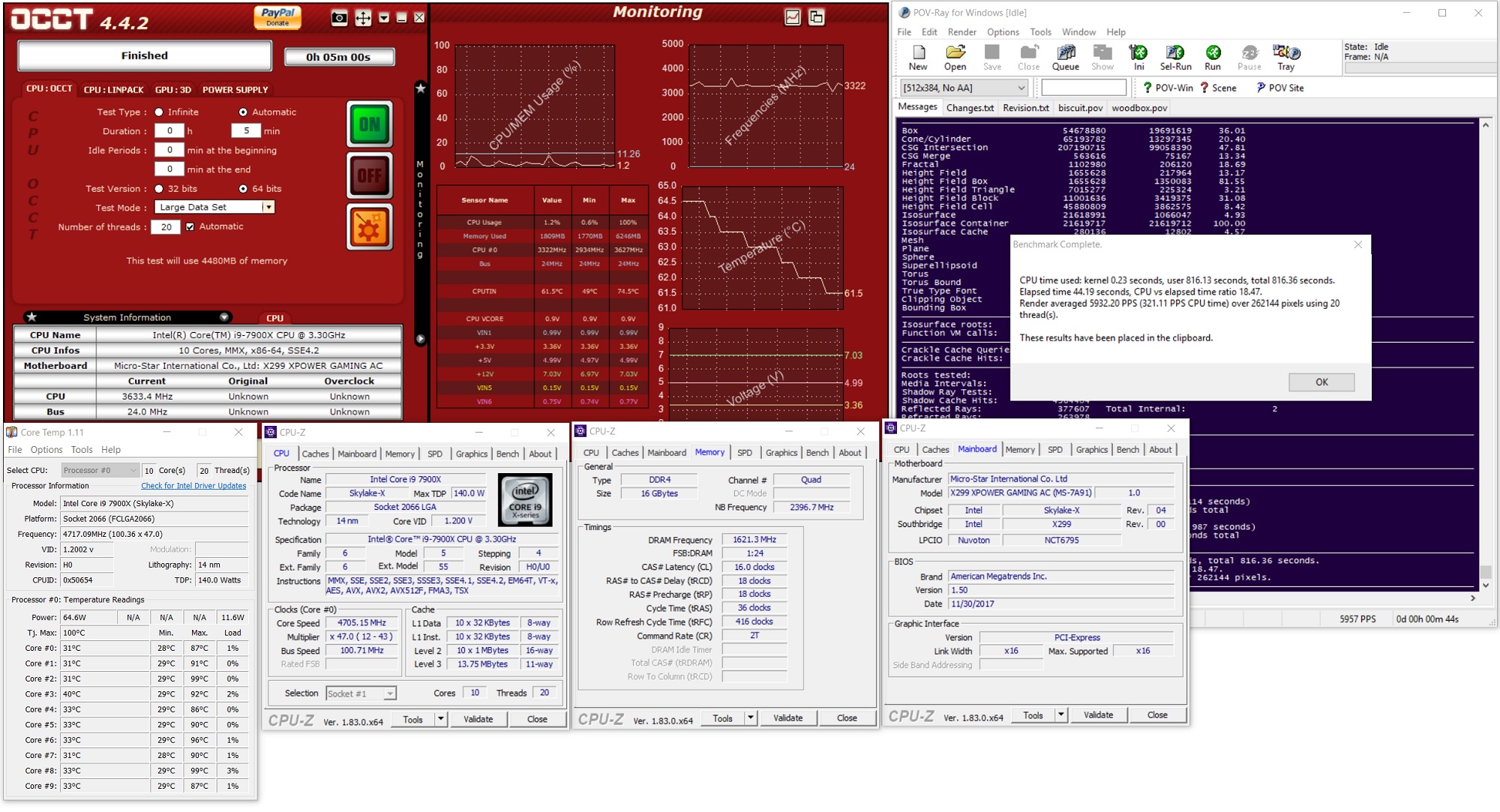
The MSI X299 XPower Gaming AC topped out at 4.6 GHz when keeping things under 90C with the processor. Due to our test bench cooling solution, we are temperature limited and without a larger custom cooler and possible delid of the CPU, we are unable to push further. There was very little or no vdrop and vdroop with LLC set to auto. This board has voltage read points and the values listed in the table below are from the Digital Multi-Meter (and matched Core Temp, the software used to read the Vcore). All boards we have tested were very stable with voltages not needing any manual adjustment to keep load voltage close to what was set in the BIOS. At the top overclock of 4.6 GHz and 1.149V, the system pulled 307W at the wall with the CPU itself claiming about 200W of that value.
Originally published at https://www.anandtech.com/show/12416/the-msi-x299-xpower-gaming-ac-motherboard-review (Wayback Machine).