
Socket 940 Roundup: Motherboards for the Athlon64 FX
- Posted in
- Motherboards
Asus SK8V: Features and Board Layout
Since Asus often provides Reference Boards for technology introductions, and the Socket 940 SK8N was already available in the marketplace, it was a bit of a surprise to see Asus introduce a new Socket 940 motherboard. The SK8V, based on the competing VIA K8T800 chipset, was an all-new design for Asus, and unquestionably, a risky venture in a limited market segment. With a somewhat limited lifespan expected for boards catering to the Socket 940 version of the Athlon64 FX processor, Asus must be confident that this board will stand out from the competition.The Asus SK8N was one of the first boards to be introduced for the Opteron, and with BIOS revisions, it has remained a very competitive Socket 940 board with a good feature set. However, with the new SK8V, Asus pulled out all the stops and loaded it with all the latest Asus trademark features.
Please refer to the table below for the main difference between SK8V and SK8N.
| SK8V | SK8N | |
| North Bridge | VIA K8T800 VIA VT8237 |
nVidia nForce 3 Pro150 |
| South Bridge | ||
| DDR 400 support | Yes (With Athlon 64 FX) | |
| RAID | Dual RAID (Promise 20378 & VIA 8237) | Promise 20378 |
| Audio chipset | ADI 1985-6CH | ALC650-6CH |
| Gigabit LAN | 3Com 3C940 | CK8 MAC+ Realtek RTL8201BL PHY |
| Max 1394 ports | 2 | 2 |
| Max USB 2.0 ports | 8 | 6 |
| WiFi Slot | Yes | No |
| PCI standard | PCI 2.2 | PCI 2.3 |
As you can see, the SK8V certainly has a different look than most current Asus boards. Instead of the gold/pale brown color that Asus normally uses, the SK8V is finished in all black. The Asus SK8V is a full-size, ATX 3-phase design that is a very different design and layout from the earlier SK8N.
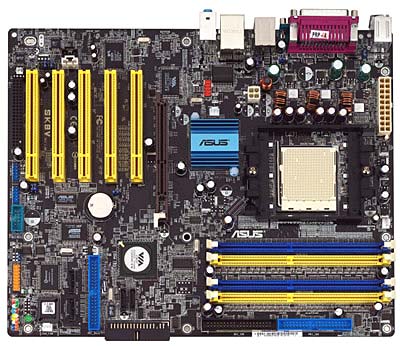
Probably a result of the 2-chip VIA K8T800, the SK8V uses a more familiar layout that is similar to other top motherboards. The only placement that is a bit unique is the CPU socket in the top center instead of the top left as seen in many boards. This allows more room between the CPU and the back of the I/O ports. The layout of the board is a little different than what we normally see, but it was well-conceived and in general, works very well.
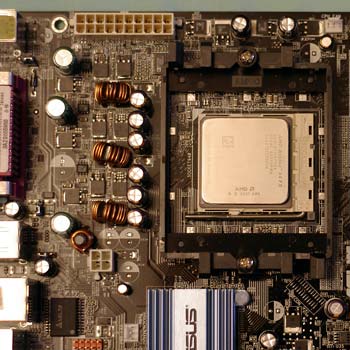
The 20-pin ATX connector and the 4-pin 12 volt connector are both to the left of the CPU instead of our preferred upper right position. However, with more space between the CPU and I/O ports, this does not create a routing problem in our standard tower case. In some designs, this could be a little more of a challenge, so please check your case design to make sure that this placement will work for you. The 4 memory slots on the SK8V are in the more common upper right location. There is plenty of room for adding and removing dimms, and the 8X AGP slot does not interfere with the dimm slots in any way.
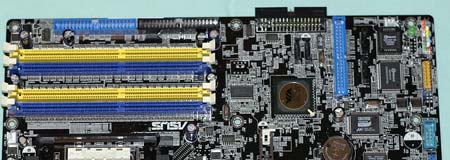
The IDE connectors, IDE RAID, floppy, and 4 SATA connectors are all in good locations. The floppy connector is edge-mounted about the middle right of the board, which works well in larger cases, but is disliked by some. None of these locations presented any problems in a full tower design, and should present no problems in most case designs.
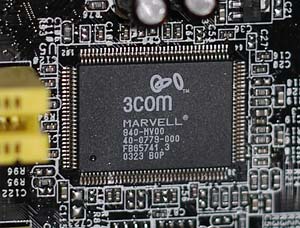
The Asus SK8V uses the familiar 3Com Gigabit LAN seen on many Asus designs.
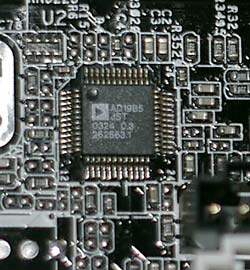
In the continuing upgrades to on-board audio, Asus is using the high-quality Analog Devices SoundMax AD1885 codex to supply 6-channel audio. This is the same chip that Asus uses on its top-end boards, and it is the chip pioneered by Intel on their top 875 boards along with the auto-jack-sensing feature. A Coaxial SPDIF out jack is provided on the rear panel for Dolby Digital setups. More information on the SoundMax audio codec is available at http://www.soundmax.com/.
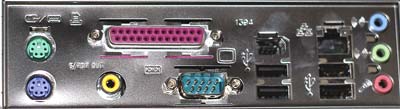
I/O port offerings on the SK8V include the PS2 ports, SPDIF out, Parallel, Serial, Firewire, 4 USB 2.0 ports, Gigabit LAN, and 3 mini jacks with auto-sensing for up to 6 external speakers. The auto-sensing feature is nice, but keep in mind that with 6 speakers connected, you will no longer have a MIC port available in this configuration. 3 Accessory brackets are included: 4 USB 2.0, 1 Firewire, and SPDIF coax/Optical.
Originally published at https://www.anandtech.com/show/1210 (Wayback Machine).