
Image Quality Analysis Fall 2003: A Glance Through the Looking Glass
- Posted in
- GPUs
Antialiasing
Non-horizontal and non-vertical straight lines and edges need to be approximated via multiple small horizontal or vertical lines. This is due to the fact that pixels on the screen are laid out in a grid. The resulting problem is called aliasing and it can bee seen as jagged edges in an image.To combat this, supersample antialiasing was created. The principle behind this is that a larger resolution image is generated for each scene. This larger image is then downsampled and filtered. Of course, generating this image is very expensive, and to combat the performance hit, multisample antialiasing was devised.
Multisample antialiasing works on the same principal as supersample without having to generate the image at a larger resolution. The idea is to generate multiple, slightly-shifted versions of each pixel at the same time for use in the filtering process. The level of antialiasing has to do with the number of pixels generated (subsamples) to calculate the final pixel color value.
The differences in image quality come in when we look at what subsamples are generated for each pixel. Generating subsamples that form a square with horizontal and vertical edges within each pixel means we are using a method called ordered grid antialiasing. This doesn't lend itself to smoothing very close to horizontal or very close to vertical edges. To address such edges, we can slightly rotate or skew the square in order (giving us the rotated grid antialiasing scheme).
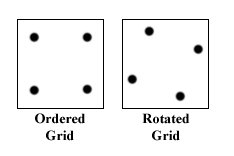 |
| The squares represent pixels while the dots within are multisample subsamples. |
As it happens, ATI uses a rotated grid antialiasing, while NVIDIA sticks with ordered. This creates a lot of room for variation between the cards antialiased images.
Originally published at https://www.anandtech.com/show/1205 (Wayback Machine).