
SiS755 Reference Board: Athlon64 from SiS
- Posted in
- CPUs
SiS755 Reference Board: Basic Features
| Motherboard Specifications | |
| CPU Interface | Socket 754 Athlon64 |
| Chipset | SiS755 / SiS964 |
| Bus Speeds | 133 to 253 (in 1MHz increments) |
| PCI/AGP Speeds | Synchronous or Asynchronous PCI/AGP FIX at 66/33, 75/37, or 80/40 |
| Core Voltage | None available on Reference Board |
| DRAM Voltage | None available on Reference Board |
| AGP Voltage | None available on Reference Board |
| HyperTransport Voltage | None available on Reference Board |
| Memory Slots | Three 184-pin DDR DIMM Slots Single-Channel Configuration Regular Unbuffered Memory to 2GB Total |
| Expansion Slots | 1 AGP 8X Slot 2 PCI Slots (up to 6 may be available) |
| Onboard Serial ATA RAID | SiS964 (2 Drives, 0, 1) |
| Onboard IDE | Two Standard ATA133/100/66 (4 drives) Up to 3 connectors/6 drives may be used |
| Onboard USB 2.0/IEEE-1394 | 8 USB 2.0 ports supported by 964 No Firewire — Must use additional chip |
| Onboard LAN | 10/100 Ethernet by 964 |
| Onboard Modem | v.90 Modem |
| Onboard Audio | AC '97 2.3 6-Channel supported by 964 Realtek ALC658 codec |
| BIOS Revision | Reference Board |
In most cases, Reference Boards are quite different from the production boards that will later appear with the Reference Board chipset. While certain component arrangements may be retained from a Reference Board, we are evaluating a board designed for testing and qualification, and generally not for production. They are also normally designed to be tested on the bench, out of any case.
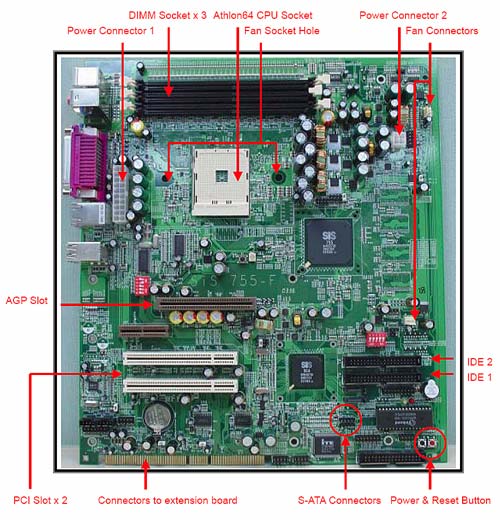
In the picture above, please ignore layout, but look instead at the features provided on the Reference Board. With SATA Raid, 8 USB 2.0/1.1 ports, ATA133 IDE, 10/100 Ethernet, v.90 Modem, and the higher level 2.3 AC'97, the SiS755/964 certainly compares favorably in features with the VIA K8T800. As with the VIA, SiS755 far outclasses the nForce3 in the features category, but we are told this will be corrected with the nF3-250. The only feature really missing from the 755/964 is Firewire, which must be implemented with a separate chip by the board manufacturer. Frankly, this is not a problem at all in our estimation. We also wish SiS had provided a real option for Gigabit LAN. While the current need for 1000Mb LAN is mostly hype, there is no doubt that this speed will catch on fast and make a real difference in performance in the future. With most broad-band connections still only requiring 10Mb speed, the option for 100Mb speeds seems adequate. However, many are already enjoying 1000 speeds between components on their home or Office LAN, and the usefullness of 1000Mb LAN capabilities will certainly increase quickly.
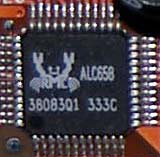
We are seeing the Realtek ALC658 audio codec used on many of the top boards that we have recently tested. The 658 is a significant improvement over the earlier Realtek AC97 codecs, and provides much higher quality performance:
“The ALC658 has six 20-bit DAC channels, two pairs of stereo 18-bit ADC, and an AC'97 2.3 compatible six-channel audio CODEC designed for PC multimedia systems. The ALC658 incorporates proprietary converter technology to achieve 100dB sound quality, meeting performance requirements on PC99/2001 systems and placing PC sound quality at the same level as consumer equipment.”More information on the features and specifications of ALC658 is available at Realtek
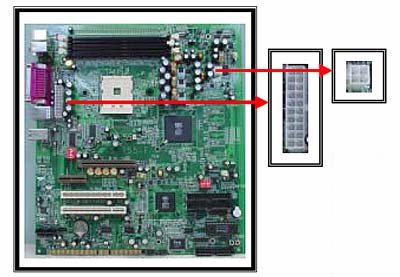
As seen on every Athlon64 and Athlon64 FX board we have tested, the SiS755 Reference Board uses both the 20-pin ATX power connector plus the 4-pin 12V power connector.
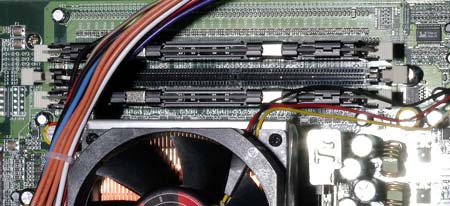
Three DIMM slots support up to 2 Gigabytes of standard unbuffered Single-Channel memory. Single-Channel is the only memory configuration available with any of the Athlon64 chips. We demonstrated in our launch articles on the Athlon64 and Athlon64FX processors that Dual-Channel memory provides only a small benefit on the A64 platform. The real performance difference between single and dual-channel memory is small on the Athlon64/Athlon64 FX and not comparable to the large performance differences that we see on the bandwidth-hungry Pentium 4. 1, 2 or 3 DIMMs can be installed.
Originally published at https://www.anandtech.com/show/1197 (Wayback Machine).