
The ADATA XPG GAMMIX S10 (512GB) SSD Review: Entry-Level NVMe With Style
Sequential Read Performance
Our first test of sequential read performance uses short bursts of 128MB, issued as 128kB operations with no queuing. The test averages performance across eight bursts for a total of 1GB of data transferred from a drive containing 16GB of data. Between each burst the drive is given enough idle time to keep the overall duty cycle at 20%.
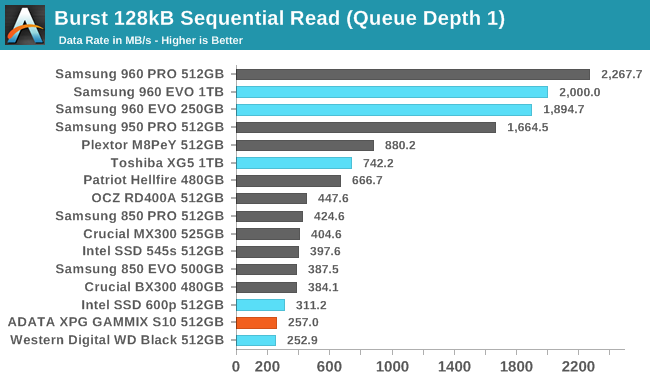
While the ADATA XPG GAMMIX S10 offers good burst random read performance, its burst sequential read performance is very close to last place among this collection of drives. Most mainstream SATA SSDs are quicker on this test, and the Samsung 960 EVO is more than seven times faster.
Our test of sustained sequential reads uses queue depths from 1 to 32, with the performance and power scores computed as the average of QD1, QD2 and QD4. Each queue depth is tested for up to one minute or 32GB transferred, from a drive containing 64GB of data.
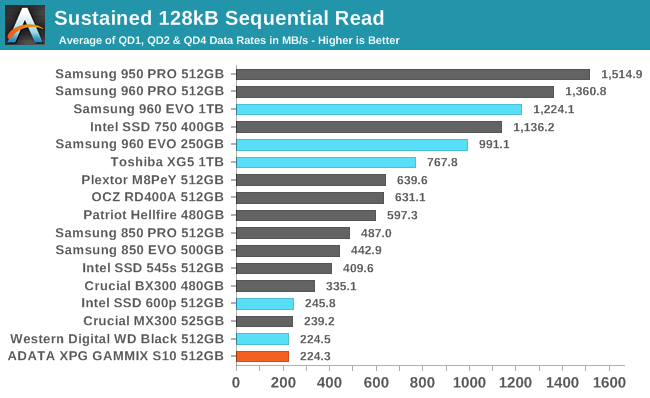
On the longer sequential read test, the GAMMIX S10 comes in last place, tied with the WD Black and just a hair behind the Crucial MX300 and Intel 600p. The PCIe interface isn't helping at all here; Micron's 3D NAND is just too slow.
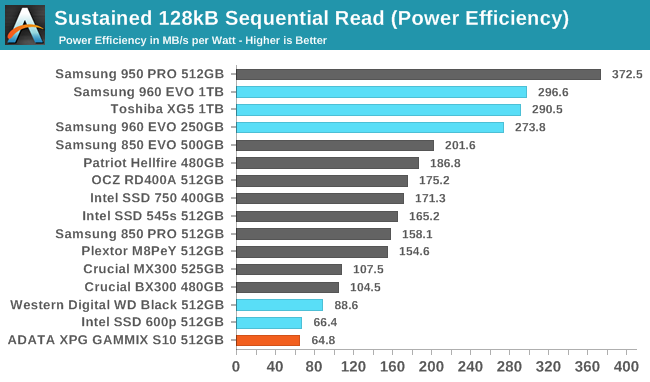
The power efficiency of the GAMMIX S10 is also in last place alongside the Intel 600p, and on this metric the WD Black has a small advantage. The other TLC-based NVMe SSDs deliver more than four times the performance per Watt.
 |
|||||||||
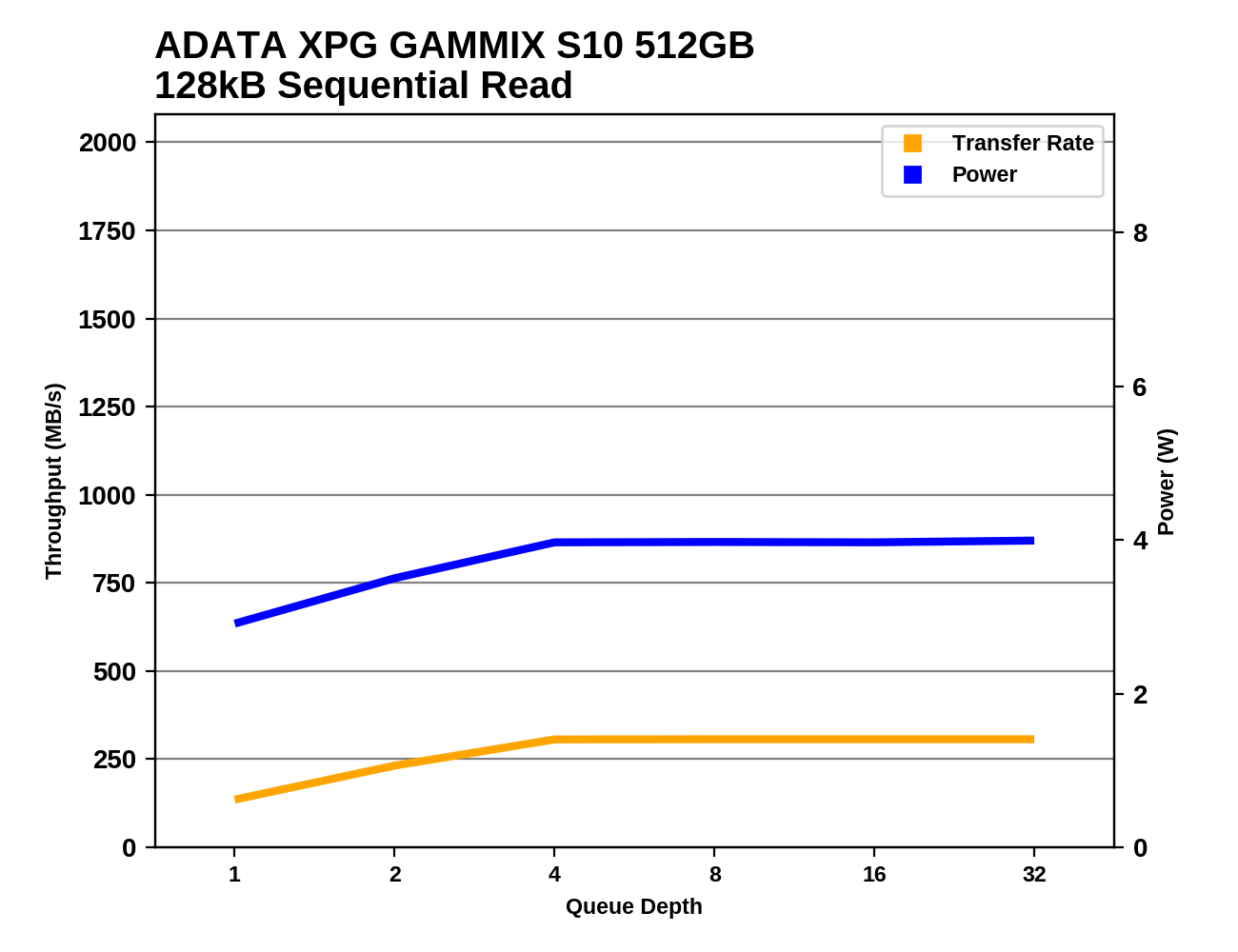
The sequential read performance of the GAMMIX S10 doesn't saturate until QD4, and that top speed is unimpressive even by SATA standards. With power consumption only reaching about 4W, thermal throttling is unlikely to be the problem. Instead, this is mostly a limitation of the flash itself, though the controller isn't making the situation better.
Sequential Write Performance
Our test of sequential write burst performance is structured identically to the sequential read burst performance test save for the direction of the data transfer. Each burst writes 128MB as 128kB operations issued at QD1, for a total of 1GB of data written to a drive containing 16GB of data.
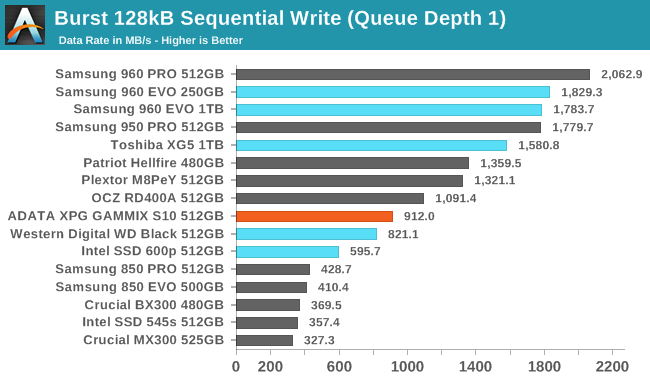
The burst sequential write speed of the ADATA XPG GAMMIX S10 is much higher than the Intel 600p and more than twice as fast as a SATA SSD. The GAMMIX S10 still falls on the low end by NVMe standards.
Our test of sustained sequential writes is structured identically to our sustained sequential read test, save for the direction of the data transfers. Queue depths range from 1 to 32 and each queue depth is tested for up to one minute or 32GB, followed by up to one minute of idle time for the drive to cool off and perform garbage collection. The test is confined to a 64GB span of the drive.
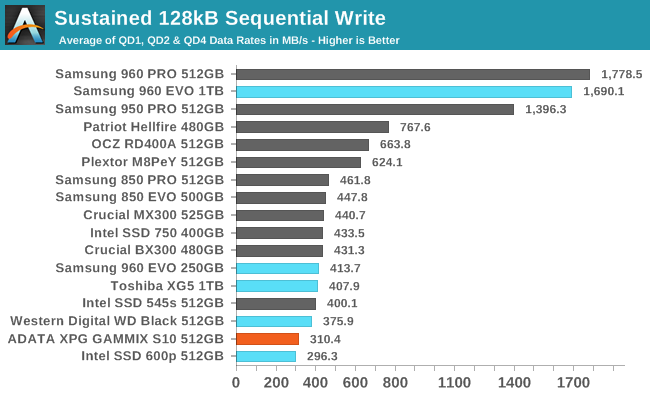
On the longer sequential write test, the GAMMIX S10's performance falls apart. It is barely faster than the last-place Intel 600p, and can't keep up with the typical mainstream SATA SSD.
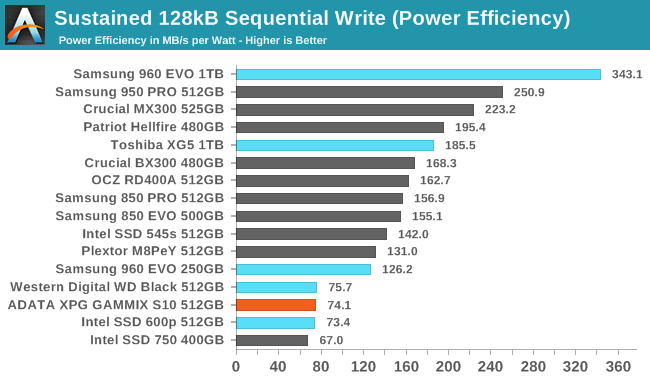
The GAMMIX S10's power efficiency during the sustained sequential write test is bad, but at least it isn't alone at the bottom of the chart: both the Intel 600p and 750 rank slightly below the GAMMIX S10, and the WD Black's efficiency is comparable. Among the rest of the field, there isn't a clear separation between NVMe and SATA SSDs when it comes to efficiency; the fast NVMe drives pay for that performance with higher power consumption.
 |
|||||||||
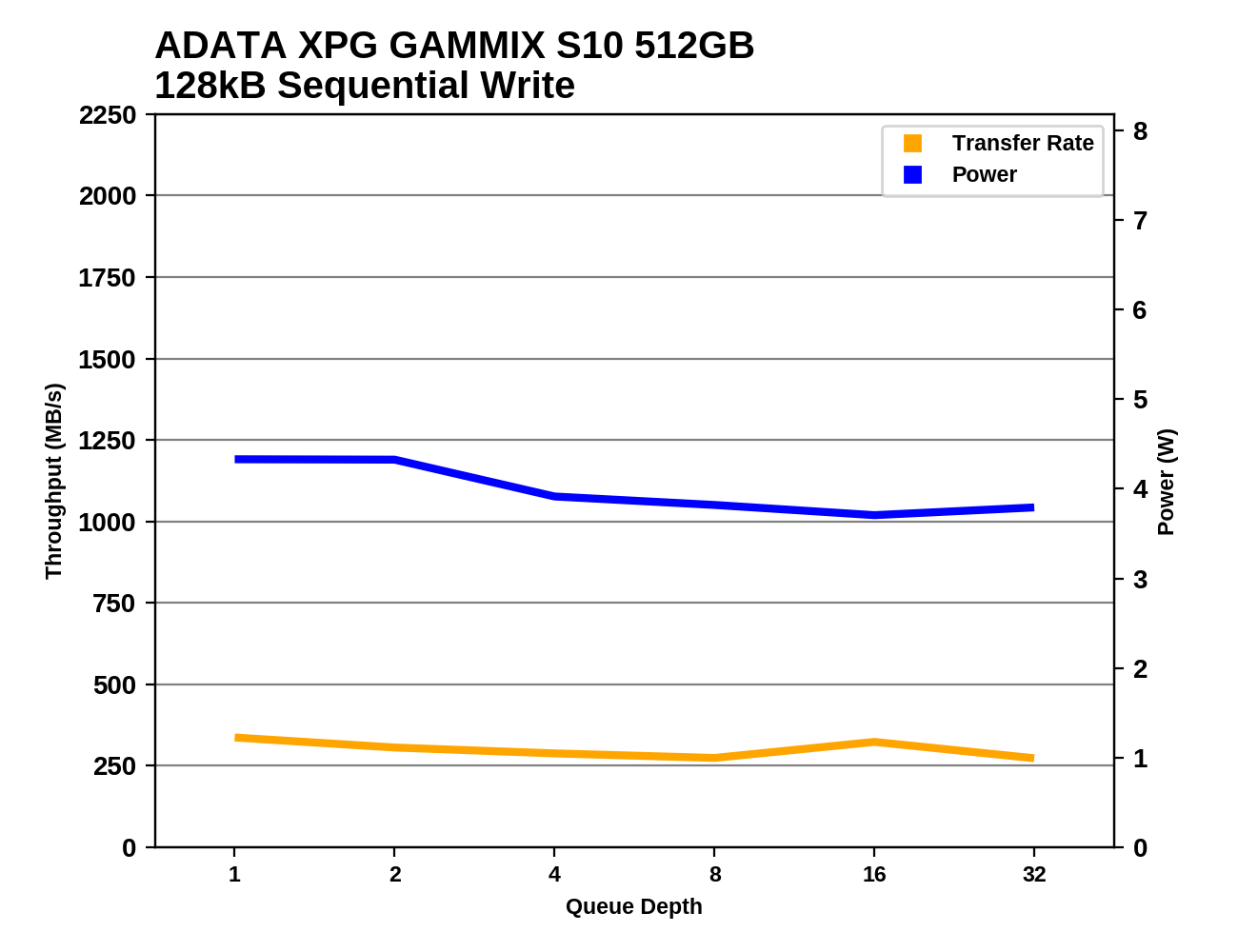
The sequential write performance of the ADATA XPG GAMMIX S10 doesn't increase with higher queue depths, and instead the performance drops and varies a bit as the SLC cache is filled and background garbage collection adds some overhead.
Originally published at https://www.anandtech.com/show/11934/the-adata-xpg-gammix-s10-512gb-ssd-review (Wayback Machine).