
The ASRock Fatal1ty X299 Professional Gaming i9 Motherboard Review
The ASRock X299 Professional Gaming i9 Conclusion
The ASRock X299 Professional Gaming i9 set out to be a motherboard that comes with a lot of features and, for the most part, hit that nail on the head. For example, the Gaming i9 uses an integrated Aquantia 10 gigabit Ethernet controller as well as two Intel gigabit Ethernet ports and 2T2R Intel WiFi. So while not many boards come with a 10 GbE built in, fewer come bundled with dual Intel NICs plus WiFi, which is a bit overkill perhaps. This is also a departure for ASRock, given that this is a gaming motherboard but doesn't have a Killer NIC present.
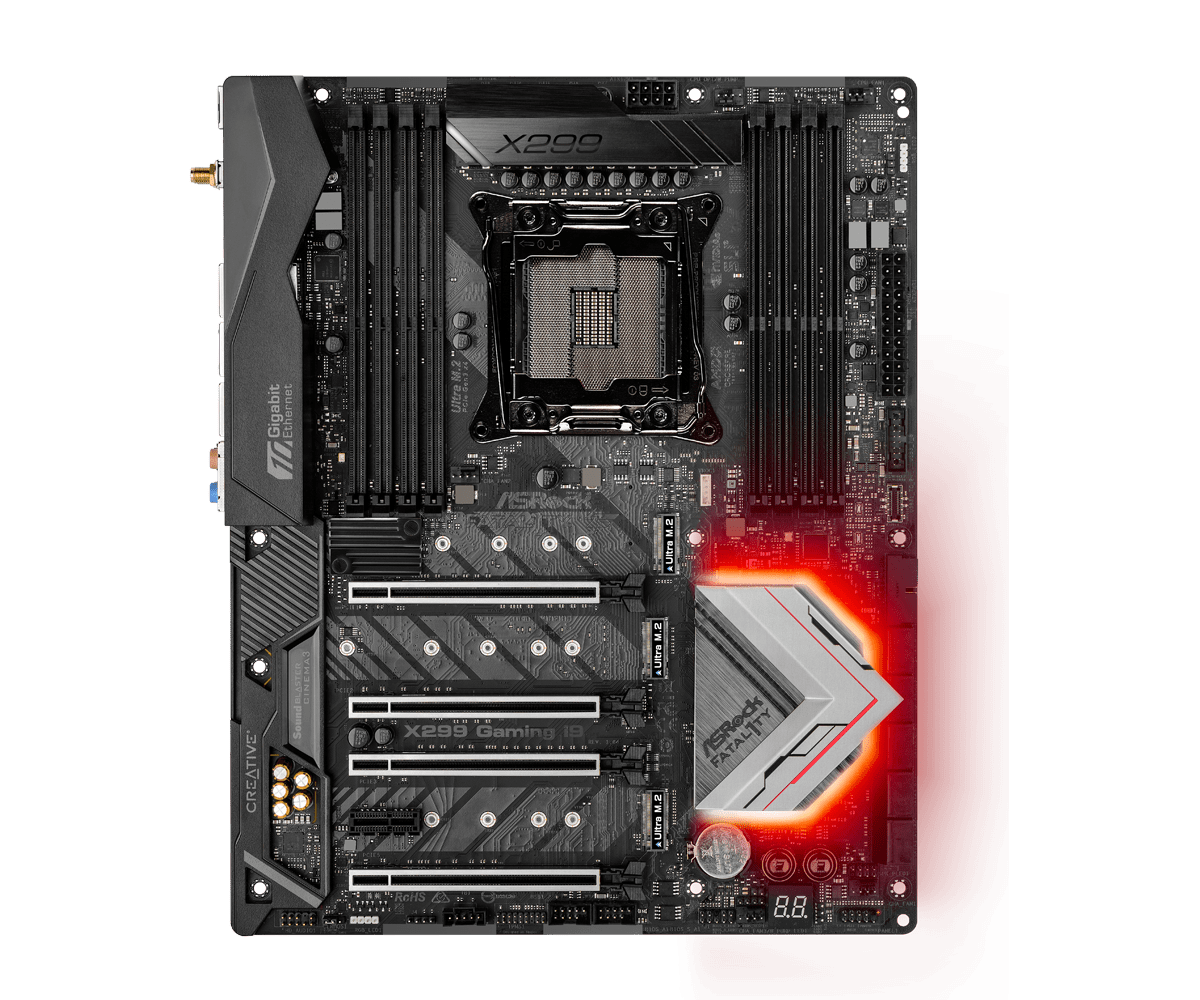
With the platform allowing support for multiple PCIe x4 based devices, X299 will see many boards with multiple M.2 support. ASRock includes three M.2 slots for PCIe or SATA based storage devices here, alongside a total of 10 SATA ports. It is worth noting that due to the varying CPU features that can be supported, users will need to keep an eye on what will be disabled when using certain CPUs. For example, on the Gaming i9, the first M.2 slot is driven by the CPU and always keeps its bandwidth, but the other two M.2 slots revert to SATA-only support when a 16-lane Kaby Lake-X CPU is used. On the storage front, the only thing missing here is a U.2 connector - I would have thought being at least a quasi-workstation/professional board, it should have this option.
For gaming, the X299 Professional Gaming i9 has physical slot protection for the reinforced PCIe slots in case heavy GPUs are used. ASRock also uses the latest Realtek ALC1220 codec, with included software for sound shaping and the set of 'enhanced features' for gaming audio: PCB separation, filter caps, and high-impedence headphone jack detection. Surprisingly, the Realtek IC does not have a separate EMI cover, a feature I would expect to see at this level of motherboard. For multi-GPU users, ASRock has setup its two primary PCIe slots with triple slot spacing for enough airflow on regular cards or for pushing it with two double or triple slot cards. The gaming crowd, and plenty others, seem to like RGB LEDs. So while the Gaming i9 doesn't have RGB LEDs all over, those under the PCH do a good job of conveying whatever colored light theme users may want to go with. This is probably a restriction based on the 'Professional' half of the naming of this board.

Little was left out for the overclocker too. The Dr. MOS based VRM should handle what can be thrown at it under air and water. The board includes uses a base clock 'Engine' (Hyper BCLK Engine III) which allows for overclocking the PCIe lanes as well as a broader range of BCLK frequency manipulation. For users going sub-ambient there may be better choices from ASRock, such as the upcoming X299 OC Formula. Both the BIOS and F-Stream software have all the controls and functions an overclock would need to push the CPU to its limits.
One standout difference between most of its competition is ASRock including the Aquantia 10 GbE vs others which do not have one. We are seeing the inclusion, either intgrated or with an add-in card, coming to more boards, but slowly. Separate PCIe 10 GbE cards can approach the $100 mark, so integrating direct on the board can making it a great value-add and money saver as well.
Overall performance was good across our benchmarks with a win in some, lose in some type of trade off. There was nothing anomolous which would raise concern. Pricing on the ASRock X299 Professional Gaming i9 comes in at an MSRP of $399. Currently, it can be found on Newegg for $390, and Amazon has it listed for $1400 from 3rd party sellers. Ignoring Amazon for a second, the pricepoint puts it squarely between the GIGABYTE X299 AORUS Gaming 7 and the MSI X299 Gaming M7 ACK, both of which are aiming at a similar level of customers
Originally published at https://www.anandtech.com/show/11727/asrock-fatal1ty-x299-professional-gaming-i9-motherboard-review (Wayback Machine).