
The Toshiba XG5 (1TB) SSD Review
Mixed Random Performance
Our test of mixed random reads and writes covers mixes varying from pure reads to pure writes at 10% increments. Each mix is tested for up to 1 minute or 32GB of data transferred. The test is conducted with a queue depth of 4, and is limited to a 64GB span of the drive. In between each mix, the drive is given idle time of up to one minute so that the overall duty cycle is 50%.
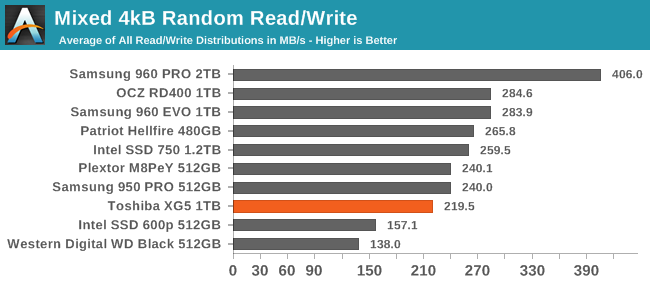
The Toshiba XG5 ranks near the bottom for mixed random I/O performance, but it is only moderately slower than average, with more than three quarters the performance of the Samsung 960 EVO. The Intel 600p and WD Black are substantially slower, while the Samsung 960 PRO is a major outlier at the top of the chart.
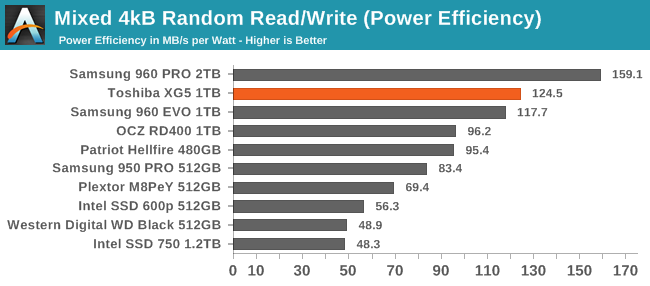
The Toshiba XG5 delivers better power efficiency than any NVMe SSD save for the Samsung 960 PRO. The 960 EVO's efficiency is close to that of the XG5, and the other TLC SSDs are at the bottom of the chart with less than half the performance per Watt.
 |
|||||||||
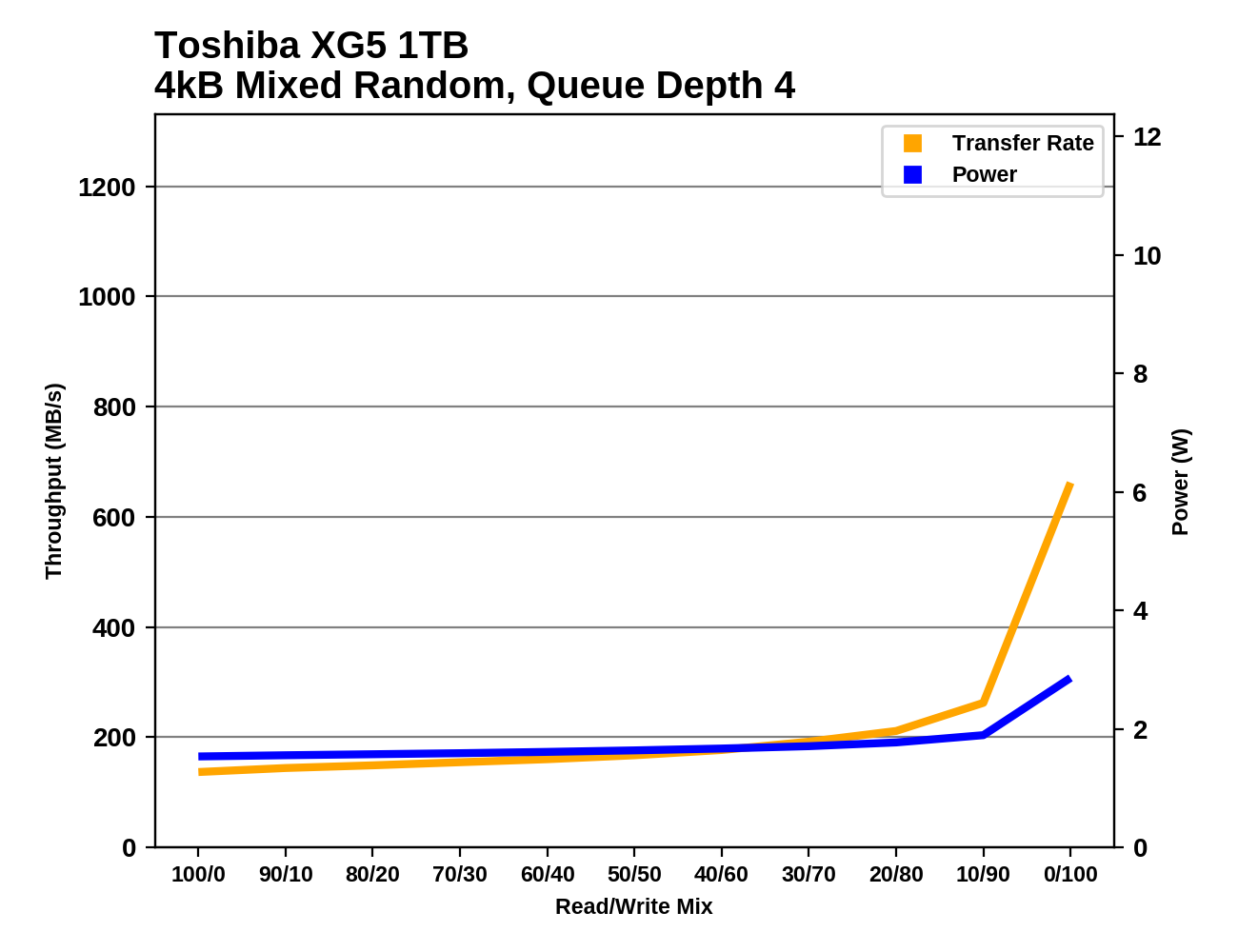
The Toshiba XG5's performance across the mixed random I/O test is mostly flat until near the very end. It's typical for performance to spike once most of the operations are writes that can be efficiently combined and cached. The performance spike the XG5 experiences is only half the boost the 960 EVO gets, which accounts for almost all of the difference in their average performance scores. Most of the drives perform very similarly across most of the test, with only the Intel 600p and the WD Black showing substantially worse performance across large portions of the test.
Mixed Sequential Performance
Our test of mixed sequential reads and writes differs from the mixed random I/O test by performing 128kB sequential accesses rather than 4kB accesses at random locations, and the sequential test is conducted at queue depth 1. The range of mixes tested is the same, and the timing and limits on data transfers are also the same as above.
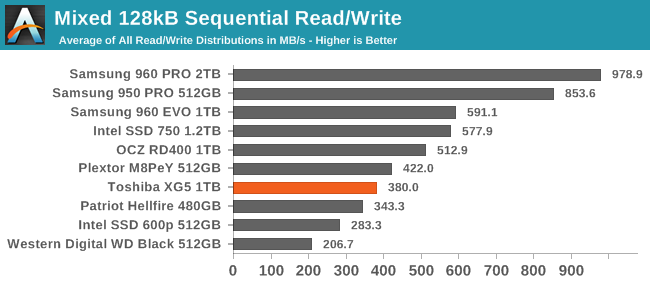
As with the mixed random I/O test, the Toshiba XG5 is slower than average on the mixed sequential I/O test. The Samsung 960 EVO is only outperformed by Samsung's MLC-based PCIe SSDs, which have a large lead.
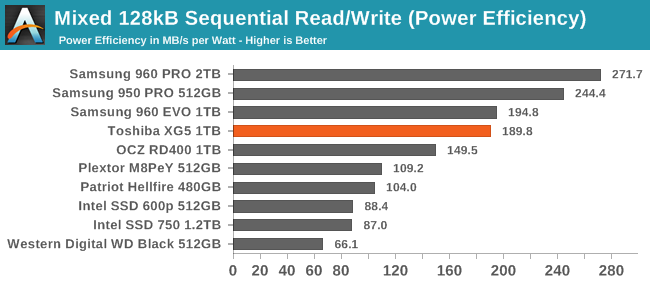
The XG5 almost ties the 960 EVO for power efficiency and is the only drive that comes close to Samsung's efficiency.
 |
|||||||||
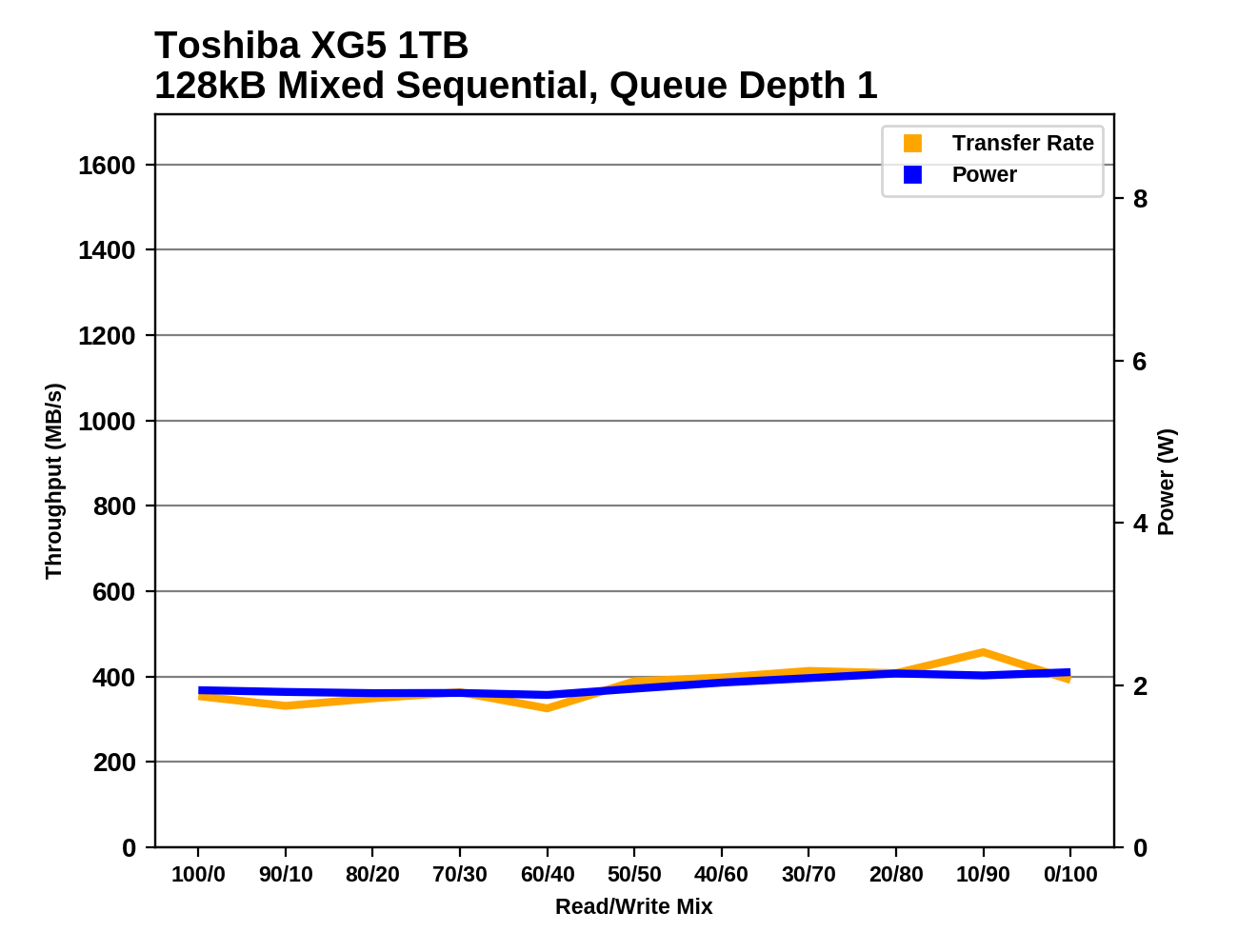
The Toshiba XG5's performance varies slightly over the course of the mixed sequential test but the overall trend is flat. Power usage is also quite steady at around 2W. The best-performing drives exhibit a bathtub curve of performance that bottoms out around a 50/50 or 40/60 read/write mix, while most of the other drives show gradual increases as the portion of writes grows, followed by a more dramatic spike at the end of the test.
The Samsung 960 EVO comes closest to matching the power consumption of the Toshiba XG5, but only when its performance bottoms out at about two-thirds of what the XG5 provides.
Originally published at https://www.anandtech.com/show/11663/the-toshiba-xg5-1tb-ssd-review (Wayback Machine).