
The Toshiba XG5 (1TB) SSD Review
Sequential Read Performance
Our first test of sequential read performance uses short bursts of 128MB, issued as 128kB operations with no queuing. The test averages performance across eight bursts for a total of 1GB of data transferred from a drive containing 16GB of data. Between each burst the drive is given enough idle time to keep the overall duty cycle at 20%.
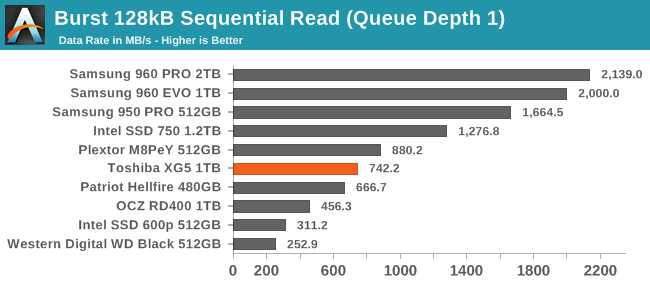
The sequential read speed of the Toshiba XG5 at queue depth 1 is quite disappointing compared to the Samsung 960 EVO. The XG5 does well compared to the other TLC SSDs and several MLC SSDs, including Toshiba's OCZ RD400.
Our test of sustained sequential reads uses queue depths from 1 to 32, with the performance and power scores computed as the average of QD1, QD2 and QD4. Each queue depth is tested for up to one minute or 32GB transferred, from a drive containing 64GB of data.
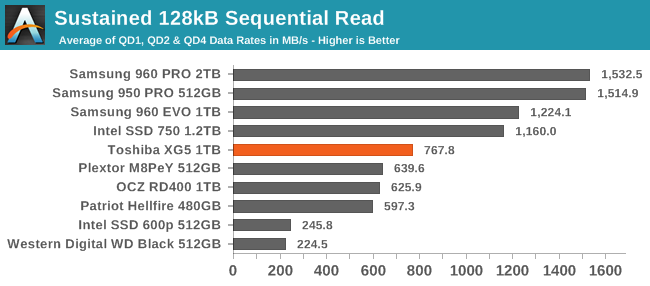
The Samsung NVMe SSDs don't perform quite as well on the longer sequential read test, so their performance lead over the Toshiba XG5 is diminished to about a factor of two. The XG5's ranking is slightly improved, and it is only outperformed by Samsung and the Intel 750.
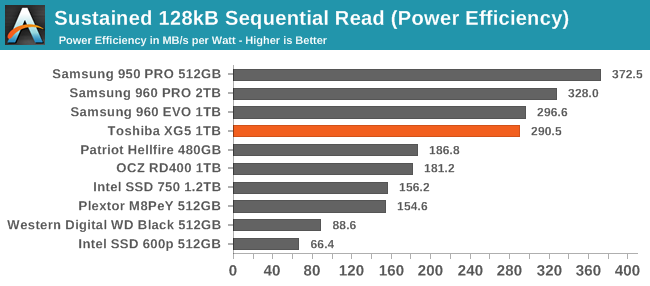
The Toshiba XG5's performance on the sustained sequential read test is low enough that it doesn't beat Samsung's drives on efficiency, though it does almost tie the Samsung 960 EVO. All the other drives are far less efficient.
 |
|||||||||
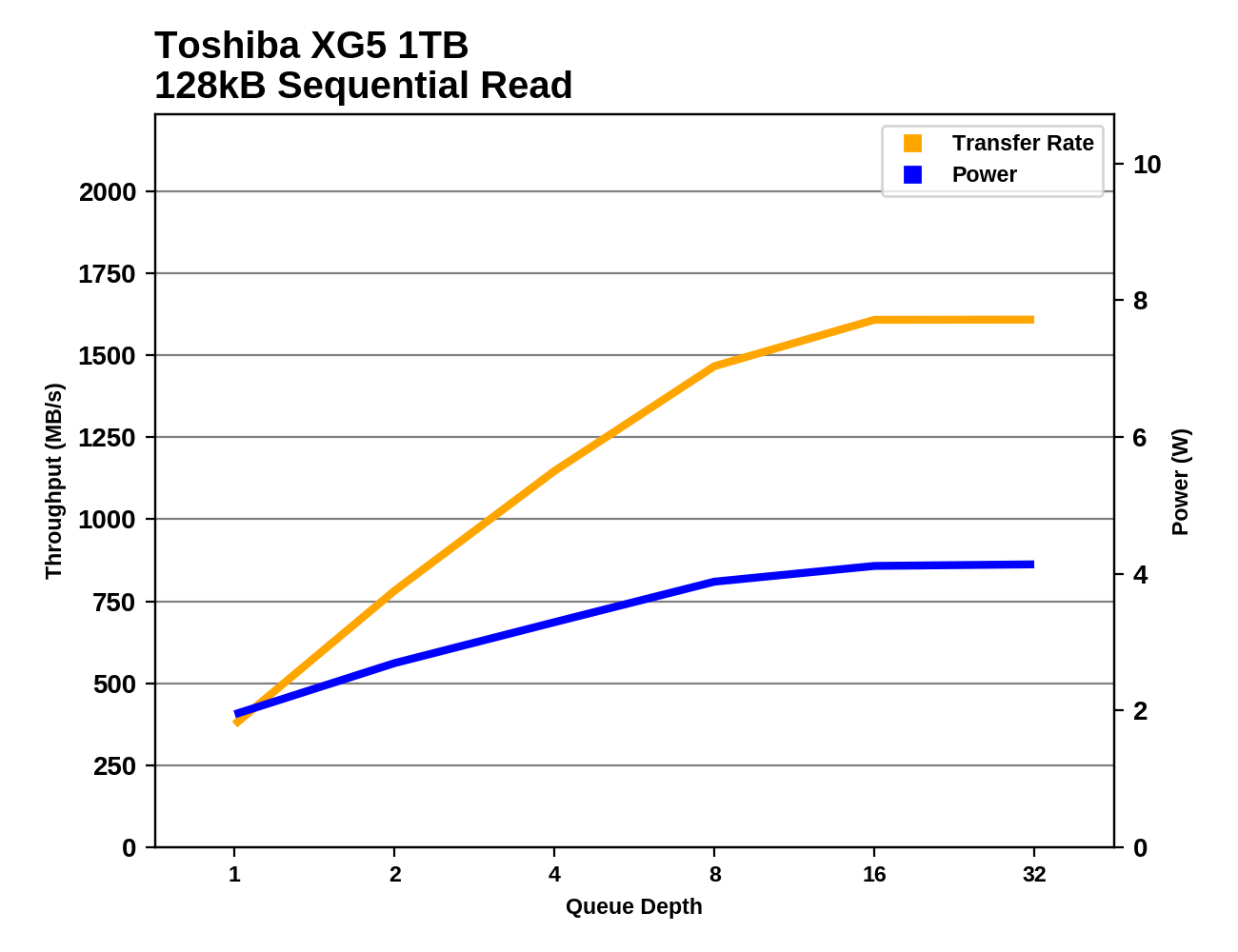
The Toshiba XG5's sequential read performance doesn't reach full speed until QD16, much later than most drives, especially Samsung's 960 PRO and EVO which offer nearly full speed at QD1. When it does saturate, the XG5 is delivering the same write performance as the Samsung 960 PRO, which is substantially faster than the 960 EVO.
The WD Black and the Patriot Hellfire are the only two drives in this batch that use less power than the XG5 at any point during this test. Their performance is not even close to competitive with the XG5 when they manage to use less power.
Sequential Write Performance
Our test of sequential write burst performance is structured identically to the sequential read burst performance test save for the direction of the data transfer. Each burst writes 128MB as 128kB operations issued at QD1, for a total of 1GB of data written to a drive containing 16GB of data.
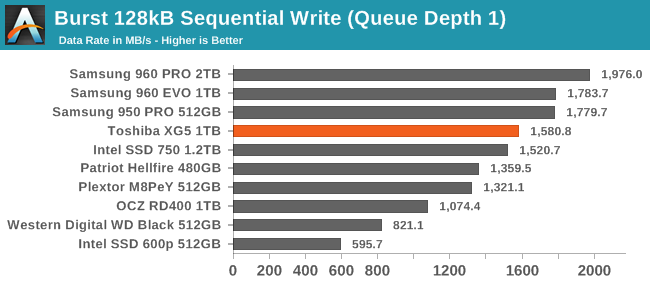
With ideal conditions to take advantage of SLC write caching, the Toshiba XG5 delivers great sequential write performance. It's not quite as fast as Samsung's drives, but it is ahead of everything else including a slight lead over the Intel 750.
Our test of sustained sequential writes is structured identically to our sustained sequential read test, save for the direction of the data transfers. Queue depths range from 1 to 32 and each queue depth is tested for up to one minute or 32GB, followed by up to one minute of idle time for the drive to cool off and perform garbage collection. The test is confined to a 64GB span of the drive.
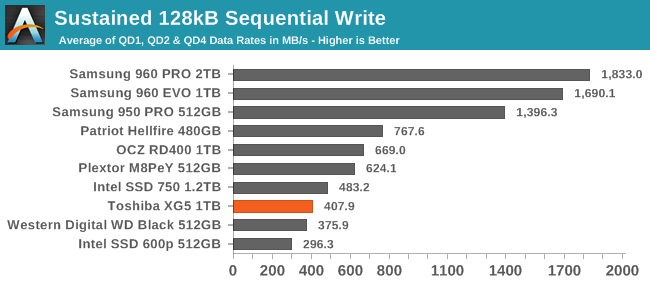
The longer run times of our sustained sequential write test have a huge impact on the Toshiba XG5's performance: instead of outperforming everything except Samsung's SSDs, it slows down to SATA-like speeds and is only faster than the WD Black and the Intel 600p. Meanwhile, the Samsung 960 EVO holds on to second place and is only slightly slower than its burst performance.
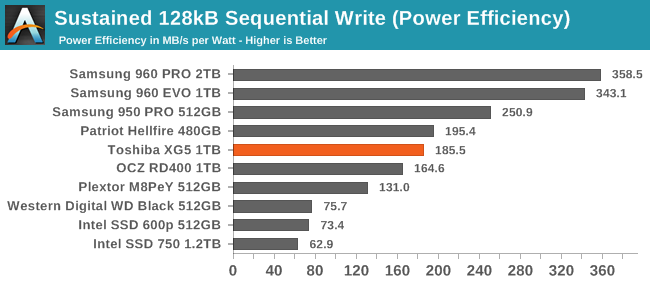
In spite of its poor performance, the Toshiba XG5's power efficiency is still decent (by NVMe standards) on the longer sequential write test, but it's not even close to being competitive with Samsung's drives. The 960 EVO offers almost twice the performance per Watt during sustained writes.
 |
|||||||||
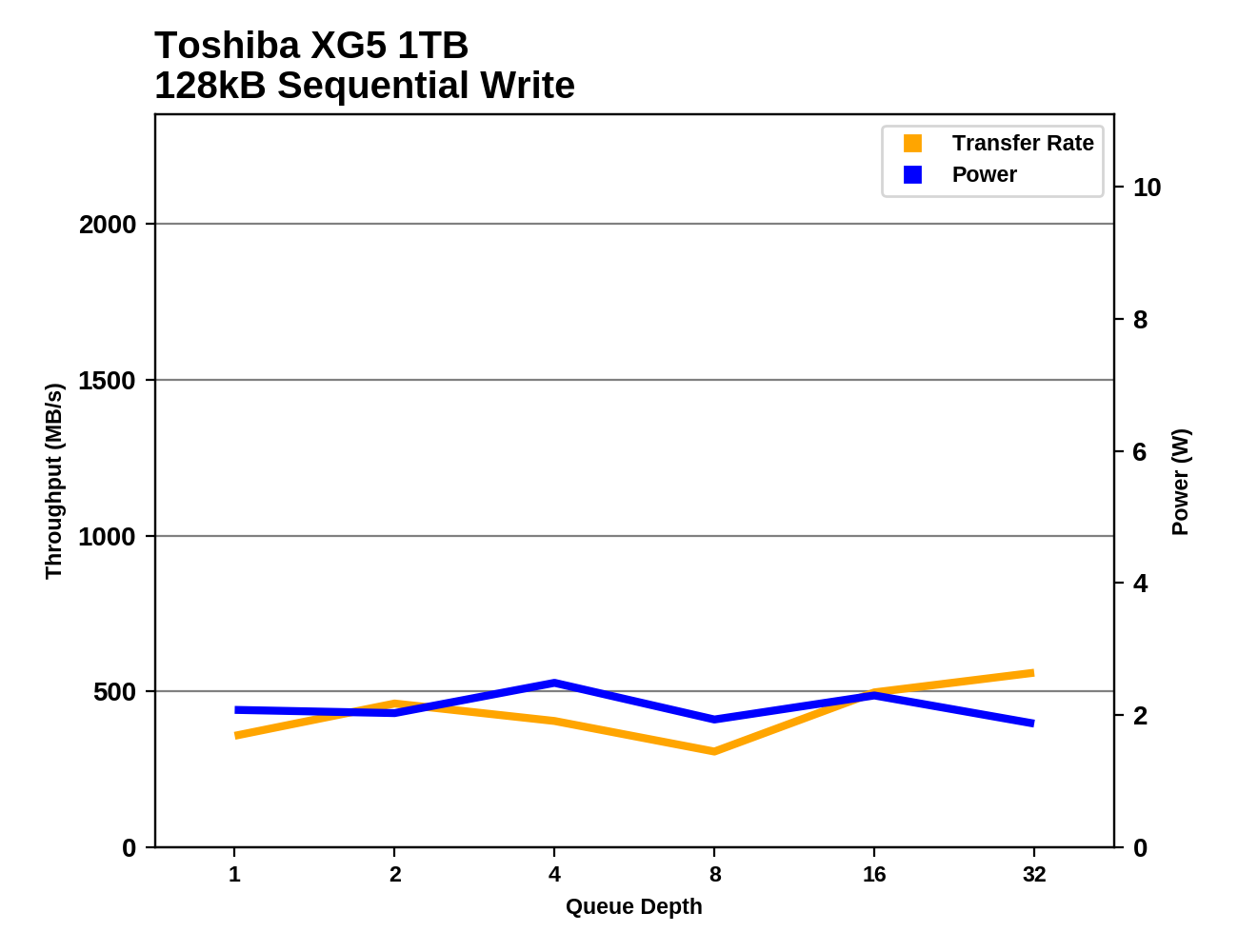
The performance and power consumption of the Toshiba XG5 bounce around over the course of the sustained sequential write test as it spends a large portion of its time dealing with a filled SLC write cache. Most competing NVMe SSDs offer far more consistent performance and saturate with a queue depth of two. The power draw of the XG5 averages around 2W while most of the other drives are pulling 4W or more.
Originally published at https://www.anandtech.com/show/11663/the-toshiba-xg5-1tb-ssd-review (Wayback Machine).