
ABIT KV7 (KT600): Budget Performance in a Small Package
- Posted in
- Motherboards
ABIT KV7: Basic Features
| Motherboard Specifications | |
| CPU Interface | Socket-462 |
| Chipset | VIA KT600 North Bridge VIA VT8237 South Bridge |
| Bus Speeds | up to 250MHz (in 1MHz increments) |
| Core Voltages | up to 2.325V in 0.0250V increments excluding 1.925V, 2.050V, 2.150V, & 2.250V) |
| DRAM Voltage | up to 2.80V (in 0.05V increments excluding 2.75V) |
| Chipset Voltag | up to 2.95V (in 0.1V increments) |
| AGP Voltage | up to 1.65V (in 0.05V increments) |
| Memory Slots | 3 X 184-pin DDR DIMM Slots |
| Expansion Slots | 1 X AGP 8X Slot 5 X PCI Slots |
| Onboard IDE RAID | N/A |
| Onboard USB 2.0/IEEE-1394 | Eight USB 2.0 ports supported by VT8237 No IEEE 1394 FireWire available |
| Onboard LAN | VIA VT6103 10/100 controller |
| Onboard Audio | VIA VT1616 AC’97 codec |
| Onboard Serial ATA | Two SATA connectors via VT8237 (RAID 0, 1 & 0 + 1) |
| BIOS Revision | August 4th, 2003 |
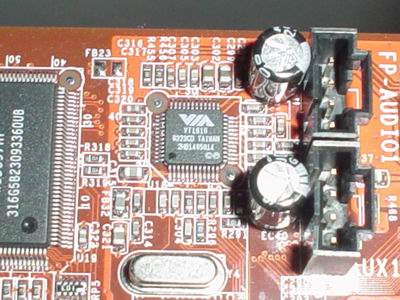
ABIT is one of the first motherboard makers (Soltek being the first we’ve seen) to finally implement the VIA VT1616 codec that has been glaringly absent on previous KT600 motherboards, such as Epox’s 8KRA2+, Gigabyte’s 7VT600 1394, MSI’s KT6 Delta-FIS2R, and ASUS’ A7V600. We have preached the use of VIA’s VT1616 codec instead of cheaper codecs like Realtek’s ALC650/655 because the VT1616 is capable of outputting higher sound quality when an analog speaker system is utilized (in other words, when you use the analog out port). While this sound solution isn’t in the same league as VIA’s Envy24 solutions (which are capable of 24 bit/96KHz sampling), it’s better than most Socket A motherboards that are bound to using fairly low-end Realtek codecs. However, for everyday audio tasks, such as listening to MP3s and even occasional gaming, the KV7 offers good sound quality. Therefore, the KV7’s onboard sound quality really isn’t terribly different from the other KT600 motherboards that AnandTech has reviewed in the past, but it certainly is better.
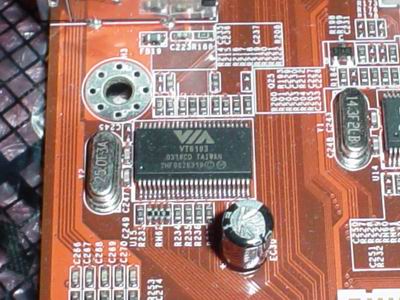
The ABIT KV7’s LAN controller is powered by an uncommon, but perfectly functional, IC (integrated circuit) named the VIA VT6103. The VIA VT6103 is your standard 10/100 Fast Ethernet PHY that will serve any basic broadband user’s needs. We’ve mentioned in countless reviews that 10/100/1000 network controllers can be found on most modern-day Intel motherboards, but that the same cannot be said about modern-day AMD motherboards (KT600, nForce2, or otherwise). GbE (Gigabit Ethernet) is quite useful for a small niche of home/home office users who transfer large files between networked computers, but besides that it’s not terribly helpful for the majority of mainstream users and enthusiasts. Therefore, we view the absence of onboard GbE as a minor negative attribute of the KV7.
The ABIT KV7 comes with a rather standard collection of I/O ports for a low-end enthusiast motherboard. Included in the rear panel are two PS/2 ports, one serial port, one parallel port, four USB 2.0 ports, one LAN port, SPDIF ports, and Mic In, Line In, and Line Out, which drive the onboard sound. The four USB 2.0 ports should be just enough for people that use everyday USB equipment, such as printers, scanners, digital cameras, USB flash memory keys, etc. ABIT is known for adding intriguing sets of I/O ports, so the addition of SPDIF ports to the KV7 is no surprise whatsoever. SPDIF won’t be too useful to the average person, but enthusiasts should be pleased with this option as it gives them flexibility. It is to be expected that the KV7 omits any support for IEEE 1394 FireWire, via the rear I/O panel or otherwise. There are very few mainstream motherboards that come with onboard FireWire to begin with, save for select few Intel motherboards. So, the lack of FireWire is not a huge loss, especially since USB devices are quite prevalent.
As expected with all current KT600 motherboards, the KV7 has native Serial ATA support, courtesy of VIA's brand new VT8237 South Bridge. The VT8237 supports RAID 0, 1 and 0 + 1, which is a nice addition for users looking for the best combination of RAID support in a desktop motherboard. The advantage of RAID 0 + 1 is fast data access (like RAID 0), with the ability to lose one drive, and still have a complete duplicate surviving drive or set of drives (like RAID 1). In case you didn't already know, RAID 0 + 1 is stripping (RAID 0) and mirroring (RAID 1) combined without parity having to be calculated and written. In addition to all of this, VIA has also upped V-link's throughput from 533MB/s to 1066MB/s. All in all, VIA's new South Bridge is impressive, and certainly gives KT600 boards some added value compared to nForce2 motherboards. The new increased chipset I/O bandwidth is also a welcome addition, as it should help in those “intangible” computing experiences, such as multitasking.
Originally published at https://www.anandtech.com/show/1140 (Wayback Machine).